Revelation word counts · Part 4 reference appendix
This appendix keeps the numerical framework visible: every band in the original master grids, the calendar operations, the seal ladder, the full-sequence mirrors, and the chronological branches behind the main discussion. It distinguishes the source’s fixed data from alternative constructions and corrects explanatory arithmetic without changing the established word counts.
In this appendix
A. Definitions and calculation rules
The word token identifies an occurrence in the selected Greek word groups. Position identifies its place in the arranged model, including conceptual bookends. Band is the interval assigned to a position. The same occurrence can receive a weekly calendar label, a symbolic month label, and a scaled year band; those are separate assignments.
| Term | Meaning in this study |
|---|---|
| MT / LXX / SP | Masoretic Text / Septuagint / Samaritan Pentateuch. Each chronological comparison requires its stated textual configuration. |
| W-grid | Seven-year bands beginning at spring 6 BC. |
| M-grid | Thirty-year bands beginning at spring 6 BC. |
| Weekly calendar | Seven-day bands placed in a 364-day, 30–30–31 quarterly arrangement. |
| Month label | The sequence Nisan through Adar, repeated every 12 M-grid positions. It does not supply a historical month for an AD event. |
| Quarter day | The fourth day beyond 360 within a completed 364-day year, counted as one after each three symbolic months. |
| Included / withheld | Whether the 10 thunder occurrences receive duration. The occurrences themselves remain counted in the inventory. |
| Anchored expansion | A converted number laid out as a new comparison span from a stated fixed anchor. It generates a model coordinate. |
| SKL | Sumerian King List, used here through an explicitly comparative chronology. |
A1. Boundaries and inclusive labels
Use astronomical year coordinates only as a calculation device: an AD year A has coordinate A; a BC year B has coordinate 1 − B. Thus 6 BC has coordinate −5. This mathematical zero is the civil year 1 BC; it does not insert a civil “year zero.” With start coordinate s = −5 and band width u, position i begins at s + ui and ends at s + u(i + 1).
Start(i, u) = −5 + ui; End(i, u) = −5 + u(i + 1).
For chronology tables, “AD 25–55” means a 30-year interval between like-season boundaries. Adjacent bands share a boundary; they do not both contain a whole extra boundary year. A convenient interval notation is [25, 55), meaning “from 25 up to 55.” By contrast, the weekly date label Nisan 1–7 names seven consecutive days inclusively, from the start of day 1 to the start of day 8.
The earlier 81-band arrangement covers #0–80. Its M-grid midpoint is AD 1210, inside #40, and its end is AD 2425. Adding #81 gives 82 bands, with midpoint at the #40/#41 boundary, AD 1225, and end AD 2455. The corresponding W-grid midpoint of the full 82-band construction is AD 282. The index midpoint, a band’s center, and a shared band boundary cannot be exchanged merely because each can be called “the middle.”
For the compressed reading, retain the original lexical labels but use a second, compressed index. Positions #0–42 keep index i. Original #43–52 are withheld. Original #53–81 receive index i − 10. For example, original #53 becomes compressed index 43, and original #81 becomes compressed index 71. A 72-position mirror pairs compressed index k with 71 − k; it does not invariably pair original label i with 81 − i.
A2. Complete seven-year table
All 82 original bands are preserved. The 13 rows arrange positions by their place within a 91-unit block; they are not 13 separate seven-position groups. Reading each column downward gives the successive positions. The final column is necessarily incomplete.
| Heptad Group | Cycle 1 | Cycle 2 | Cycle 3 | Cycle 4 | Cycle 5 | Cycle 6 | Cycle 7 |
| Heptad 1 | #0 (6 BC–AD 2) | #13 (AD 86–93) | #26 (AD 177–184) | #39 (AD 268–275) | #52 (AD 359–366) | #65 (AD 450–457) | #78 (AD 541–548) |
| Heptad 2 | #1 (AD 2–9) | #14 (AD 93–100) | #27 (AD 184–191) | #40 (AD 275–282) | #53 (AD 366–373) | #66 (AD 457–464) | #79 (AD 548–555) |
| Heptad 3 | #2 (AD 9–16) | #15 (AD 100–107) | #28 (AD 191–198) | #41 (AD 282–289) | #54 (AD 373–380) | #67 (AD 464–471) | #80 (AD 555–562) |
| Heptad 4 | #3 (AD 16–23) | #16 (AD 107–114) | #29 (AD 198–205) | #42 (AD 289–296) | #55 (AD 380–387) | #68 (AD 471–478) | #81 (AD 562–569) |
| Heptad 5 | #4 (AD 23–30) | #17 (AD 114–121) | #30 (AD 205–212) | #43 (AD 296–303) | #56 (AD 387–394) | #69 (AD 478–485) | |
| Heptad 6 | #5 (AD 30–37) | #18 (AD 121–128) | #31 (AD 212–219) | #44 (AD 303–310) | #57 (AD 394–401) | #70 (AD 485–492) | |
| Heptad 7 | #6 (AD 37–44) | #19 (AD 128–135) | #32 (AD 219–226) | #45 (AD 310–317) | #58 (AD 401–408) | #71 (AD 492–499) | |
| Heptad 8 | #7 (AD 44–51) | #20 (AD 135–142) | #33 (AD 226–233) | #46 (AD 317–324) | #59 (AD 408–415) | #72 (AD 499–506) | |
| Heptad 9 | #8 (AD 51–58) | #21 (AD 142–149) | #34 (AD 233–240) | #47 (AD 324–331) | #60 (AD 415–422) | #73 (AD 506–513) | |
| Heptad 10 | #9 (AD 58–65) | #22 (AD 149–156) | #35 (AD 240–247) | #48 (AD 331–338) | #61 (AD 422–429) | #74 (AD 513–520) | |
| Heptad 11 | #10 (AD 65–72) | #23 (AD 156–163) | #36 (AD 247–254) | #49 (AD 338–345) | #62 (AD 429–436) | #75 (AD 520–527) | |
| Heptad 12 | #11 (AD 72–79) | #24 (AD 163–170) | #37 (AD 254–261) | #50 (AD 345–352) | #63 (AD 436–443) | #76 (AD 527–534) | |
| Heptad 13 | #12 (AD 79–86) | #25 (AD 170–177) | #38 (AD 261–268) | #51 (AD 352–359) | #64 (AD 443–450) | #77 (AD 534–541) |
A3. Complete thirty-year table
The seven columns arrange successive cycles of 12 symbolic months. Their headings describe model cycles, not additional literal years superimposed on the AD spans. An asterisk marks a quarter-ending month; it records where a quarter day is counted separately. The displayed bands themselves remain 30 years wide and are not silently enlarged to 31.
| Symbolic Month | Yr 1 | Yr 2 | Yr 3 | Yr 4 | Yr 5 | Yr 6 | Yr 7 |
| Nisan (1) | #0 (6 BC–AD 25) | #12 (AD 355–385) | #24 (AD 715–745) | #36 (AD 1075–1105) | #48 (AD 1435–1465) | #60 (AD 1795–1825) | #72 (AD 2155–2185) |
| Iyar (2) | #1 (AD 25–55) | #13 (AD 385–415) | #25 (AD 745–775) | #37 (AD 1105–1135) | #49 (AD 1465–1495) | #61 (AD 1825–1855) | #73 (AD 2185–2215) |
| Sivan (3)* | #2 (AD 55–85) | #14 (AD 415–445) | #26 (AD 775–805) | #38 (AD 1135–1165) | #50 (AD 1495–1525) | #62 (AD 1855–1885) | #74 (AD 2215–2245) |
| Tammuz (4) | #3 (AD 85–115) | #15 (AD 445–475) | #27 (AD 805–835) | #39 (AD 1165–1195) | #51 (AD 1525–1555) | #63 (AD 1885–1915) | #75 (AD 2245–2275) |
| Av (5) | #4 (AD 115–145) | #16 (AD 475–505) | #28 (AD 835–865) | #40 (AD 1195–1225) | #52 (AD 1555–1585) | #64 (AD 1915–1945) | #76 (AD 2275–2305) |
| Elul (6)* | #5 (AD 145–175) | #17 (AD 505–535) | #29 (AD 865–895) | #41 (AD 1225–1255) | #53 (AD 1585–1615) | #65 (AD 1945–1975) | #77 (AD 2305–2335) |
| Tishrei (7) | #6 (AD 175–205) | #18 (AD 535–565) | #30 (AD 895–925) | #42 (AD 1255–1285) | #54 (AD 1615–1645) | #66 (AD 1975–2005) | #78 (AD 2335–2365) |
| Cheshvan (8) | #7 (AD 205–235) | #19 (AD 565–595) | #31 (AD 925–955) | #43 (AD 1285–1315) | #55 (AD 1645–1675) | #67 (AD 2005–2035) | #79 (AD 2365–2395) |
| Kislev (9)* | #8 (AD 235–265) | #20 (AD 595–625) | #32 (AD 955–985) | #44 (AD 1315–1345) | #56 (AD 1675–1705) | #68 (AD 2035–2065) | #80 (AD 2395–2425) |
| Tevet (10) | #9 (AD 265–295) | #21 (AD 625–655) | #33 (AD 985–1015) | #45 (AD 1345–1375) | #57 (AD 1705–1735) | #69 (AD 2065–2095) | #81 (AD 2425–2455) |
| Shevat (11) | #10 (AD 295–325) | #22 (AD 655–685) | #34 (AD 1015–1045) | #46 (AD 1375–1405) | #58 (AD 1735–1765) | #70 (AD 2095–2125) | |
| Adar (12)* | #11 (AD 325–355) | #23 (AD 685–715) | #35 (AD 1045–1075) | #47 (AD 1405–1435) | #59 (AD 1765–1795) | #71 (AD 2125–2155) |
A4. Complete 364-day weekly calendar
This is the original 30–30–31 weekly assignment, with the 82 bands running for 574 days: one complete 364-day year plus 210 days. The calendar begins with #0 at Nisan 1–7; #52 begins the second year. The month and day labels are part of the symbolic model. They do not assign historical dates to Revelation’s composition or visions.
| Symbolic Week | Q1 (Nisan-Sivan) | Q2 (Tammuz-Elul) | Q3 (Tishrei-Kislev) | Q4 (Tevet-Adar) | Q5 (Y2 Nisan-Sivan) | Q6 (Y2 Tammuz-Elul) | Q7 (Y2 Tishrei-Kis.) |
| Week 1 | #0 (Nisan 1-7) | #13 (Tammuz 1-7) | #26 (Tishrei 1-7) | #39 (Tevet 1-7) | #52 (Nisan 1-7) | #65 (Tammuz 1-7) | #78 (Tishrei 1-7) |
| Week 2 | #1 (Nisan 8-14) | #14 (Tammuz 8-14) | #27 (Tishrei 8-14) | #40 (Tevet 8-14) | #53 (Nisan 8-14) | #66 (Tammuz 8-14) | #79 (Tishrei 8-14) |
| Week 3 | #2 (Nisan 15-21) | #15 (Tammuz 15-21) | #28 (Tishrei 15-21) | #41 (Tevet 15-21) | #54 (Nisan 15-21) | #67 (Tammuz 15-21) | #80 (Tishrei 15-21) |
| Week 4 | #3 (Nisan 22-28) | #16 (Tammuz 22-28) | #29 (Tishrei 22-28) | #42 (Tevet 22-28) | #55 (Nisan 22-28) | #68 (Tammuz 22-28) | #81 (Tishrei 22-28) |
| Week 5 | #4 (Nisan 29-Iyar 5) | #17 (Tammuz 29-Av 5) | #30 (Tishrei 29-Hesh. 5) | #43 (Tevet 29-Shev. 5) | #56 (Nisan 29-Iyar 5) | #69 (Tammuz 29-Av 5) | |
| Week 6 | #5 (Iyar 6-12) | #18 (Av 6-12) | #31 (Heshvan 6-12) | #44 (Shevat 6-12) | #57 (Iyar 6-12) | #70 (Av 6-12) | |
| Week 7 | #6 (Iyar 13-19) | #19 (Av 13-19) | #32 (Heshvan 13-19) | #45 (Shevat 13-19) | #58 (Iyar 13-19) | #71 (Av 13-19) | |
| Week 8 | #7 (Iyar 20-26) | #20 (Av 20-26) | #33 (Heshvan 20-26) | #46 (Shevat 20-26) | #59 (Iyar 20-26) | #72 (Av 20-26) | |
| Week 9 | #8 (Iyar 27-Sivan 3) | #21 (Av 27-Elul 3) | #34 (Heshvan 27-Kislev 3) | #47 (Shevat 27-Adar 3) | #60 (Iyar 27-Sivan 3) | #73 (Av 27-Elul 3) | |
| Week 10 | #9 (Sivan 4-10) | #22 (Elul 4-10) | #35 (Kislev 4-10) | #48 (Adar 4-10) | #61 (Sivan 4-10) | #74 (Elul 4-10) | |
| Week 11 | #10 (Sivan 11-17) | #23 (Elul 11-17) | #36 (Kislev 11-17) | #49 (Adar 11-17) | #62 (Sivan 11-17) | #75 (Elul 11-17) | |
| Week 12 | #11 (Sivan 18-24) | #24 (Elul 18-24) | #37 (Kislev 18-24) | #50 (Adar 18-24) | #63 (Sivan 18-24) | #76 (Elul 18-24) | |
| Week 13 | #12 (Sivan 25-31) | #25 (Elul 25-31) | #38 (Kislev 25-31) | #51 (Adar 25-31) | #64 (Sivan 25-31) | #77 (Elul 25-31) |
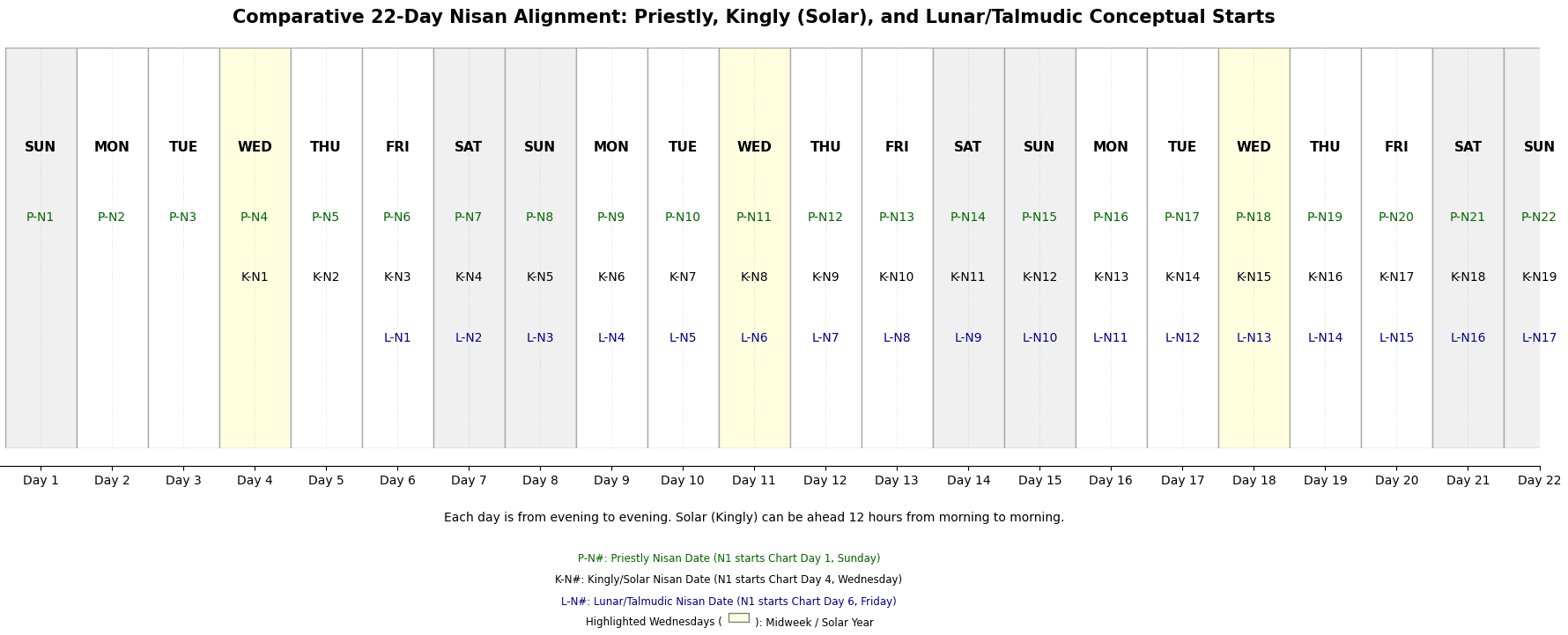
The fixed weekday overlay employed in Part 2 puts Nisan 1 on Wednesday. The separate Sunday/Wednesday/Friday creation-day overlays discussed below are alternative points of reference, not three simultaneous weekday names for this table’s Nisan 1.
A5. Compressed boundaries and the two bookends
| Original label | Compressed index | W-grid, included | W-grid, withheld | M-grid, included | M-grid, withheld |
|---|---|---|---|---|---|
| #0 | 0 | 6 BC–AD 2 | 6 BC–AD 2 | 6 BC–AD 25 | 6 BC–AD 25 |
| #20 | 20 | AD 135–AD 142 | AD 135–AD 142 | AD 595–AD 625 | AD 595–AD 625 |
| #21 | 21 | AD 142–AD 149 | AD 142–AD 149 | AD 625–AD 655 | AD 625–AD 655 |
| #42 | 42 | AD 289–AD 296 | AD 289–AD 296 | AD 1255–AD 1285 | AD 1255–AD 1285 |
| #53 | 43 | AD 366–AD 373 | AD 296–AD 303 | AD 1585–AD 1615 | AD 1285–AD 1315 |
| #68 | 58 | AD 471–AD 478 | AD 401–AD 408 | AD 2035–AD 2065 | AD 1735–AD 1765 |
| #69 | 59 | AD 478–AD 485 | AD 408–AD 415 | AD 2065–AD 2095 | AD 1765–AD 1795 |
| #80 | 70 | AD 555–AD 562 | AD 485–AD 492 | AD 2395–AD 2425 | AD 2095–AD 2125 |
| #81 | 71 | AD 562–AD 569 | AD 492–AD 499 | AD 2425–AD 2455 | AD 2125–AD 2155 |
At the seven-year scale, omitting 10 bands subtracts 70 years; at the 30-year scale, it subtracts 300. The band widths and the 6 BC anchor remain fixed. The same operation can be applied at other scales, but a festival alignment must then be recalculated rather than carried over automatically.
B. Calendar ratios and quarter-day accounting
B1. The three related ratios
| Schematic measure | Day length | Ratio | Basic count relation | Calibrated day value |
|---|---|---|---|---|
| Priestly service model | 336 | 25/23 | 23 → 25 | 336 × 25/23 = 8400/23 |
| Prophetic measure | 360 | 70/69 | 69 → 70 | 360 × 70/69 = 8400/23 |
| Enochian measure | 364 | 300/299 | 299 → 300 | 364 × 300/299 = 8400/23 |
The expressions in the final column are exactly equal. The factors 70/69, 25/23, and 300/299 are different operations on different input units, but their calibrated day value belongs to one rational family. With a comparison year of 365.2423 days, the shared value is about 0.0249087 day, or 35.87 minutes, shorter per year. This is an approximation to a tropical year; it cannot be described as perfect astronomical synchronization across unlimited time.
At the shared rational calibration, 69 reference years equal 70 schematic 360-day years; 23 reference years equal 25 schematic 336-day years; and 299 reference years equal 300 schematic 364-day years. The direction matters. Multiplying a day length by its ratio gives the comparison day length. Multiplying a count of reference years by the same ratio gives a larger count of shorter schematic years. Extending that new count from an anchor is a further modeling operation.
For example, the converted counts from 1656 are 1680 prophetic years and 1800 priestly years. Their common schematic duration is 1680 × 360 = 1800 × 336 = 604,800 days. The separate numerical identities 1680 = 5 × 336 and 1800 = 5 × 360 are also true, but they must not determine the calendar-unit labels of the converted counts. Key of 23, conversion table and unit explanation.
B2. The 299- and 293-year comparisons
The source’s 299-year comparison is retained as 299 → 300 on the 364-day scheme. It is not a further refinement beyond the shared rational value, since 364 × 300/299 = 8400/23 exactly. It also cannot be substituted into the 360-day year: 299 solar years do not approximately equal 300 years of 360 days.
The distinct calibration is 364 × 294/293 = 365.242320819… days. At the source’s comparison value of 365.2423 days, 294 × 364 = 107,016 days, while 293 × 365.2423 = 107,015.9939 days, a difference of 0.0061 day, or about 8.8 minutes, across the complete cycle. This displays the source’s numerical closeness without calling a rounded decimal an exact identity. The site’s File 53, §14A treats this as a calibration display within its Enoch accounting; it does not open an additional unrestricted chronological conversion operator.
The claim that 293 solar years nearly equal 294 336-day priestly years is not retained: those units do not agree. The 294/293 display concerns 364-day years. Nor does its close numerical fit show that a specific ancient community implemented a 293-year intercalation rule.
B3. Historical and symbolic calendar claims
The priestly number 24 is grounded in the course list of 1 Chronicles 24. Twice traversing 24 weekly courses yields 48 weeks, or 336 days. The Qumran texts incorporate priestly service cycles in a 364-day year, according to Jonathan Ben-Dov’s research account. This supports comparison between priestly rotation and annual calendar; it does not establish the entire two-rotation block as an independently attested civil year. Ben-Dov, 2015.
First Enoch 82:4–7, 11–20 describes 364 days, four additional days, and leaders assigned to the heavenly order. The names of the four seasonal leaders in the Charles translation are Mîlkî’êl, Hel’emmêlêk, Mêl’êjal, and Nârêl. Uriel is the revealer of the system. Equating the fourth church marker with Uriel is the study’s typological choice, not a name supplied by Revelation. The four days complete the schematic quarters; they do not by themselves correct the difference between 364 and a tropical year. 1 Enoch, primary text.
The reference to a 28-day lunar period in 1 Enoch 78:9 remains relevant as evidence that 28 occurs in the text’s lunar discussion. It does not establish 12 uniform 28-day months. The same chapter discusses differing lunar months. The equation 12 × 28 = 336 is therefore identified here as the numerical construction used in the study.
B4. Complete quarter-day counter
After n completed positions, the accumulated count is floor(n/3). The first additional day follows #2, the second follows #5, and so on. “After #11” and “before #12” refer to the same boundary. The table includes every completed group through #80; there is no 28th complete group within 82 positions.
| Boundary | Group | Accumulated quarter days | Completed positions | Interpretive location |
|---|---|---|---|---|
| After #2 | Church | 1 | 3 | First marker: after #2 |
| After #5 | Church | 2 | 6 | |
| After #8 | Church | 3 | 9 | |
| After #11 | Church | 4 | 12 | Fourth marker: after #11, before #12 |
| After #14 | Church | 5 | 15 | |
| After #17 | Church | 6 | 18 | |
| After #20 | Church | 7 | 21 | Church–seal boundary |
| After #23 | Seal | 8 | 24 | |
| After #26 | Seal | 9 | 27 | |
| After #29 | Seal | 10 | 30 | |
| After #32 | Seal | 11 | 33 | |
| After #35 | Seal | 12 | 36 | |
| After #38 | Seal | 13 | 39 | |
| After #41 | Seal | 14 | 42 | Accumulated count within the seal group |
| After #44 | Thunder | 15 | 45 | |
| After #47 | Thunder | 16 | 48 | |
| After #50 | Thunder | 17 | 51 | |
| After #53 | Trumpet | 18 | 54 | |
| After #56 | Trumpet | 19 | 57 | |
| After #59 | Trumpet | 20 | 60 | |
| After #62 | Trumpet | 21 | 63 | |
| After #65 | Trumpet | 22 | 66 | |
| After #68 | Trumpet | 23 | 69 | Trumpet–bowl boundary |
| After #71 | Bowl | 24 | 72 | |
| After #74 | Bowl | 25 | 75 | |
| After #77 | Bowl | 26 | 78 | |
| After #80 | Bowl | 27 | 81 | Final complete group of three |
There are seven quarter-day boundaries during the 22-position seal group: after #23, #26, #29, #32, #35, #38, and #41. The total from #0 is 14 at the end of #42. Thus 660 + 7 = 667 describes the seal group alone, whereas AD 1285 + 14 = AD 1299 describes a cumulative endpoint adjustment. They cannot be substituted for one another.
The general difference between M and W at the same boundary is 23n. Its 70/69 expansion adds n/3. When n is not divisible by three, that increase is fractional, while the count of completed quarter days remains an integer. The statement that the two counts agree exactly therefore applies at completed three-position boundaries, including n = 3, 21, and 69.
B5. Key-of-23 reference ladder
| Factorization | Value | Use in the argument |
|---|---|---|
| 23 × 1 | 23 | Per-position M–W difference; also the increase at the 69-position boundary. |
| 23 × 7 | 161 | The square root in 25,921 = 161². |
| 23 × 29 | 667 | Seal-group duration 660 plus seven local quarter-day equivalents. |
| 23 × 30 | 690 | Exodus-related 30-unit steps. |
| 23 × 40 | 920 | Ascending route of the first seal-ladder row in E1. |
| 23 × 60 | 1380 | Selected MT/LXX chronological difference; also a seal-ladder value. |
| 23 × 62 | 1426 | Descending route of the first seal-ladder row. |
| 23 × 69 | 1587 | Difference between W and M after 69 positions. |
| 23 × 72 | 1656 | Difference between the ends of the compressed W and M grids. |
| 23 × 90 | 2070 | 1929 BC → AD 142; or 1446 BC → AD 625. Also 69 × 30. |
| 23 × 111 | 2553 | 1929 BC → AD 625. |
| 23 × 120 | 2760 | 1446 BC → AD 1315. |
| 23 × 140 | 3220 | 1922 BC → AD 1299. |
| (23 × 7)² | 25921 | 25,920 + 1 = 49 × 23². |
The 1380 comparison belongs to selected MT/LXX chronological configurations. It is not a claim that every LXX manuscript has the same Creation-to-Flood difference from MT. The 2553-year line measures Jacob’s 1929 BC departure coordinate to AD 625; the separate Danielic arch begins at 1926 BC and has length 2550. Both survive with their distinct anchors.
C. Chronological source tables and their qualifications
The following two tables preserve the date fields of the original Part 4 as a reference snapshot. They make its calculations reproducible; they are not a replacement for the current canonical chronology tables. In particular, cumulative lifespans, normal begetting chronology, rounded coordinates, and optional calendar overlays remain different families.
The main discussion follows the site’s normal MT settings: Creation endpoint 4114 BC, Flood 2458 BC, Abraham 2166 BC, 430 years in Egypt, and the 6 BC New Testament anchor. The +60 Terah option is not required to produce Abraham’s 2166 BC birth in that frame. The original regular table itself gives Terah 2236 BC and Abraham 2166 BC, a difference of 70. Its prose statement that a +60 addition establishes the same baseline was therefore inconsistent. Current chronological setting.
C1. Original cumulative chronology snapshot
The starred column records the original narrow cumulative range; the next column gives its broader seven-year window. The widths are model conventions involving the Aaron/Moses endpoints and Noah/Shem choices. Exodus 7:7 gives rounded ages of 83 and 80, but does not establish a precise 3.5-year birth interval. The 123.5 entry below belongs to the source’s seasonal construction; Aaron’s stated lifespan is 123 years.
| Patriarch | 3-yr gap of Aaron/Moses (BC) | 7-yr Span forwarded | Lifespan (years) |
|---|---|---|---|
| Adam | *14009 – 14006 | 14011 – 14004 | 930 |
| Seth | *13079 – 13076 | 13081 – 13074 | 912 |
| Enos | *12167 – 12164 | 12169 – 12162 | 905 |
| Kenan | *11262 – 11259 | 11264 – 11257 | 910 |
| Mahalaleel | *10352 – 10349 | 10354 – 10347 | 895 |
| Jared | *9457 – 9454 | 9459 – 9452 | 962 |
| Enoch | *8495 – 8492 | 8497 – 8490 | 365 |
| Methuselah | *8130 – 8127 | 8132 – 8125 | 969 |
| (Flood) Lamech | *7161 – 7158 | 7163 – 7156 | 777 |
| Noah | *6384 – 6381 | 6386 – 6379 | 950 |
| Shem | *5434 – 5431 | 5436 – 5429 | 600 |
| Flood to Arphaxad: “Shem, Ham & Japheth” allow ±2 | *4834 – 4831 | 4836 – 4829 | ±2 |
| Arphaxad | *4834-4831 | 4836-4829 | 438 |
| Shelah | *4396 – 4393 | 4398 – 4391 | 433 |
| Eber | *3963 – 3960 | 3965 – 3958 | 464 |
| Peleg | *3499 – 3496 | 3501 – 3494 | 239 |
| Reu | *3260 – 3257 | 3262 – 3255 | 239 |
| Serug | *3021 – 3018 | 3023 – 3016 | 230 |
| Nahor | *2791 – 2788 | 2793 – 2786 | 148 |
| Terah | *2643 – 2640 | 2645 – 2638 | ***205 |
| Abraham | *2438 – 2435 | 2440 – 2433 | 175 |
| Isaac | *2263 – 2260 | 2265 – 2258 | 180 |
| Jacob | *2083 – 2080 | 2085 – 2078 | 147 |
| Levi | *1936 – 1933 | 1938 – 1931 | 137 |
| Kohath | *1799 – 1796 | 1801 – 1794 | 133 |
| Amram | *1666 – 1663 | 1668 – 1661 | 137 |
| Aaron/Moses | *1530/1526 | 1531/1524 | 123.5/120 |
| Death: Aaron/Moses | *1407/1406 | NA | (Exodus *1446) |
| Joshua begins a new line | 1296 | NA | 110 |
The “(Flood) Lamech” wording is an inherited source label and must not be mistaken for the Flood coordinate used in this article. The calculations use 4836 BC, the leading boundary of the displayed 4836–4829 Flood/Arphaxad window. The source’s narrow and broad Creation ranges are likewise distinct from the rounded 14006 BC reference used in its larger comparisons. Joshua’s final row begins a new construction, as the source says, rather than continuing the same patriarchal sum.
The original notes also discuss a 460-year addition for the LXX second Cainan, a 120-year MT/SP cumulative difference, and Terah’s 205/145-year alternatives. These are retained as variant operations requiring their own source configuration. Substituting 145 for 205 changes an otherwise fixed sum by 60 years; that substitution alone cannot remove a 120-year difference. A claim to complete reconciliation would need a second specified adjustment.
The proposed 120-year connection with Genesis 6:3 and the jubilee factor 3430 = 70 × 49 remain comparative observations. The snapshot does not supply enough paired endpoint detail to turn every statement in the old note into an independently specified calculation. The current cumulative appendix is the controlling reference for the broader method.
C2. Original regular chronology snapshot
The original dates and event notes are retained below. Dates marked “implicit,” or described as traditional or likely, remain interpretations within that source. They are not newly established biblical dates. The table’s Noah/Shem and Aaron rows also retain their original variant and seasonal labels; current normal settings should be consulted before combining them with another article’s dates.
| (MT) Creation to the Flood | |||
|---|---|---|---|
| Patriarch/Event | Lifespan (BC) | Years Lived | Key Events |
| Creation | 4121 – 4114 | 7 | Seven days of Creation as years |
| Adam | 4114 – 3184 | 930 | |
| Seth | 3984 – 3072 | 912 | *Cain’s birth (4115, 4113; mid. 4114); Abel’s birth (4046, 4044; mid. 4045) implicit. Inverse pattern of Terah’s age at Abram’s birth. |
| Enosh | 3879 – 2974 | 905 | |
| Kenan | 3789 – 2879 | 910 | |
| Mahalalel | 3719 – 2824 | 895 | |
| Jared | 3654 – 2692 | 962 | |
| Enoch | 3492 – 3127 | 365 | |
| Methuselah | 3427 – 2458 | 969 | |
| Lamech | 3240 – 2463 | 777 | |
| Noah | 3058 – 2108 | 950 | See below note |
| “120 yrs to Flood”(2578-2458) FLOOD (2458 – 2457) Post-Flood to Abraham | |||
| Shem | 2556 – 1956 | 600 | See notes for Noah & Shem in LXX table concerning “2-yrs” |
| Arphaxad | 2456 – 2018 | 438 | |
| Salah | 2421 – 1988 | 433 | |
| Eber | 2391 – 1927 | 464 | |
| Peleg | 2357 – 2118 | 239 | Tower of Babel (2357 with ±1 implied) |
| Reu | 2327 – 2088 | 239 | |
| Serug | 2295 – 2065 | 230 | |
| Nahor | 2265 – 2117 | 148 | |
| Terah | 2236 – 2031 | 205 | |
| Patriarchal Period | |||
| Abraham | 2166 – 1991 | 175 | Call of Abram (2091 BC), Covenant of Pieces (2081 BC), Covenant of Circumcision & Destruction of Sodom (2067 BC) |
| Sarah | 2156 – 2029 | 127 | |
| Ishmael | 2080 – 1943 | 137 | |
| Isaac | 2066 – 1886 | 180 | Wedding of Isaac (2026) *Sacrifice of Isaac within 7yr period (2051, 2049, 2046, 2044) implicit. |
| Jacob | 2006 – 1859 | 147 | Jacob flees Esau (1929 BC) Jacob works for wives (1929-1922-1915 BC) Jacob returns to Canaan (1909 BC) Gen. 48:1 implies 147th yr = 3 jub.; hence, 147th is fig. “Year of Jub” (1860-1859 BC) |
| Esau | 2006 – ? | – | Esau marries (1966 BC) |
| Levi | 1919 – 1782 | 137 | |
| Judah | 1918 – 1789 | 129 | Death year per tradition |
| Joseph | 1915 – 1805 | 110 | Joseph sold as slave (1898 BC) 7 years plenty (1885-1878 BC) 7 years famine (1878-1871 BC) |
| Benjamin | 1906 – ? | – | Birth of Benjamin (likely 1906 BC) |
| Egypt to Exodus | |||
| Israelites in Egypt | 1876 – 1446 | 430 | |
| Kohath | – | 133 | |
| Amram | – | 137 | |
| Aaron | 1529 – 1406 | 123 | Birth (summer of 1530 exact) Death (summer of 1407) |
| Moses | 1526 – 1406 | 120 | Birth (winter of 1526 exact) Flees to Midian (1486 BC) Exodus (1446 BC) Tabernacle (1445 BC) Death (winter of 1406) |
| Conquest (1406-1400 BC) First Sabbath year of rest (1399 BC) Conquest and Judges | |||
| Joshua, “And also וְגַם all that GENERATION died” (Judges 2:9-10) | 1476 – 1366 | 110 | “Generation” of 40-yrs implied (1406-1366) |
The Shem entry 2556–1956 BC is the source’s displayed alternative; the site’s normal Gear-2 birth is 2558 BC, with Arphaxad fixed at 2456 BC. The Aaron row mixes civil-year and seasonal labels: the main article uses the normal 1530 BC birth and the biblical lifespan 123. No displayed range is used to revise the established lexical count.
The conjectural Cain and Abel dates, the Isaac-sacrifice window 2051–2044 BC with internal points 2049 and 2046, the Judah lifespan tradition, and the Benjamin date remain source proposals. The source links the sacrifice window with a 23 × 520 = 11,960-year comparison to cumulative Creation; a particular match requires the chosen endpoint in each window. These proposals are not necessary for the Part 4 token formulas.
C3. Additional anchors and creation-day overlays
| Anchor or alternative | Value retained | Status |
|---|---|---|
| Restoration frame | 538–536 BC | Series framework; Ezra 3 and Daniel 10 supply the related month references, not every BC assignment. |
| Backward grand-jubilee comparison | 1028 BC → 538 BC = 490 | A generated comparison; not the date of Solomon’s Temple. |
| Normal Temple reference | 966 BC | Kept distinct from the 1028 BC comparison. |
| Jacob’s first labor term | 1929–1922 BC | Source chronology; seven elapsed years. |
| Jacob-pivot | 1926 BC | Integer comparison coordinate within that term; exact temporal midpoint is 1925.5 BC. |
| Danielic intermediate coordinate | 666 BC | 1926 − 666 =1260; 666 +625 −1=1290. |
| Alternate Creation comparison | 3966 BC | 3966 +355 −1=4320. Source’s asserted LXX attribution lacks a specified variant recipe here. |
| Figurative Abraham comparison | 2136 BC | A deliberate 30-year shift from 2166; not Abraham’s normal birth date. |
| Creation overlay day 1 | 6 BC | Beginning of the modeled annual creation week. |
| Creation overlay day 4 | 3 BC | Fourth annual position of that overlay. |
| Creation overlay day 6 | 1 BC → AD 1 | Sixth annual position; distinct from a historical date established by the token count. |
The original three creation-day starting points are preserved as an overlay: day 1/Sunday at 6 BC, day 4/Wednesday at 3 BC, and day 6/Friday at 1 BC. Day 6’s annual band runs from spring 1 BC to spring AD 1. These positions arise by mapping a creation week onto seven years. Describing them as “priestly,” “Enochian,” and “Talmudic” does not, without separate evidence, establish that those ancient communities all used these exact Nisan or incarnation dates. The fixed Wednesday weekly grid in A4 remains a distinct arrangement.
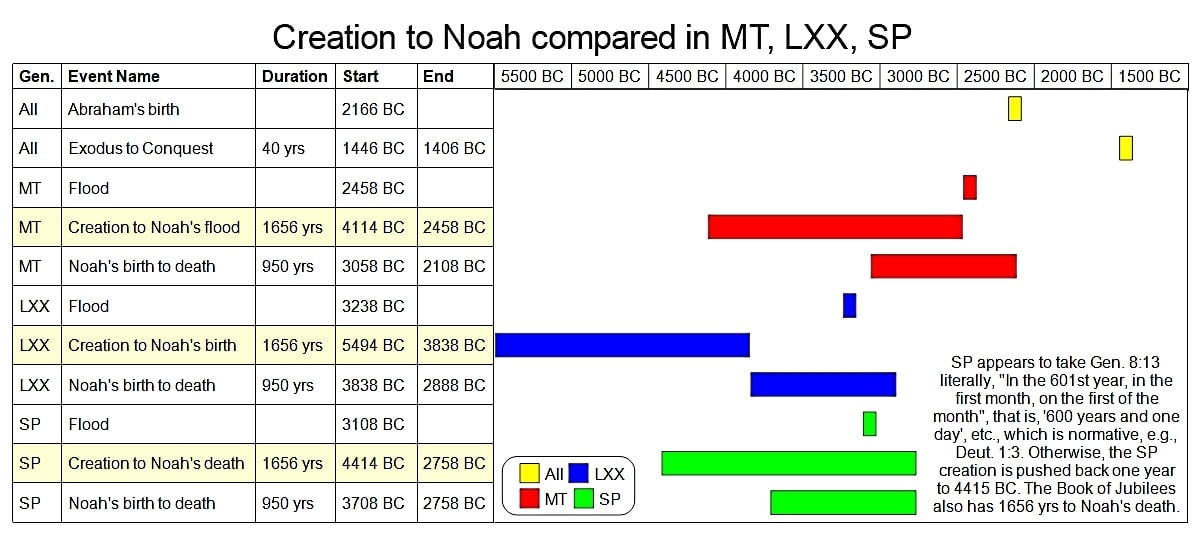
The comparative 1656 pattern is strongest here in its explicit MT derivation. The original also assigns 1656 to Creation-to-Noah’s-birth in its selected LXX arrangement and Creation-to-Noah’s-death in SP/Jubilees comparisons. These are configuration-dependent claims. File 53’s SP discussion explicitly uses a one-year compression or an inclusive “600th-year” route; that qualification matters when presenting the number as shared across traditions. File 53, §14A.
D. Detailed token and macro-scale calculations
D1. Chronological branches at the seals and first trumpet
| Comparison | Arithmetic | Result | Interpretation / branch |
|---|---|---|---|
| First seal: W–M boundary | 625 −142 | 483 =69 ×7 | ×70/69 gives 490, increasing by 7. |
| Jacob departure to W seal boundary | 1929 +142 −1 | 2070 =23 ×90 | Distinct from the 1926 BC divided-week comparison. |
| Jacob departure to M seal boundary | 1929 +625 −1 | 2553 =23 ×111 | Unexpanded source span. |
| Jacob-pivot to intermediate point | 1926 −666 | 1260 | First Danielic arch. |
| Intermediate point to first seal | 666 +625 −1 | 1290 | Second Danielic arch. |
| Exodus to first seal | 1446 +625 −1 | 2070 | ×70/69=2100; adds 30. |
| Alpha end to final seal end | 1285 −25 | 1260 | Unexpanded boundary. |
| Alpha end to expanded final seal | 1315 −25 | 1290 | Optional 30-year extension. |
| Seal-group duration | 22 ×30 | 660 | 22 lexical seal tokens remain fixed. |
| Seal group with local quarter days | 660 +7 | 667 =23 ×29 | Separate adjustment branch. |
| Cumulative quarter-day endpoint | 1285 +14 | AD 1299 | 14 from the beginning of #0. |
| Jacob wedding to adjusted end | 1922 +1299 −1 | 3220 =23 ×140 | ×25/23=3500. |
| Exodus to AD 1315 | 1446 +1315 −1 | 2760 =23 ×120 =69 ×40 | ×70/69=2800. |
| Seal beginning to AD 1315 | 1315 −625 | 690 =23 ×30 | One more 30-year band beyond the 660-year group. |
| Exodus to AD 1285 | 1446 +1285 −1 | 2730 =7.5 ×364 | First trumpet beginning when thunders withheld. |
| Jared to AD 1315 | 3654 +1315 −1 | 4968 =23 ×216 | 216=6 ×6 ×6. |
| Cumulative Creation endpoint to AD 1315 | 14004 +1315 −1 | 15,318 =23 ×666 | Corrects the source’s displayed 15,320 arithmetic typo. |
| Conquest to first trumpet W beginning | 1406 +366 −1 | 1771 =23 ×77 | Full model. |
| Conquest to first trumpet M beginning | 1406 +1585 −1 | 2990 =10 ×299 | ×300/299=3000, giving AD 1595. |
| Alpha anchor to adjusted trumpet boundary | 1595 +6 −1 | 1600 =40 ×40 =4 ×400 | Anchored expansion, not an altered observed event. |
The original D1 heading called AD 1285–1315 the “first thunder” in the withheld scenario. That interval is #43 on the full M-grid and becomes original #53’s interval when thunders are withheld. In the compressed sequence it belongs to the first trumpet; an omitted thunder is not simultaneously a retained band.
The original Creation row printed a calculation ending “15,320” beside the value 15,318. The correct arithmetic is 14004 + 1315 − 1 = 15,318 = 23 × 666. The row’s endpoints and its intended factorization are preserved. Its Exodus row also confused the beginning and end of the AD 1285–1315 band: 2730 reaches AD 1285, while 2760 reaches AD 1315.
D2. Alpha, bowls, Omega, and covenant spans
| From | To | Elapsed span | Role |
|---|---|---|---|
| 2166 BC | 6 BC | 2160 =6 ×360 | Abraham to the model anchor. |
| 6 BC | AD 2155 | 2160 =72 ×30 | Compressed M-grid through Omega. |
| 2166 BC | AD 355 | 2520 =7 ×360 | Through the beginning of #12; six units plus one. |
| 3966 BC | AD 355 | 4320 =12 ×360 | Alternative Creation comparison. |
| 2166 BC | AD 715 | 2880 | Beginning of #24; additional 100-fold magnification gives 288,000. |
| 2136 BC | AD 745 | 2880 | Figurative shifted anchor to #24’s end. |
| 536 BC | AD 715 /AD 745 | 1250 /1280 | The unchanged #24 boundaries do not produce 1290. |
| 6 BC | AD 478 /AD 485 | 483 /490 | Beginning and end of #69 on W. |
| 1876 BC | AD 2425 | 4300 =10 ×430 | Omega beginning, thunders included. |
| 1876 BC | AD 2455 | 4330 | Omega end, thunders included. |
| 1876 BC | AD 2125 | 4000 =10 ×400 | Omega beginning, thunders withheld. |
| 1876 BC | AD 2155 | 4030 | Omega end, thunders withheld. |
| AD 499 | AD 2155 | 1656 =23 ×72 | Compressed W–M endpoint difference. |
The 4300/4000 pair is measured to Omega’s beginning. The 4330/4030 pair includes its whole 30-year band. The difference between scenarios is 300 years in either case. The 400 and 430 of Genesis 15 and Exodus 12 need not designate identical starting events; their 30-year numerical difference supplies the comparison without rewriting the MT’s 430-year Egyptian sojourn.
D3. Cumulative, generation, and pillar comparisons
| From / operation | To / result | Span or equality | Qualification |
|---|---|---|---|
| 4836 BC | 6 BC | 4830 ×70/69=4900 | Cumulative Flood/Arphaxad leading coordinate. |
| 4836 BC | AD 2065 | 6900 ×70/69=7000 | First bowl M-grid beginning; expanded comparison. |
| 4836 BC | AD 2095 | 6930 ×70/69=7030 +10/23 | First bowl M-grid end; not 7000. |
| 4830 +2160 | 6990 | 10 short of 7000 | Unexpanded cumulative-to-compressed-end total. |
| 1399 BC | AD 562 | 1960 =40 ×49 | End#80 /start#81, full W-grid. |
| 1399 BC | AD 492 | 1890 =1960 −70 | Same boundary with thunders withheld. |
| 1406 BC | AD 5595 | 7000 | 70-year scale, #80 beginning. |
| 2456 BC comparison branch | AD 5595 | 8050 =7 ×1150 | Endpoint recovery from original outline; branch family not inferred from date alone. |
| 2106 BC comparison branch | AD 5735 | 7840 =16 ×490 | 70-year scale, #81 ending; same qualification. |
| 6 BC | AD 29,515 | 29,520 =82 ×360 | Full 360-year-per-position scale. |
| AD 715 | AD 29,515 | 28,800 =400 ×72 | M-grid#24 beginning to pillar. |
| 1446 BC | AD 29,515 | 30,960 =430 ×72 | Exodus to pillar. |
| AD 2425 | AD 29,515 | 27,090 =21 ×1290 =63 ×430 | Omega M-grid beginning to pillar. |
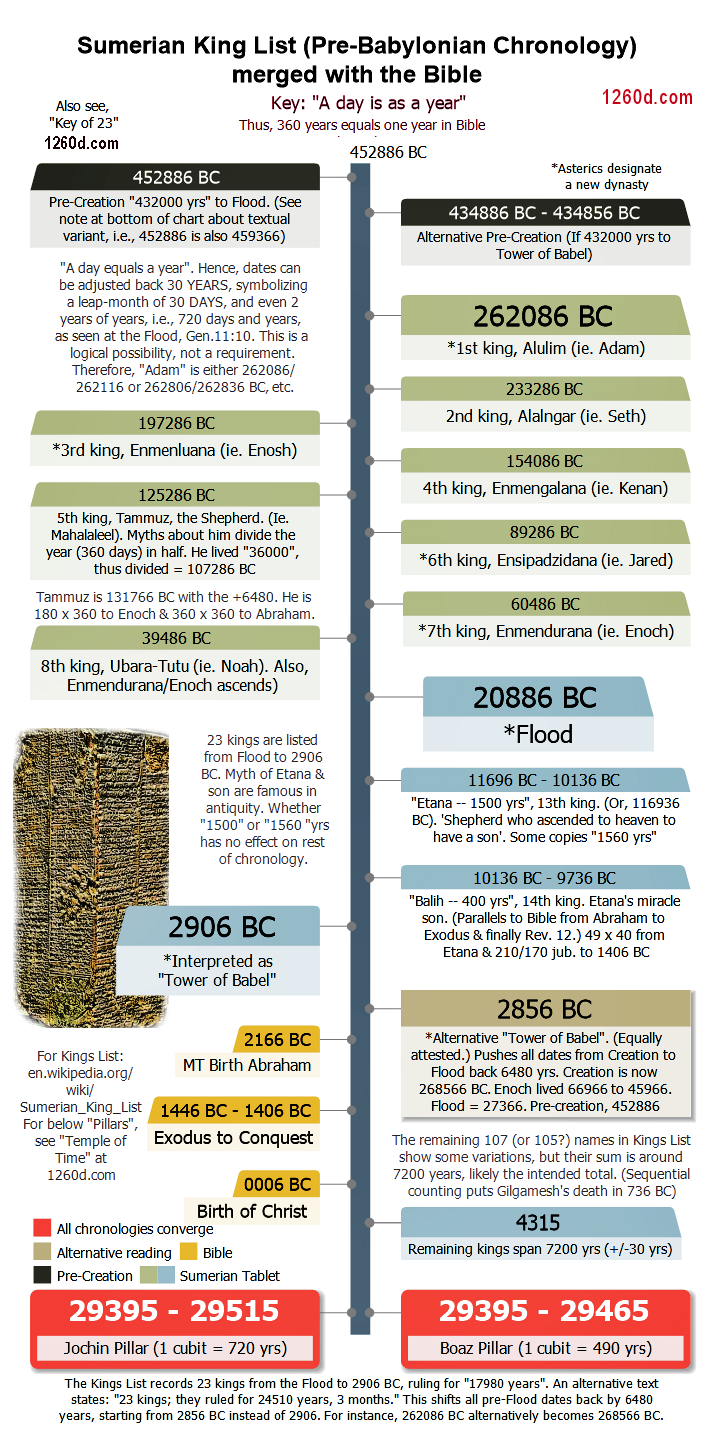
| 262,086 BC | 6 BC | 262,080 =360 ×728 =360 ×(2 ×364) | Adam/Alulim comparative coordinate. |
The 70-year scale’s three large comparisons require more precision than the original outline provided. Its 7000-year Conquest relation reaches #80’s beginning, AD 5595, not #81’s beginning at AD 5665. The 8050 and 7840 identities are recoverable using the comparison coordinates 2456 BC and 2106 BC; the table identifies them as that branch. With the normal 2458 and 2108 BC coordinates, those spans are 8052 and 7842. The shared labels 2456 and 2106 alone do not establish whether a particular source calculation came from a regular Gear-1 or rounded chronology. No family is silently substituted.
The source’s proposed pillar links with 1290 remain available at exact M-grid boundaries: AD 29,515 − AD 2395 = 27,120, which is not a multiple of 1290, while AD 29,515 − AD 2425 = 27,090 = 21 × 1290 = 63 × 430. The last equality reaches Omega’s beginning. Using AD 2455 gives 27,060, so the endpoint cannot be shifted casually.
The outline also proposed a 30,000-year comparison to a mirrored 605 coordinate. The original diagram supplies a leading pillar boundary, AD 29,395, in addition to AD 29,515. Using the signed coordinate −605 gives 29,395 − (−605) = 30,000. The later boundary instead gives 29,515 − (−605) = 30,120. Under A1’s astronomical notation, coordinate −605 means 606 BC; it should not be written as a negative BC year. Thus the 30,000-year branch uses the figure’s earlier pillar boundary and its explicitly stated reflection.
The 262,086 BC Adam/Alulim coordinate is a comparative construction. The primary King List names Alulim and gives a reign of 28,800 years, but does not give the BC coordinate or identify him with Adam. The model’s calculation to 6 BC is exact given its chosen anchor; the historical identification is a separate interpretation. Oxford Electronic Text Corpus of Sumerian Literature, King List.
D4. Precessional and further scale totals
| Unit per position | 82-position total | 72-position total | Related observation |
|---|---|---|---|
| 1 hour | 82 hours | 72 hours | The earlier 81+3-hour branch is separately described in F3. |
| 1 day | 82 days | 72 days | Ordinal #80 is the 81st position when #0 is first. |
| 7 units | 574 | 504 | 504=7 ×72. |
| 30 units | 2460 | 2160 | 2160=30 ×72=(7+23) ×72. |
| 70 years | 5740 years | 5040 years | Full Omega AD 5665–5735. |
| 84 units per modeled priestly quarter | 6888 | 6048 | 84=3 ×28; distinguish 91-day Enochian quarters. |
| 360 years | 29,520 years | 25,920 years | 72 ×360 is the schematic precessional circle. |
| 1000 years | 82,000 years | 72,000 years | Further magnification;30 units would equal 30,000 years. |
| Cosmic circle plus one | 25,921 | 161² =49 ×23² | Explicit symbolic addition to 25,920, not an astronomical measurement. |
“Great month,” “great week,” and “star day” name the study’s analogy using 72 years per degree. Their totals are exact in that scheme. They are not precision measurements of an invariant celestial cycle. The 84-unit seasonal option follows the 336-day, four-quarter model; a season in the 364-day arrangement has 91 days. These two seasonal widths should not share an unqualified label.
At 1000 years per unit, a 30-unit symbolic month totals 30,000 years. The original outline names this further scale without completing every proposed comparison. It is preserved as an available scale, not a requirement that every other calendar operation produce the same result under every magnification.
E. Two explicit mirror constructions
“Atbash” refers by analogy to reversing an ordered series, as Hebrew Atbash pairs the first letter with the last. It is not a claim that these date equations are a literal cipher written in Revelation. The original Part 4 used two different reflections. Retaining its numerical results requires stating the axis of each rather than calling both simply “the BC/AD mirror.”
| Construction | Coordinate reflection | Axis | Example |
|---|---|---|---|
| Local seal ladder | R(x) = 1 − x | x = 0.5 | AD 142 becomes coordinate −141, the civil label 142 BC. |
| Whole-sequence mirror | R(x) = −x | x = 0 | AD 25 becomes coordinate −25, the civil label 26 BC; 6 BC, coordinate −5, becomes +5. |
A reflection around an independently specified date must use that date’s coordinate. For an axis a, the formula is R(x) = 2a − x. Choosing a different axis changes the resulting spans by twice the axis shift. In particular, reflection around the 6 BC model anchor, a = −5, produces the full band totals; it does not produce the constants in E3 below. These distinctions also separate symbolic reflections from actual years elapsed between historical events.
E1. The 22-position seal ladder
Let i run from 21 to 42, and pair it with j = 63 − i. For the descending path, reflect the W-grid start of i by 1 − x and measure to the M-grid end of j. The first row is AD 1285 − (−141) = 1426 = 62 × 23. The reflected value −141 is a coordinate, not a civil date written “−141 BC.”
The original ascending factor column uses a complementary endpoint choice. It is recovered by reflecting the W-grid end of j and measuring to the M-grid start of i. This gives the ascending factor 40 on the first row. The two routes are:
Descending D(i) = M-end(j) − [1 − W-start(i)] = 23(83 − i).
Ascending A(i) = M-start(i) − [1 − W-end(j)] = 23(i + 19).
| Seal ordinals | Global labels | Reflected W start coordinate | Paired M end | Descending path | Ascending path |
|---|---|---|---|---|---|
| 1 → 22 | #21 → #42 | -141 | AD 1285 | 1426 = 62 ×23 | 920 = 40 ×23 |
| 2 → 21 | #22 → #41 | -148 | AD 1255 | 1403 = 61 ×23 | 943 = 41 ×23 |
| 3 → 20 | #23 → #40 | -155 | AD 1225 | 1380 = 60 ×23 | 966 = 42 ×23 |
| 4 → 19 | #24 → #39 | -162 | AD 1195 | 1357 = 59 ×23 | 989 = 43 ×23 |
| 5 → 18 | #25 → #38 | -169 | AD 1165 | 1334 = 58 ×23 | 1012 = 44 ×23 |
| 6 → 17 | #26 → #37 | -176 | AD 1135 | 1311 = 57 ×23 | 1035 = 45 ×23 |
| 7 → 16 | #27 → #36 | -183 | AD 1105 | 1288 = 56 ×23 | 1058 = 46 ×23 |
| 8 → 15 | #28 → #35 | -190 | AD 1075 | 1265 = 55 ×23 | 1081 = 47 ×23 |
| 9 → 14 | #29 → #34 | -197 | AD 1045 | 1242 = 54 ×23 | 1104 = 48 ×23 |
| 10 → 13 | #30 → #33 | -204 | AD 1015 | 1219 = 53 ×23 | 1127 = 49 ×23 |
| 11 → 12 | #31 → #32 | -211 | AD 985 | 1196 = 52 ×23 | 1150 = 50 ×23 |
| 12 → 11 | #32 → #31 | -218 | AD 955 | 1173 = 51 ×23 | 1173 = 51 ×23 |
| 13 → 10 | #33 → #30 | -225 | AD 925 | 1150 = 50 ×23 | 1196 = 52 ×23 |
| 14 → 9 | #34 → #29 | -232 | AD 895 | 1127 = 49 ×23 | 1219 = 53 ×23 |
| 15 → 8 | #35 → #28 | -239 | AD 865 | 1104 = 48 ×23 | 1242 = 54 ×23 |
| 16 → 7 | #36 → #27 | -246 | AD 835 | 1081 = 47 ×23 | 1265 = 55 ×23 |
| 17 → 6 | #37 → #26 | -253 | AD 805 | 1058 = 46 ×23 | 1288 = 56 ×23 |
| 18 → 5 | #38 → #25 | -260 | AD 775 | 1035 = 45 ×23 | 1311 = 57 ×23 |
| 19 → 4 | #39 → #24 | -267 | AD 745 | 1012 = 44 ×23 | 1334 = 58 ×23 |
| 20 → 3 | #40 → #23 | -274 | AD 715 | 989 = 43 ×23 | 1357 = 59 ×23 |
| 21 → 2 | #41 → #22 | -281 | AD 685 | 966 = 42 ×23 | 1380 = 60 ×23 |
| 22 → 1 | #42 → #21 | -288 | AD 655 | 943 = 41 ×23 | 1403 = 61 ×23 |
The pair factors sum to 102 in each row; the path spans sum to 2346 = 102 × 23. At i = 32, the two directed routes both give 1173 = 51 × 23. This is the arithmetic equality highlighted by the source. It occurs in the directed #32 → #31 row.
The ordered center of 22 seal tokens is the boundary between #31 and #32, the 11th and 12th seal occurrences. The source sometimes called it #32/#33 and associated that boundary with the pause before the seventh seal. That was a different boundary. The token list locates #31 at Revelation 6:12, #32 at Revelation 7:2, and #33–37 at Revelation 7:3–8; #38 is the opening of the seventh seal in Revelation 8:1. The protected references allow a broad sixth-to-seventh-seal association, but not the statement that all these boundaries are identical.
The source table displayed 11 forward pairs and then the reverse #32/#31 row, which it called the “central pivot.” The complete directed table above preserves its values and exposes the endpoint convention that generates the 51 × 23 equality. The narrative comparison with ascending and descending angels remains a typological interpretation of this ladder.
E2. The whole-sequence mirror
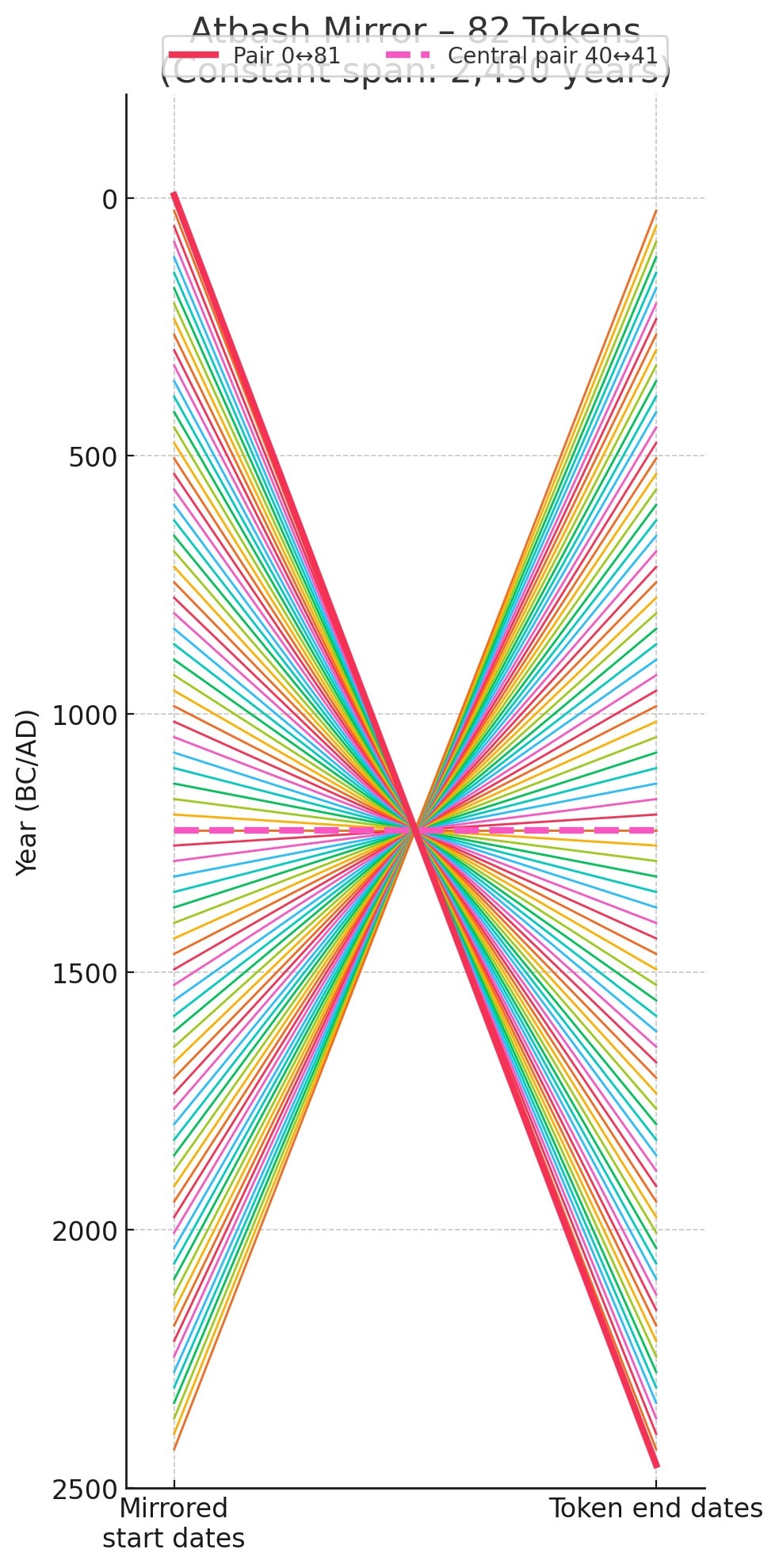
For N bands of width u, pair index i with N − 1 − i. Reflect the first band’s start by R(x) = −x, then measure to the paired band’s end. The result is independent of i:
[−5 + u(N − i)] − [5 − ui] = Nu − 10.
This proves the constant within the chosen construction. The minus 10 comes from the doubled −5 anchor coordinate. It is not 10 missing years of elapsed history. For the 82-position model, the reversed index center is the #40/#41 boundary. For the 72-position model, it is compressed #35/#36; the original labels there are also #35/#36 because the withheld thunders occur later.
| First label | Reflected M start coordinate | Partner,82 positions | M end,82 | Path span | Partner,72 positions | M end,72 | Path span |
|---|---|---|---|---|---|---|---|
| #0 | 5 | #81 | AD 2455 | 2450 | #81 | AD 2155 | 2150 |
| #1 | -25 | #80 | AD 2425 | 2450 | #80 | AD 2125 | 2150 |
| #2 | -55 | #79 | AD 2395 | 2450 | #79 | AD 2095 | 2150 |
| #35 | -1045 | #46 | AD 1405 | 2450 | #36 | AD 1105 | 2150 |
| #40 | -1195 | #41 | AD 1255 | 2450 | #31 | AD 955 | 2150 |
The source’s full-model row #40 ↔ #41 correctly uses AD 1255 as the paired M-grid end. Its withheld counterpart AD 955 is also retained, but belongs to original #31, the correct reversed partner of #40 after compression. Relabeling original #41 as AD 955 would change an unchanged pre-thunder band. The table therefore gives each scenario’s actual partner.
E3. Paired paths and mixed-scenario means
| Scale / scenario | One path | Two equal paths | Mixed-scenario sum / mean |
|---|---|---|---|
| M:82 positions | 82 ×30 −10=2450 | 4900 | 2450+2150=4600; mean 2300 |
| M:72 positions | 72 ×30 −10=2150 | 4300 | 4600 ×25/23=5000 |
| W:82 positions | 82 ×7 −10=564 | 1128 | 564+494=1058; mean 529=23² |
| W:72 positions | 72 ×7 −10=494 | 988 | Same mixed mean 529 |
For the M-grid, the two identical full-model paths sum to 4900; the withheld-model paths sum to 4300. These are sums of two constructed path lengths, not a claim that one ordinary historical interval from Alpha to Omega contains that many years. The author’s terms “half” and “full circuit” refer to this two-path display.
The mixed-scenario M-grid sum is 2450 + 2150 = 4600; its mean is 2300, recalling Daniel 8:14. Applying 25/23 to 4600 gives 5000, which can be expressed as 100 units of 50. This last use of 50 is distinct from the 49-year jubilee-cycle convention used in the 2450 = 50 × 49 display.
The mixed W-grid sum is 564 + 494 = 1058; its mean is 529 = 23². For #1, the original illustration is reproduced by AD 562 − (−2) = 564 in the full model and AD 492 − (−2) = 494 in the compressed model. At each scale, the mean follows from the same fixed formula with N = 82 and 72. It is therefore a compact invariant of the construction rather than a separately discovered fact in every row.
The source describes the seal mirror as Alpha-to-Tav and the complete mirror as Alpha-to-Omega. Both express reversal, but they employ different reflections and, in the local ladder, different grid widths and endpoint choices. Their theological kinship should not obscure their mathematical differences.
F. Festival positions and hour-scale continuation
F1. Fixed positions retained from the tables
| Position | Weekly table | M-grid month label | Interpretive association |
|---|---|---|---|
| #2 | Nisan 15–21 | Sivan | Passover/Unleavened Bread week on the weekly scale. |
| #12 | Sivan 25–31 | Nisan | Church-address center; proposed Paschal center on the month scale. |
| #24 | Elul 18–24 | Nisan | Elder’s announcement; a different scale supplies each label. |
| #26 | Tishri 1–7 | Sivan | First seal opened at the model’s autumn festival beginning. |
| #27 | Tishri 8–14 | Tammuz | Week containing Tishri 10/Atonement. |
| #28 | Tishri 15–21 | Av | Tabernacles week. |
| #29 | Tishri 22–28 | Elul | Week beginning with the eighth-day assembly. |
| #42 | Tevet 22–28 | Tishri | Final seal occurrence; Tabernacles association belongs to month scale. |
| #62 | Sivan 11–17,year 2 | Sivan | Third trumpet,Rev 8:10; week contains the model’s Sivan 15. |
| #68 | Tammuz 22–28,year 2 | Kislev | Seventh trumpet,Rev 11:15; not Pentecost week in this table. |
| #80 | Tishri 15–21,year 2 | Kislev | Final bowl occurrence,Rev 21:9; Tabernacles/New Jerusalem association. |
| #81 | Tishri 22–28,year 2 | Tevet | Added Omega; begins with Tishri 22 on weekly scale. |
The table deliberately retains #62 and #68 in their established places. It does not repair the source’s Pentecost claim by moving the seventh trumpet. Sivan 15 is the model’s fixed festival label; the historical and inclusive-count conventions behind it are explained in Part 2. With Wednesday Nisan 1 and two initial 30-day months, counting 50 days inclusively from Nisan 26 reaches Sivan 15. Counting instead from the Sunday Nisan 19 during Unleavened Bread reaches Sivan 8. These starting conventions cannot be combined.
The midmonth description of #12 and #24 is also a matter of convention. The start of ordinal day 15 occurs after 14 completed days; the midpoint boundary of an exactly 30-day interval occurs after 15. The phrase “Passover axis” names the proposed festival focus in the middle of the band, not an assertion that all time-of-day endpoints coincide.
The original outline suggested further Hanukkah connections at #80/#81 on the M-grid, using 1150/2300 spans to #42’s Tishri month and #4’s Av month. The month assignments survive: #80 is Kislev, #81 Tevet, #42 Tishri, and #4 Av. The proposed day labels require an additional rule. The M-grid starts of #4 and #42 are 1140 years apart; shifting an endpoint by 10 yields 1150, and doubling yields 2300. A particular Av 10, Tabernacles, or Hanukkah comparison must specify whether day labels are counted inclusively or as elapsed offsets. The source did not provide a complete endpoint derivation here, so the connection remains a proposed branch rather than a completed exact alignment.
F2. The 1335, Pentecost, and Sinai extension
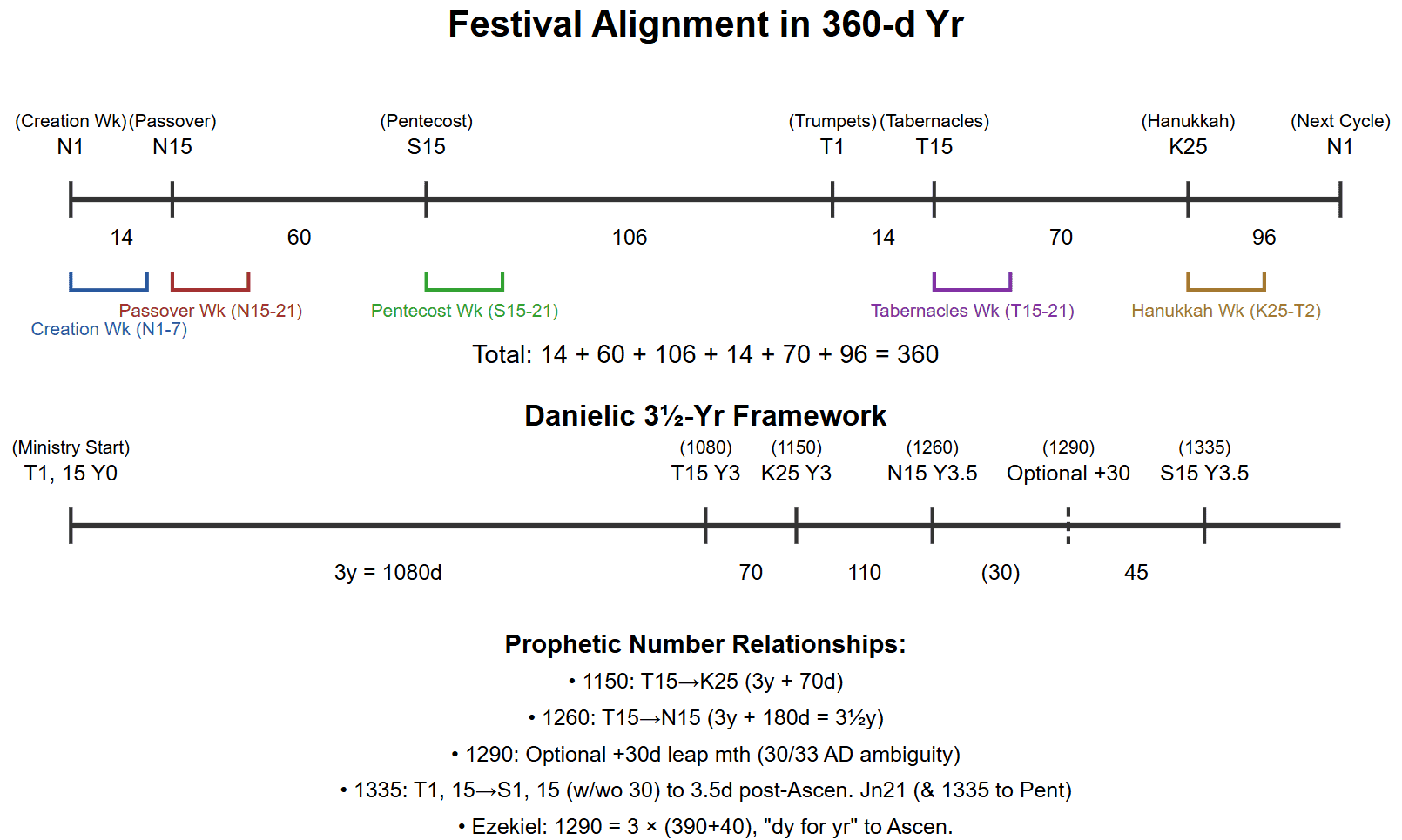
Daniel 12:12 supplies 1335; the comparison with 1260 yields 75. With Nisan and Iyar each 30 days, Sivan 15 is day 75 by ordinal count. An extension of 75 elapsed days from a year’s beginning finishes at the end of that day; 74 elapsed days reach its beginning. No festival coordinate follows from 1260 + 75 unless the ending of 1260 and the day-boundary convention have been established.
The related Sinai model treats days 75–81 as seven days inclusively and identifies #80, the 81st position when #0 counts as the first day, with the seventh day of waiting. This is a symbolic placement of Exodus 24:16, which records the six days and the call on the seventh. The passage does not provide the Nisan-based day number used in the construction. The connection with the two witnesses likewise combines the text’s resurrection imagery with a festival reading, not an explicit Pentecost date in Revelation 11.
F3. The earlier 81 + 3 hour proposal
The original Appendix F was subsequently developed into Part 5. Its compact arithmetic remains part of the source history: the 81 bands #0–80, read as hours, plus three hours of darkness give 84 hours, or 3.5 days. The three hours refer to the sixth-to-ninth-hour darkness in Matthew 27:45. Revelation 11:9–11 supplies a separate 3.5-day period for the two witnesses.
| Component | Duration | Qualification |
|---|---|---|
| #0–80 read as hour bands | 81 hours | The earlier construction omits the additional Omega band #81. |
| Darkness comparison | 3 hours | An additional symbolic component; not an unnoticed gap in the token inventory. |
| Combined symbolic total | 84 hours = 3.5 days | 81 + 3 = 84 exactly. |
| Two witnesses | 3.5 days | The period stated in Revelation 11; compared typologically with the cross. |
This does not establish an 84-hour elapsed burial interval for Jesus. Nor can the three hours be added to an 82-band arrangement while retaining the same total. Part 5 distinguishes centered hour bands, mirrored positions, and the historical Passion narrative before extending the comparison. The original statement that all scales “must” yield the same harmonies has therefore been replaced with the more limited claim that each scale can be examined under its own explicit rules.
F4. Structural proportions
| Relationship | Result | Proposed comparison |
|---|---|---|
| Seals + trumpets + bowls | 22 + 16 + 12 = 50 | Jubilee/Pentecost number |
| Full framework minus seals | 82 − 22 = 60 | Sexagesimal unit; the source invokes the Babylonian sos |
| Compressed framework minus seals | 72 − 22 = 50 | Another expression of the 50 comparison |
| Alpha + thunders + Omega | 1 + 10 + 1 = 12 | 12 × 30 = 360 units |
The equations describe group proportions. Their association with release, festival counting, or sexagesimal timekeeping is the interpretive step. The 50th-year language of Leviticus 25 and the 50-day count of Leviticus 23 remain distinct from an elapsed 49-year jubilee interval; the source uses both numbers in different comparisons.
G. Sources and scope
The controlling local source is the original Part 4, read with Parts 1–3 and 5. The full originals accompany the editorial package so that every substantive branch can be traced. The source’s repeated outline, drafting instructions, duplicate conclusions, unfinished figure instructions, and statements of mathematical inevitability as proof of divine authorship have been consolidated into an explicit argument and reproducible reference tables.
Primary biblical checks use the public-domain World English Bible, especially Daniel 8–12; Ezra 3; Revelation 1, 5–12, 21–22; Genesis 15, 28–29; Leviticus 23 and 25; and Exodus 24. Calendar qualifications refer to 1 Enoch 78 and 82 and Jonathan Ben-Dov, “Astronomy and Calendars at Qumran” (2015). Astronomical and comparative qualifications use NASA’s account of precession and Oxford’s Sumerian King List translation.
For the site’s current chronological conventions, consult The Key of 23 appendix, the cumulative chronology appendix, and the Unified Chronology source index. The Revelation study remains an exploratory numerical and theological reading. Its alternatives and expanded coordinates do not silently revise those controlling chronology files.
Reference appendix prepared with the complete Part 4 replacement. Established lexical counts, occurrence labels, and the three master grids are preserved. Explicit changes concern definitions, arithmetic, endpoint labels, historical qualifications, and the presentation of speculative interpretations.