A short passage in Luke’s genealogy opens a much larger chronological question:
… the son of Shelah, the son of Cainan, the son of Arphaxad, …
— Luke 3:35–36, Berean Standard Bible (BSB), excerpt
This is the second Cainan, between Arphaxad and Shelah, distinct from the earlier Kenan in Genesis 5. His place in the genealogy is discussed in The Second Cainan: Why 130 and 460 Years Matter. Here we follow one particular relationship: a life of 460 years accompanies two corresponding spans of 16560 years.
The pattern joins two kinds of chronology. The regular chronology follows the ages at which the ancestral line continues; the cumulative chronology places successive lifespans end to end. The second is a schematic comparison, not an ordinary history in which every child is born when the father dies. Once these two methods are kept distinct, the central relationship becomes quite simple: move both ends of a span forward by the same amount, and its length stays the same.
One life, two chronological uses
The Masoretic Text (MT) of Genesis 11 proceeds from Arphaxad to Shelah without the second Cainan. The Greek Septuagint (LXX), as represented here by Brenton’s translation, includes him. Its Cainan passage reads:
And Cainan lived a hundred and thirty years and begot Sala; and Cainan lived after he had begotten Sala, three hundred and thirty years, and begot sons and daughters, and died.
— Genesis 11:13, Brenton Septuagint Translation, Cainan passage included under verse 13 in this edition; Sala is Shelah.
In calculation form, those two parts of his life are:
130 + 330 = 460 years.
Restoring this generation within the MT-based comparison produces two different adjustments. The regular chronology inserts the 130 years before Shelah’s birth. The cumulative chronology inserts the full 460-year lifespan. This restoration is a declared comparison using Cainan’s LXX figures; it does not turn the received MT into a text that contains him or replace the other MT ages with LXX ages.
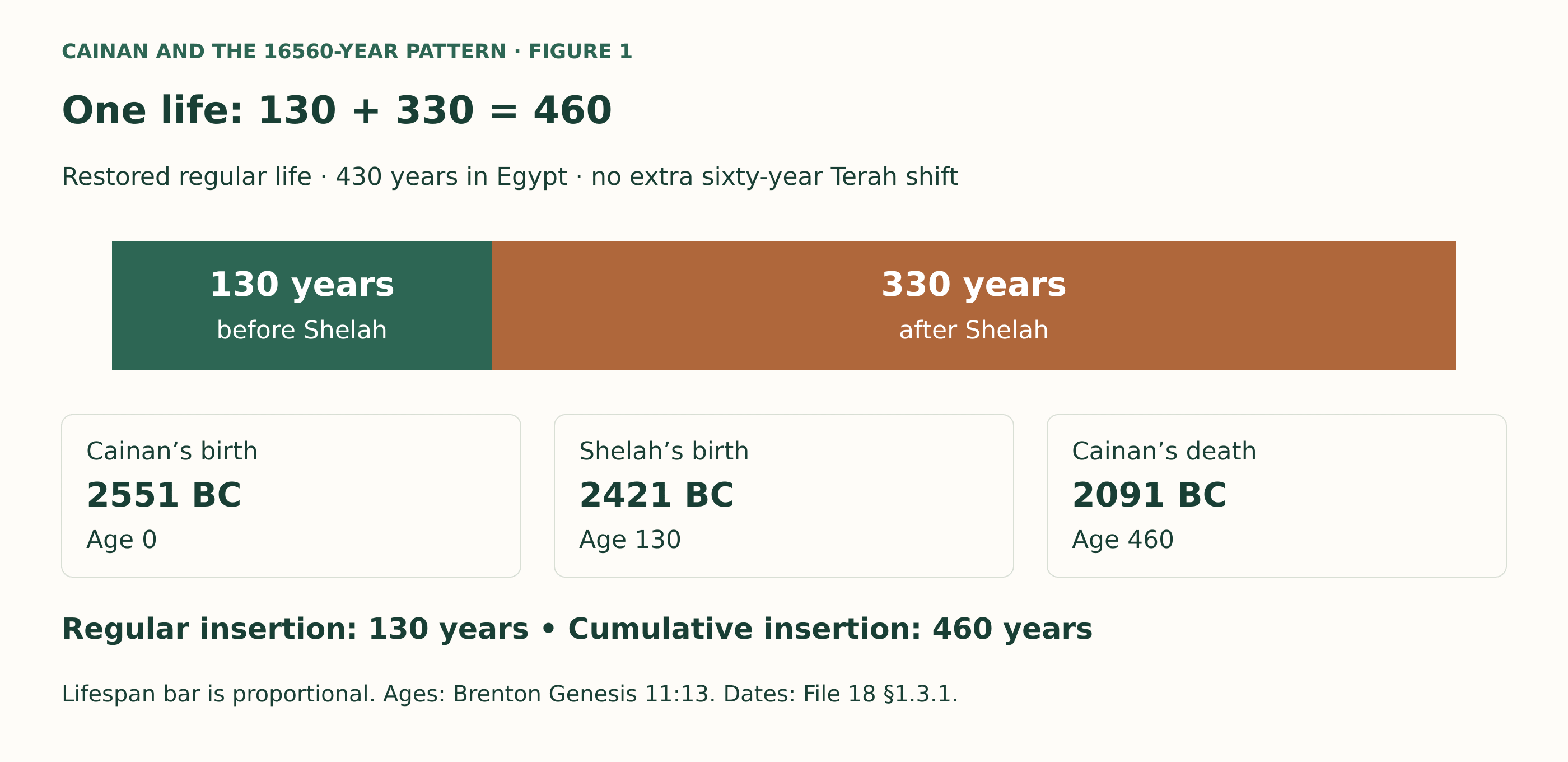
For the regular setting used here—430 years in Egypt, with no additional sixty-year Terah adjustment—the restored Cainan’s life is placed at 2551–2091 BC. Shelah’s birth at 2421 BC divides that life into 130 and 330 years. The BC dates come from the reconstructed chronology; Luke supplies the genealogical name, and Brenton’s Genesis supplies the age figures.
Cainan and the 16560-year pattern · Figure 1
One life: 130 + 330 = 460
The second Cainan: between Arphaxad and Shelah.
Regular insertion: 130 · Cumulative insertion: 460
Full supporting table · File 18 · File 22
View or download the image version of Figure 1
Full-size PNG · SVG source ZIP (all four figures and JSON data)
Figure 1 makes an important distinction visible. Cainan’s regular lifespan is still 460 years, even though the generation added to the regular birth sequence contributes 130. A lifespan and an adjustment to a sequence answer different questions. See the complete lifespan and operator tables.
What changes in the cumulative Creation framework?
In the cumulative chronology, adding a complete life moves the earlier dates back by 460 years, while the later framework remains fixed. The MT-based Creation envelope therefore changes from 14011–14004 BC to 14471–14464 BC.
An envelope is a span with distinct internal positions. Its opening, its Year 6 position, and its closing boundary must not all be called one “Creation date.” Each corresponding position moves by the same amount:
Cainan and the 16560-year pattern · Figure 2
Every corresponding position moves by 460
Cumulative MT-based framework; restored-Cainan comparison.
earlier in time
earlier in time
earlier in time
Base envelope: 14011–14004 BC
With Cainan: 14471–14464 BC
Full supporting table · File 09 · File 18
View or download the image version of Figure 2

Full-size PNG · SVG source ZIP (all four figures and JSON data)
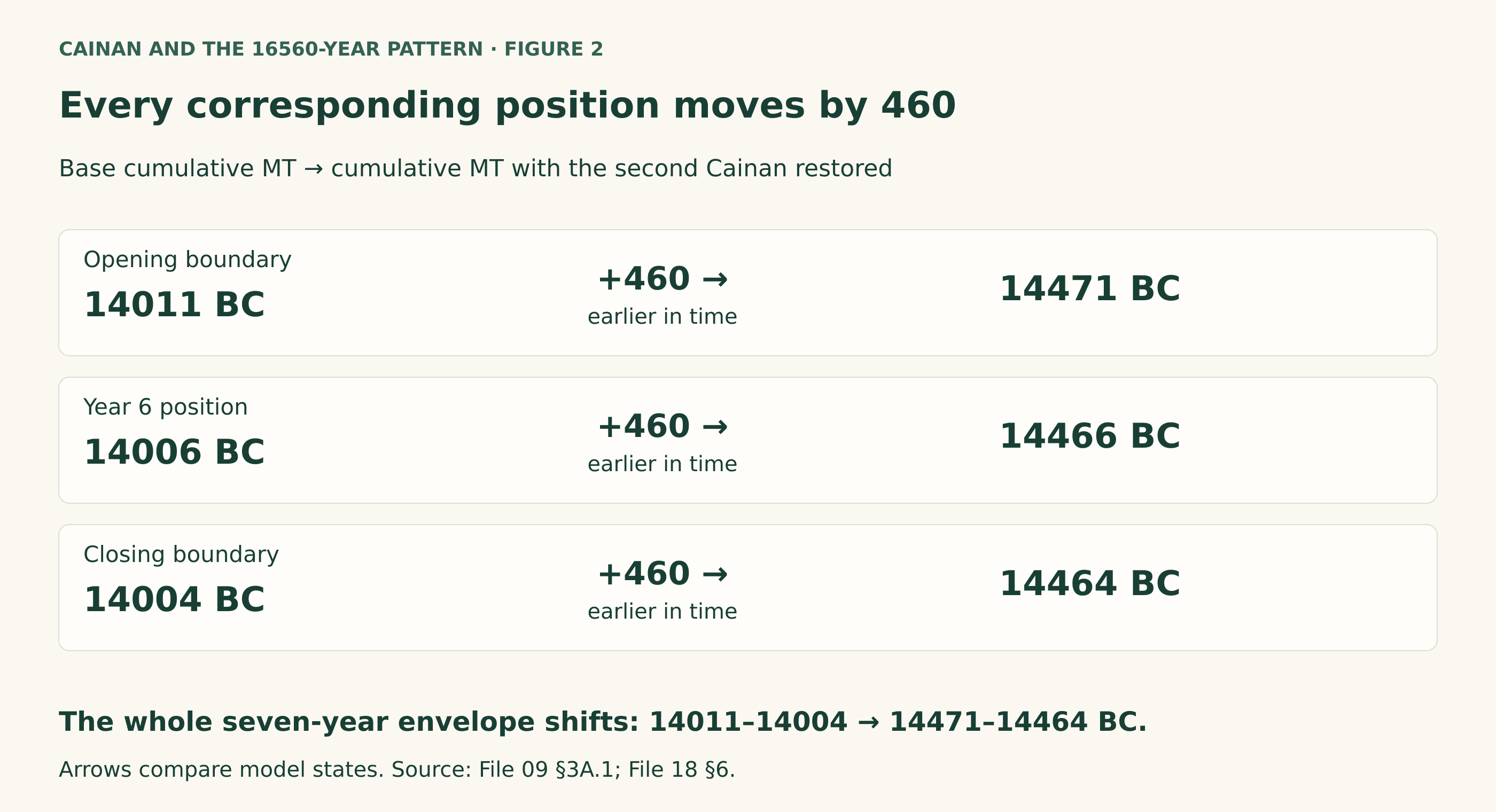
Thus the opening moves from 14011 to 14471 BC, the Year 6 position from 14006 to 14466 BC, and the closing boundary from 14004 to 14464 BC. All three differences are 460. These are cumulative coordinates; they do not replace the regular Creation dates used elsewhere on this site. The supporting table identifies every position shown.
This is the cumulative side of the relationship. The regular side supplies Cainan’s own 460-year life. The same measure now appears in two different roles: an inserted cumulative lifespan and the interval between regular birth and death.
Two spans of 16560 years
File 22 §6.1 gives the following two comparisons explicitly. The suffix n means Nisan, the spring setting:
| Regular starting point | AD comparison target | Civil calculation | Span |
|---|---|---|---|
| Cainan’s birth: 2551n BC | AD 14010n | 2551 + 14010 − 1 | 16560 |
| Cainan’s death: 2091n BC | AD 14470n | 2091 + 14470 − 1 | 16560 |
Both calculations use the ordinary civil rule BC number + AD number − 1. The subtraction of one accounts for the transition directly from 1 BC to AD 1, with no civil year zero.
Cainan and the 16560-year pattern · Figure 3
Both ends advance; the span stays the same
Canonical Mirror corroboration · n = Nisan (spring)
16560 = 23 × 720
Equal changes at both ends preserve the span.
Full supporting table · File 22 · File 09 · File 00
View or download the image version of Figure 3

Full-size PNG · SVG source ZIP (all four figures and JSON data)
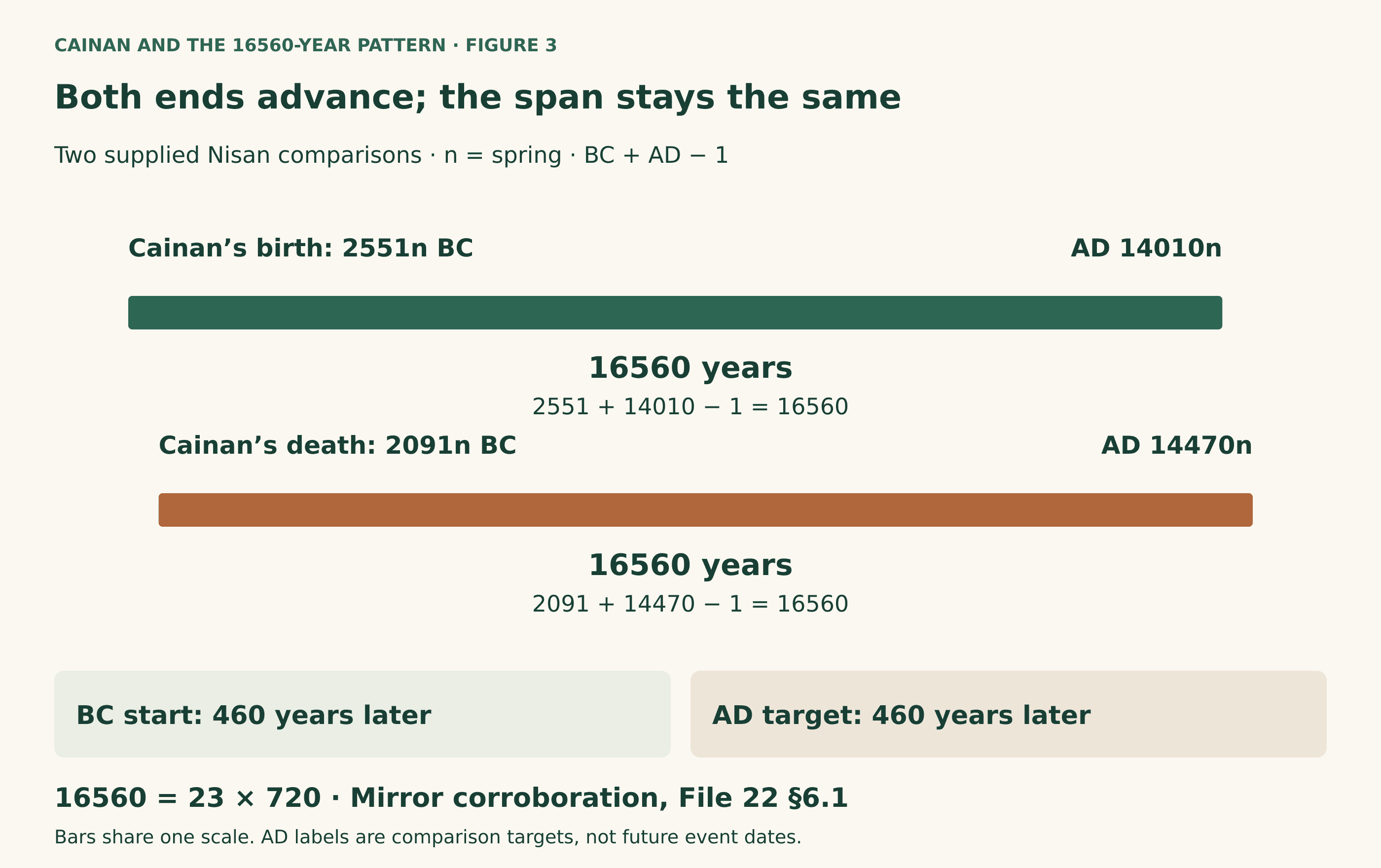
Read the two rows together. Cainan’s death in 2091 BC is 460 years later than his birth in 2551 BC. On the AD side, the second target, AD 14470, is likewise 460 years later than AD 14010. Both ends have advanced by the same interval, so the span remains unchanged:
(2551 − 460) + (14010 + 460) − 1 = 16560.
The common span also factors exactly as 23 × 720. File 22 calls these rows Mirror corroboration: they support the surrounding 460-year structure. Their AD endpoints are comparison coordinates, not forecasts of future historical events. Full calculations and endpoint classifications.
How to read the Mirror connection
The large AD target numbers have a recognizable relationship to the cumulative Creation openings. As an illustration using ordinary astronomical year numbers, 14011 BC is year −14010, and 14471 BC is year −14470. Reflecting those signed integers gives +14010 and +14470, printed AD 14010 and AD 14470.
That illustration explains the numerical correspondence. It does not, by itself, establish a month or season for the reflected points. This distinction matters: the introductory Mirror article separates reflection of year numbers from the more precise treatment of paired spring and autumn dates.
For the present pattern, the Nisan-tagged endpoints are retained exactly as supplied by File 22, and the two spans are checked with its civil arithmetic. We do not derive a new seasonal pair by subtracting one from every BC year label. The appendix compares the methods directly.
The two Cainan-to-target spans are also comparisons across the BC–AD boundary; neither row says that Cainan’s date is the direct reflection of its distant AD target. A span can reach a Mirror-related coordinate without its own endpoints being equally distant from the Mirror’s center.
The same 460-year life in two frameworks
The canon supplies a second, entirely BC relationship that helps explain why the 460-year measure matters. Selecting the stated lower members of the cumulative Cainan envelopes gives 4851–4391 BC. The regular restored life is 2551–2091 BC.
Each beginning and each ending are separated by 2300 years:
4851 − 2551 = 2300; 4391 − 2091 = 2300.
Both lives retain the same 460-year width, and 2300 = 5 × 460. This is a comparison between selected cumulative and regular coordinates. It does not merge the two methods into one historical biography. The appendix diagram shows both transfers.
The value of the pattern lies in these stated relationships. Cainan’s 130 years before Shelah and 330 afterward give a life of 460; the cumulative insertion moves corresponding Creation positions by 460; and the two canonical Mirror comparisons preserve an equal span of 16560. The arithmetic can be checked independently of its theological interpretation. Read within the genealogy’s larger story of continuity, the repeated measure offers a structural correspondence between different chronological frameworks. It does not establish why ancient scribes included or omitted a name.
Continue with the supporting tables and methodological appendix, or revisit the Second Cainan introduction for the underlying textual and chronological distinction.
For the full comparison and supporting calculations, see the detailed study.
Scripture quotations: Berean Standard Bible (BSB), public domain. The Genesis 11 quotation is from the public-domain Brenton Septuagint Translation. Scripture wording and number formatting are preserved; digit-based calculations are editorial prose.