This appendix accompanies “When Biblical Time Spans Meet: The Key of 23 in Action”. It records the exact spans and endpoint choices behind the introductory diagrams. The current canonical Markdown files govern the calculations; the detailed companion develops the fuller discussion under those controls.
The dates below have different functions. Regular dates belong to the selected chronology. Variant dates require stated additions. Schematic dates mark positions in an assigned genealogical arrangement. Generated dates are outputs of an expansion. A shared number does not erase those distinctions.
A. Complete endpoint ledger
Each expansion row identifies the original pair, the endpoint held fixed, the ratio, and the output. All lengths are years. “Backward” means toward an earlier date, which has a larger BC number.
| Original span | Setting | Fixed endpoint / direction | Exact expansion | Generated endpoint / status |
|---|---|---|---|---|
| 4114 → 1446 BC | Regular normal MT; no Terah/Cainan additions | Exodus 1446 BC; backward | 2668 × 25/23 = 2900 | 4346 BC; generated comparison head |
| 4304 → 1406 BC | Regular MT-based variant: +60 Terah, +130 restored second Cainan | Conquest 1406 BC; backward | 2898 × 70/69 = 2940 | 4346 BC; generated comparison head |
| 4836 → 6 BC | Schematic Luke-side 70-year positions | Birth hinge 6 BC; backward | 4830 × 70/69 = 4900 | 4906 BC; Jared opening boundary in selected model |
| 4836 → 6 BC | Schematic Luke-side 70-year positions | Birth hinge 6 BC; backward | 4830 × 25/23 = 5250 | 5256 BC; Adam opening boundary in selected model |
| 4836 → 6 BC | Same schematic input; earlier endpoint held | Enoch position 4836 BC; forward | 4830 × 70/69 = 4900 | AD 65; schematic Christ-generation closing boundary |
Download the endpoint ledger (CSV) · All study data with source hashes (JSON) (ZIP).
Rows using the same input are alternative applications. In particular, the two expansions of 4830 begin separately with the unexpanded span. No row authorizes multiplying their outputs by the other ratio.
B. The two paths to 4346 BC
The controlling calculation is File 22 §§9.1–9.4, supported by the regular chronology and variant definitions in File 18 §§1.6 and 2.1.2. The normal Creation endpoint is 4114 BC; the Exodus and Conquest anchors are 1446 BC and 1406 BC. Here 4114 BC is the completed Creation endpoint. Adam’s Year-6 coordinate, 4116 BC, is a distinct node and is not substituted into either input.
| Path / settings | Original span | Expansion | After expansion | Shared result |
|---|---|---|---|---|
| Standard MT path; Normal regular MT; standard/full Egypt Sojourn setting | 4114 − 1446 = 2668 | 2668 × 25/23 = 2900 | 2900 + 40 = 2940 | 4346 → 1406 BC = 2940 |
| Variant path; +60 Terah and +130 regular restored second Cainan | 4304 − 1406 = 2898 | 2898 × 70/69 = 2940 | No further extension | 4346 → 1406 BC = 2940 |
Download both paths (CSV) · Return to Figure 2.
There are two different increments: 2900 − 2668 = 232 and 2940 − 2898 = 42. The fact that both paths reach 4346 BC does not mean that their original lengths or their increases were equal.
The first path stops its multiplication at the Exodus. Its subsequent 40-year extension to the Conquest remains unscaled:
(4114 − 1446) × 25/23 + 40 = 2940
The second path expands the complete variant Creation-to-Conquest span:
(4304 − 1406) × 70/69 = 2940
Both yield 1406 + 2940 = 4346 BC. File 22 calls this generated head “Super-Creation.” The term identifies an expanded comparison coordinate; it does not establish an additional historical Creation event.
C. What the +60 and +130 additions mean
The first path uses the normal regular MT setting, with Creation at 4114 BC. The second opens two optional adjustments together:
| Component | Years | Role in this example |
|---|---|---|
| Normal regular MT Creation | 4114 BC | Starting chronology; retained in the first path |
| Terah adjustment | +60 | Optional older placement of the upstream genealogy |
| Restored second Cainan | +130 | Regular begetting-age contribution in the restored-Cainan variant |
| Variant Creation | 4304 BC | Input for the second path only |
The underlying distinction matters. Genesis 11:10–26 in the BSB, representing the MT sequence here, proceeds from Arphaxad to Shelah without a second Cainan. Luke 3:35–36, BSB, includes Cainan between them. The restored regular chronology uses the 130-year input in Brenton’s English Septuagint, Genesis 11, as controlled by File 18 §1.6.
This selective restoration does not turn the whole resulting chronology into an unmodified LXX chronology. Nor does it introduce the cumulative Cainan lifespan of 460 years. The present calculation is explicitly 4114 + 60 + 130. No Samaritan Pentateuch (SP) chronology is being calculated in these examples.
The Terah option compares a 70-year begetting setting with a 130-year setting. The latter harmonizes Terah’s 205-year life in Genesis 11:32, BSB, Abram’s departure at 75 in Genesis 12:4, BSB, and the departure after his father’s death in Acts 7:4, BSB: 205 − 75 = 130, and 130 − 70 = 60. Genesis 11:26 names Terah’s sons together; the 130-year placement is a harmonized chronological reading, not an age stated directly for Abram’s birth in that verse. File 18 §§1.1 and 1.3.1 controls the optional +60 setting and its upstream scope. It remains explicit beside 4304 BC here.
D. The 4830-year example and its named boundaries
These are boundaries of the selected 70-year genealogical display, measured from the fixed 6 BC hinge. They are not ordinary birth dates. Files 43 §3.4, 46 §4.2 and 54 §6 agree on the coordinates used here.
| Schematic boundary | BC coordinate | Operation | Span to 6 BC | 70-year units | Gain |
|---|---|---|---|---|---|
| Enoch opening | 4836 | Original input | 4830 | 69 | 0 |
| Jared opening | 4906 | 4830 × 70/69 | 4900 | 70 | 70 |
| Adam opening | 5256 | 4830 × 25/23 | 5250 | 75 | 420 |
Download the boundary table (CSV) · Return to Figure 3.
The input 4830 = 69 × 70 = 23 × 210 supports both exact divisions:
4830 × 70/69 = 4900
4830 × 25/23 = 5250
File 46 calls 4830 a solar-span input. It should not be relabeled as 4830 Enochian 364-day years. The ratios are exact operators in the model; physical calendar comparisons used to explain them elsewhere do not make them exact measurements of the astronomical year.
The displayed interval from Enoch’s position to the hinge contains 69 assigned 70-year units. The earlier Jared boundary adds one unit; the Adam boundary adds six. In Scripture, their relationships occur in Genesis 5:18–24, BSB and Luke 3:37–38, BSB. Those passages identify the people and relationships; the BC coordinates come from the specified numerical model.
E. The same length can have different placements
File 46 supplies both applications of 4830 × 70/69 = 4900. They agree in length while holding opposite ends of the original span.
| Held endpoint | Direction | Resulting placement | Elapsed-year check | Model meaning |
|---|---|---|---|---|
| Later: 6 BC | Backward | 4906 BC → 6 BC | 4906 − 6 = 4900 | Jared opening reached |
| Earlier: 4836 BC | Forward | 4836 BC → AD 65 | 4836 + 65 − 1 = 4900 | Christ-generation closing boundary reached |
Download the anchor comparison (CSV) · Return to Figure 4.
For the forward application, 4836 + 65 − 1 = 4900. The same no-year-zero rule gives 6 + 65 − 1 = 70 for the final schematic generation. AD 65 closes that assigned block; it is not a death date for Christ.
Crossing the era boundary is not, by itself, a Mirror operation. A formal reflection requires a separately specified coordinate rule. Here the operation is expansion followed by placement from a fixed endpoint. File 00 §§3.1 and 3.9 supplies the broader distinction.
F. Names, intervals and assigned blocks
The combined-span example below uses the particular counting state retained by File 43. An inventory of 76 figures has 75 intervals between its first and last names. Assigning one block to each figure instead gives 76 blocks. Both counts have a use, but they answer different questions.
| Counting state | Counted object | Units × 70 | Years | Input to 8050? |
|---|---|---|---|---|
| Luke intervals | Intervals between 76 figures in the active source inventory | 75 × 70 | 5250 | Included |
| Luke names-span | One assigned block per figure in the same inventory | 76 × 70 | 5320 | Excluded |
| Matthew birth-hinge span | Intervals in the undoubled 41-figure arrangement | 40 × 70 | 2800 | Included |
| Matthew carrier span | One assigned block per figure in that arrangement | 41 × 70 | 2870 | Excluded |
Download the counting states (CSV).
The 76-name Luke inventory is the active source-model selection, not a statement that every printed edition of Luke contains that same count. The BSB’s wording in Luke 3:33 includes Admin and Arni. The model’s single Ram entry must therefore be distinguished from the BSB’s Admin and Arni when counting the genealogy. Counting Jesus through Adam in this BSB edition gives 77 human figures; including God gives 78 entries. The model’s single Ram selection gives 76 human figures. Scripture quotations retain the BSB wording; no names have been silently changed to fit the model.
Likewise, Matthew’s 40-interval input belongs to the undoubled 41-figure arrangement used here. Matthew 1:17, BSB, states the three groups of fourteen, while the treatment of their shared boundaries requires its own counting convention. File 69 also analyzes a 42-slot Jeconiah-overlap arrangement. That later slot attribution does not replace the File 43 branch used for this calculation. File 43 §§2–5 · File 69’s count and boundary controls.
G. A combined span: 8050 becomes 8750
File 43 combines Luke’s 75 intervals with Matthew’s 40 intervals, assigning 70 years to each:
5250 + 2800 = 8050
8050 × 25/23 = 8750
8750 − 8050 = 700 = 10 × 70
Figure 5 · The Key of 23 in Action
Combining two genealogical spans
Luke’s interval count and Matthew’s birth-hinge span supply the locked inputs.
Intervals between names.
The specified birth-hinge span.
5250 + 2800 = 8050
8750 − 8050 = 700
Selected counts: Luke’s Ram-based 76-figure model; Matthew’s undoubled 41-figure arrangement. These are model counts, not an unmodified BSB inventory.
Keep the inputs distinct: Luke’s 5320 names-span and Matthew’s 2870 carrier-span do not replace 5250 and 2800 here.
Sources: File 43 §5: MirrorVolume 8050 and expansion 8750 · Counting inventory: names, intervals and assigned blocks.
Model and calculation details
File 43 distinguishes Luke’s 75 intervals at 70 years each, 5250, from a 76-name span of 5320. It also distinguishes Matthew’s birth-hinge 40 × 70 = 2800 from the carrier 41 × 70 = 2870. Only 5250 + 2800 enters the source’s MirrorVolume 8050. The 25/23 expansion gives 8750 and an increment 700. The terminology MirrorVolume names span provenance; it does not supply a formal Mirror-coordinate operation. No dated output endpoint is assigned in this figure. The count selection uses Luke’s Ram-based 76-figure model and Matthew’s undoubled 41-figure arrangement. The Luke inventory is not an unmodified count of the BSB edition.

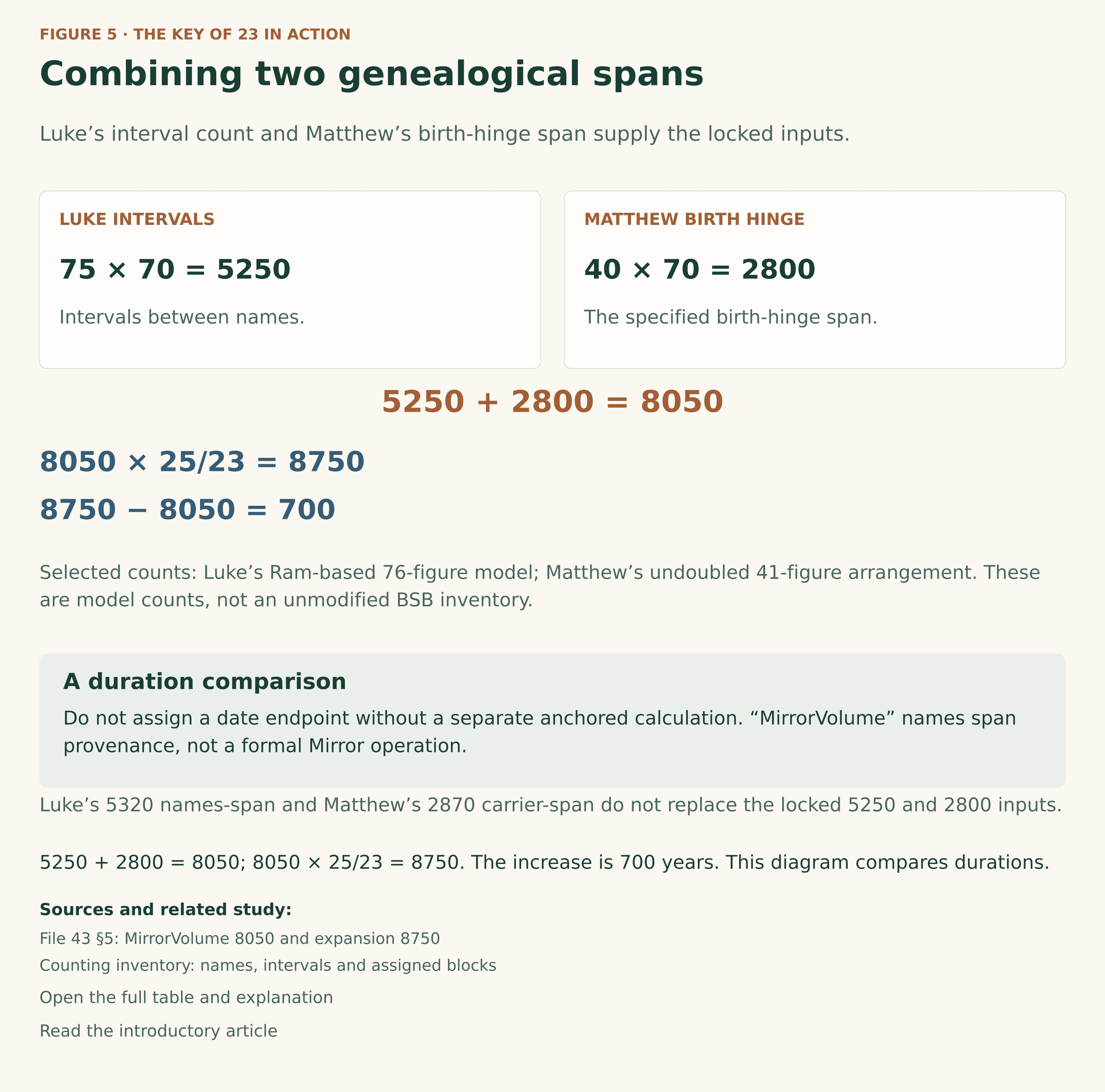
The 700 is the generated increase. It is not an independently supplied third input. Nor may 5320 replace 5250, or 2870 replace 2800, merely because those other counts also occur in the genealogical discussion.
No fixed endpoint is assigned to this addition and expansion. It therefore establishes a duration relationship, not a new date. File 43’s technical name “MirrorVolume” labels the provenance of the combined span; it does not activate coordinate reflection, the formal BC–AD Mirror, or digit reversal. Its associated theological interpretation remains distinct from the exact arithmetic. File 43 §5.
H. Source boundaries and omitted claims
The introductory selection keeps the calculations that can be displayed with their source settings intact. The detailed Strategic Overlaps study develops the fuller set of examples with their source settings and qualifications.
One significant boundary concerns 6900 → 7000 or 7500. Current File 22 §7.10 treats 6900 as the composite 4600 + 2300 in a restored-Cainan birth-transfer construction. That scalar relationship should not be redrawn as an ordinary Jared-to-Shem dated span using the legacy endpoints. Its component settings require their own explanation, so it is outside this introduction.
More generally, a divisible span does not authorize choosing any convenient ratio, anchor or textual variant. Each comparison needs its stated source setting. Numerical agreement can support a structural interpretation, but no statistical test of chance or proof of ancient authorial intention is supplied by these examples.
I. Person and event figure index
The index links each person or event to the relevant diagram and table. A Scripture link supplies narrative or genealogical context; it does not claim that the passage gives the calculated BC position.
| Person / event | Figure links | Scripture context | Classification / table |
|---|---|---|---|
| Creation | Figure 1; Figure 2 | Genesis 1:1, BSB | Completed Creation endpoint in the regular MT chronology; Figures 1 and 2; table 1, table 2 |
| Exodus | Figure 1; Figure 2 | Exodus 12:41, BSB | Fixed 1446 BC chronology anchor; table 1, table 2 |
| Wilderness period | Figure 2 | Numbers 14:33–34, BSB | Biblical 40-year wilderness duration added without scaling in Figure 2; not the generated 4346 BC head; table 2 |
| Conquest / Jordan crossing | Figure 2 | Joshua 4:19, BSB | Fixed 1406 BC chronology anchor; table 2 |
| Terah | Figure 2 | Genesis 11:26–32, BSB | Optional +60 setting in Figure 2; table 2 |
| Second Cainan | Figure 2 | Luke 3:35–36, BSB | Restored regular +130 setting in Figure 2; table 2 |
| Generated 4346 BC head | Figure 1; Figure 2 | Calculated boundary; no separate narrative event | Calculated comparison coordinate; no new historical event; table 1, table 2 |
| Enoch | Figure 3; Figure 4 | Genesis 5:21–24, BSB | Schematic 4836 BC position in Figures 3 and 4; table 3, table 4 |
| Jared | Figure 3; Figure 4 | Genesis 5:18–20, BSB | Schematic 4906 BC position in Figures 3 and 4; table 3, table 4 |
| Adam in Luke’s genealogy | Figure 3 | Luke 3:38, BSB | Schematic 5256 BC opening boundary in Figure 3; table 3 |
| Christ’s model birth hinge | Figure 3; Figure 4 | Luke 3:23, BSB | 6 BC retained as the selected model hinge; table 3, table 4 |
| AD 65 generation boundary | Figure 4 | Calculated boundary; no separate narrative event | Schematic end of the assigned Christ-generation block; not a death date; table 4 |
| Luke’s genealogy | Figure 5 | Luke 3:23–38, BSB | Selected 76-figure / 75-interval model; BSB inventory differs; table 5 |
| Matthew’s genealogy | Figure 5 | Matthew 1:1–17, BSB | Undoubled 41-figure / 40-interval model; table 5 |
Download the complete figure index (JSON) (ZIP).
J. Sources and downloads
| Source | Function in this study |
|---|---|
| File 00 | Exact ratios, fixed-endpoint method and distinction from formal Mirror |
| File 18 | Regular dates and the +60 Terah / +130 regular Cainan settings |
| File 22 §§9.1–9.4 | Two paths converging on 4346 BC; sixfold 490 interpretation |
| File 43 §§2–5 | Schematic genealogy, counted units and 8050 → 8750 |
| File 46 §§2.2 and 4.2 | Alternative placement and expansion of 4830 |
| File 54 §6 | Corroborating Jared, Enoch and Adam boundaries |
| File 69 | Later count-state controls preserving the selected File 43 relationships |
The publication package preserves full canonical captures, original source receipts, the complete official BSB text, relevant chapter captures, editable figures, machine-readable tables and the editorial record. Download all calculation data (JSON) (ZIP).
Scripture quotations: Berean Standard Bible (BSB), public domain.
Scripture references use the Berean Standard Bible (BSB), public domain, except where Brenton’s English Septuagint is explicitly identified. Brenton’s 1851 English Septuagint is public domain. No NET Scripture or translators’ notes are reproduced.