In keeping with the forty days you spied out the land, you shall bear your guilt forty years—a year for each day—and you will experience My alienation.
Numbers 14:34, Berean Standard Bible (BSB)
Forty days become forty years at a decisive moment in Israel’s journey. The spies have explored Canaan, the people have refused to enter, and the coming wilderness years answer the days of their reconnaissance. Here the relationship between days and years is part of the biblical explanation itself.
Moses’ life gives this pattern a larger setting. His 120 years divide into 40 + 40 + 40: his first forty years in Egypt, another forty before his commission to return, and forty leading Israel through the wilderness. The same number also appears in the Flood’s rain, Moses’ encounters with God on Sinai, and the purification laws. These repetitions invite comparison, provided we keep each event and each kind of evidence clear.
This introduction follows the site’s normal Masoretic Text (MT) chronology: 1446 BC for the Exodus and 1406 BC for Moses’ death and the opening of the Conquest, with 430 years in Egypt. BC dates are the chronological model’s coordinates; the biblical passages supply the ages, durations and narrative sequence. The supporting tables and notes give the sources and calculations.
1. Moses’ three forties
Stephen supplies the first two divisions. Moses was forty when he went to see his fellow Israelites; after his flight to Midian, another forty years passed before the encounter at the burning bush (Acts 7:23–30, BSB). Exodus places him at eighty when he and Aaron spoke to Pharaoh (Exodus 7:7, BSB). Stephen then describes his forty years of leadership in the wilderness (Acts 7:36, BSB). At death he was 120 (Deuteronomy 34:7, BSB).
Figure 1 · Moses and the Exodus
Moses’ life: three forties
Four model dates enclose three equal intervals. Scripture supplies the ages and narrative sequence.
1. Birth
1526 BC
Age 0
2. Age forty / Midian
1486 BC
Age 40
3. Exodus
1446 BC
Age 80
4. Death / Conquest opens
1406 BC
Age 120
Egypt40 years
Midian40 years
Wilderness
Sources: Acts 7:23–30 (BSB) · Acts 7:36 (BSB) · Exodus 7:7 (BSB) · Deuteronomy 34:7 (BSB) · File 55 §1.2.
Model and calculation details
Normal MT, Nisan default. 1526–1486–1446–1406 BC. The first forty ends in the age-forty visit and flight; Acts 7:30 supplies the next forty, and Acts 7:36 the wilderness forty. No precise day of birth or death is inferred.
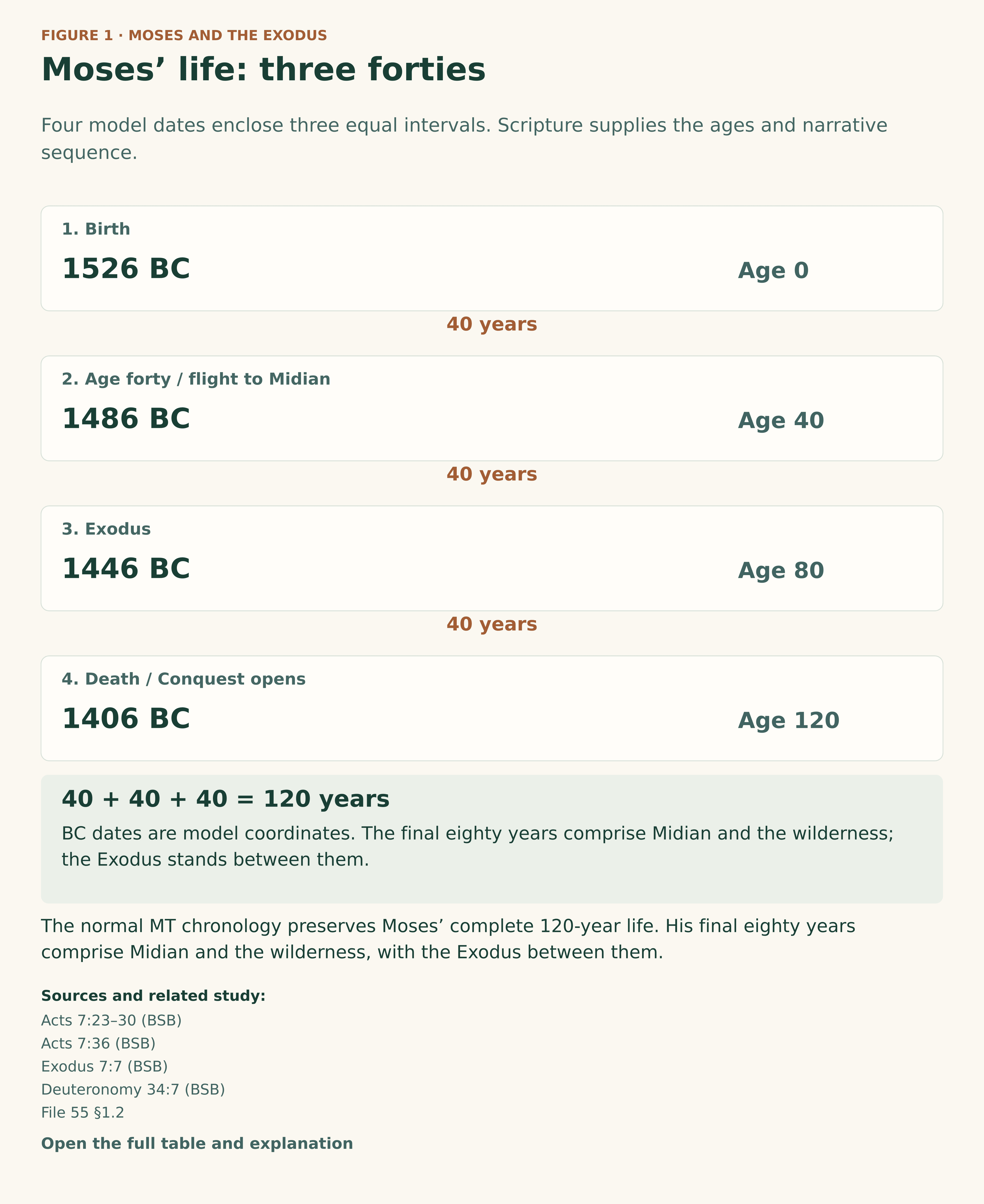
The dates follow by counting back from the model’s Exodus and Conquest anchors:
1526 → 1486 → 1446 → 1406 BC = 40 + 40 + 40 years.
The first interval ends in rejection and flight. The second ends in a renewed commission. The third carries Israel from slavery toward the promised land. The numerical form belongs to a biography with a clear movement: preparation, waiting and deliverance.
It also explains why the final eighty years matter. 1486 → 1446 → 1406 BC = 40 + 40. Moses’ preparation in Midian and Israel’s wilderness journey stand on either side of the Exodus. File 55 develops these three dates into a further mathematical method; its opening distinction is simple: selecting the final 80 years does not reduce Moses’ actual lifespan of 120 years.
2. When a day represents a year
Numbers 14:34 explicitly connects the spies’ 40 days with Israel’s 40 years. That is the strongest starting point for a day–year comparison. Ezekiel receives a related instruction: days of an enacted sign represent years of guilt (Ezekiel 4:4–6, BSB).
Other occurrences of forty have their own roles. The Flood’s rain lasts forty days and nights; Moses remains on Sinai for forty days and nights; the spies explore the land for forty days. Their shared number creates a field of testing, judgment and covenant encounter. The explicit conversion in Numbers concerns the spies and the wilderness sentence. Extending it to another event is a further symbolic reading that needs its own explanation.
Figure 2 · Moses and the Exodus
The same number, distinct events
Shared forty-day durations invite comparison; Numbers explicitly assigns forty years to the spies’ forty days.
Repeated narrative durations
Flood rainfall
40 days and nights
Genesis 7:12
Moses on Sinai
40 days and nights
Exodus 24:18
Explicit day–year correspondence · Numbers 14:34
Spies: 40 days
↓ a year assigned for each day ↓
Wilderness: 40 years
Sources: Genesis 7:12 (BSB) · Exodus 24:18 (BSB) · Numbers 13:25 (BSB) · Numbers 14:34 (BSB).
Model and calculation details
Genesis 7:12 refers to rainfall, not the full Flood duration. Exodus 24:18 refers to a mountain stay, not a complete harmonized Sinai schedule. Numbers 13:25 states the reconnaissance duration; Numbers 14:34 explicitly relates it to years.
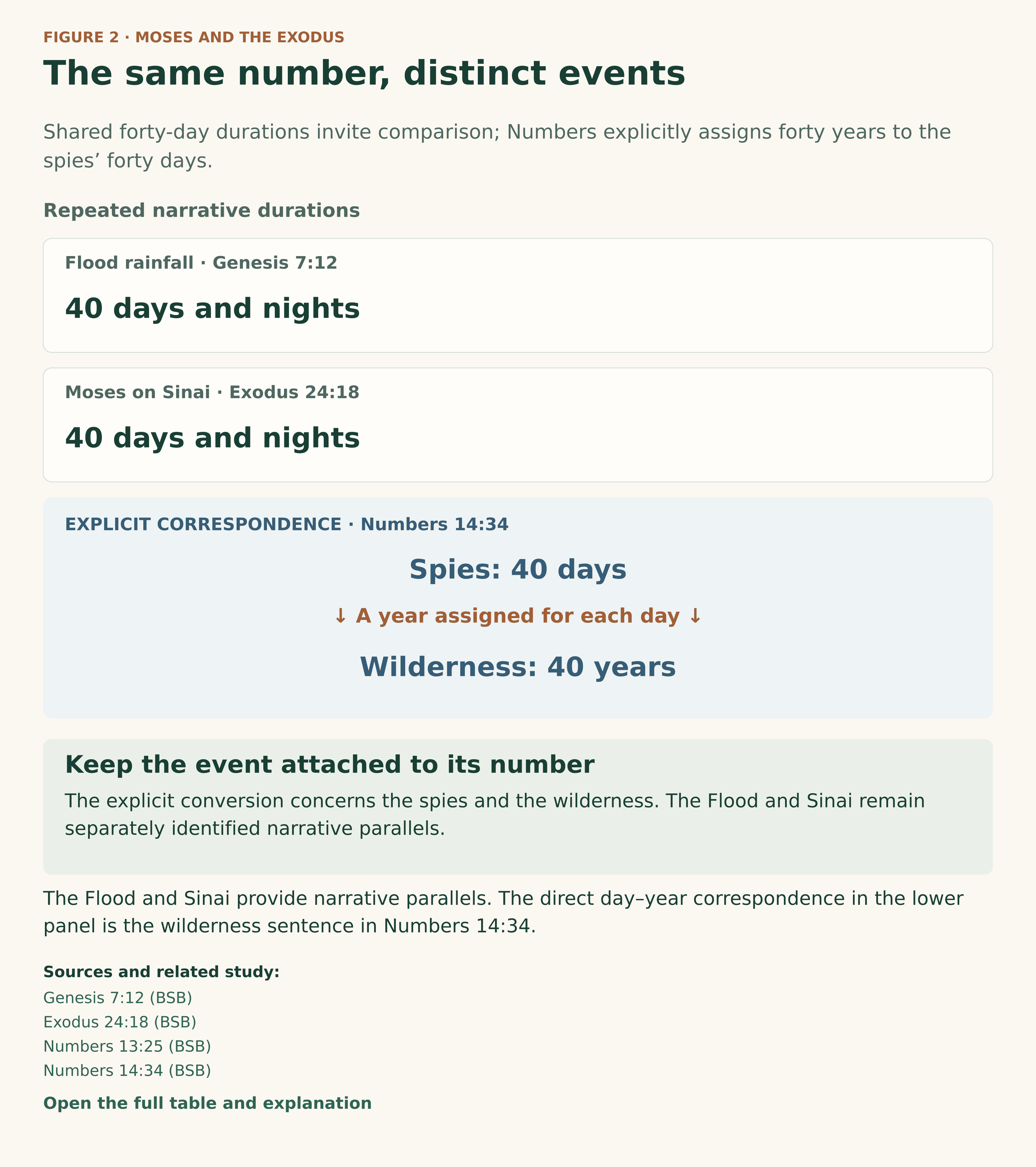
The wilderness forty should be read as the whole Exodus-to-entry era. The reconnaissance belongs after the second-year departure from Sinai. Deuteronomy separately counts 38 years from Kadesh-barnea to the crossing of the Brook of Zered (Deuteronomy 2:14, BSB). We therefore retain the model’s 1446–1406 BC frame; we do not add a fresh forty-year block after the second year.
3. The 390 + 40 comparison
One of the clearest numerical comparisons connects Moses’ second forty with the Egyptian sojourn. In the normal MT model, Jacob’s household enters Egypt in 1876 BC, Moses flees in 1486 BC, and the Exodus follows in 1446 BC. The resulting partition is:
1876 − 1486 = 390 years
1486 − 1446 = 40 years
390 + 40 = 430 years.
The final forty years of Israel’s stay in Egypt thus coincide with Moses’ forty-year Midian period in the model. The total follows the MT reading of the Egyptian sojourn in Exodus 12:40–41, BSB.
Ezekiel’s MT sign has the same numerical anatomy: 390 days for Israel followed by 40 days for Judah, with the days assigned to years. The repeated 390 + 40 = 430 is exact. Identifying Ezekiel’s two burdens with these two Egyptian periods is a comparative interpretation; Ezekiel does not identify his 390-year burden as the interval from Jacob’s arrival to Moses’ flight.
Figure 3 · Moses and the Exodus
A shared 390 + 40 structure
MT Ezekiel’s sign-days and the normal MT Egyptian-sojourn model retain separate units and contexts.
MT sign · days
390 + 40 = 430 days
Normal Egypt model · years
390 + 40 = 430 years
Sources: Ezekiel 4:5–6 (BSB) · Exodus 12:40–41 (BSB) · File 17 §16.2 · File 18 §§2.3–2.4.
Model and calculation details
Ezekiel 4:5–6 (MT / BSB): 390 days for Israel, then 40 for Judah. Normal Egypt-only 430 model: 1876–1486=390; 1486–1446=40. Ezekiel does not identify his burden-years with these Egyptian segments. Septuagint (LXX) and Samaritan Pentateuch (SP) alternatives are not combined here.
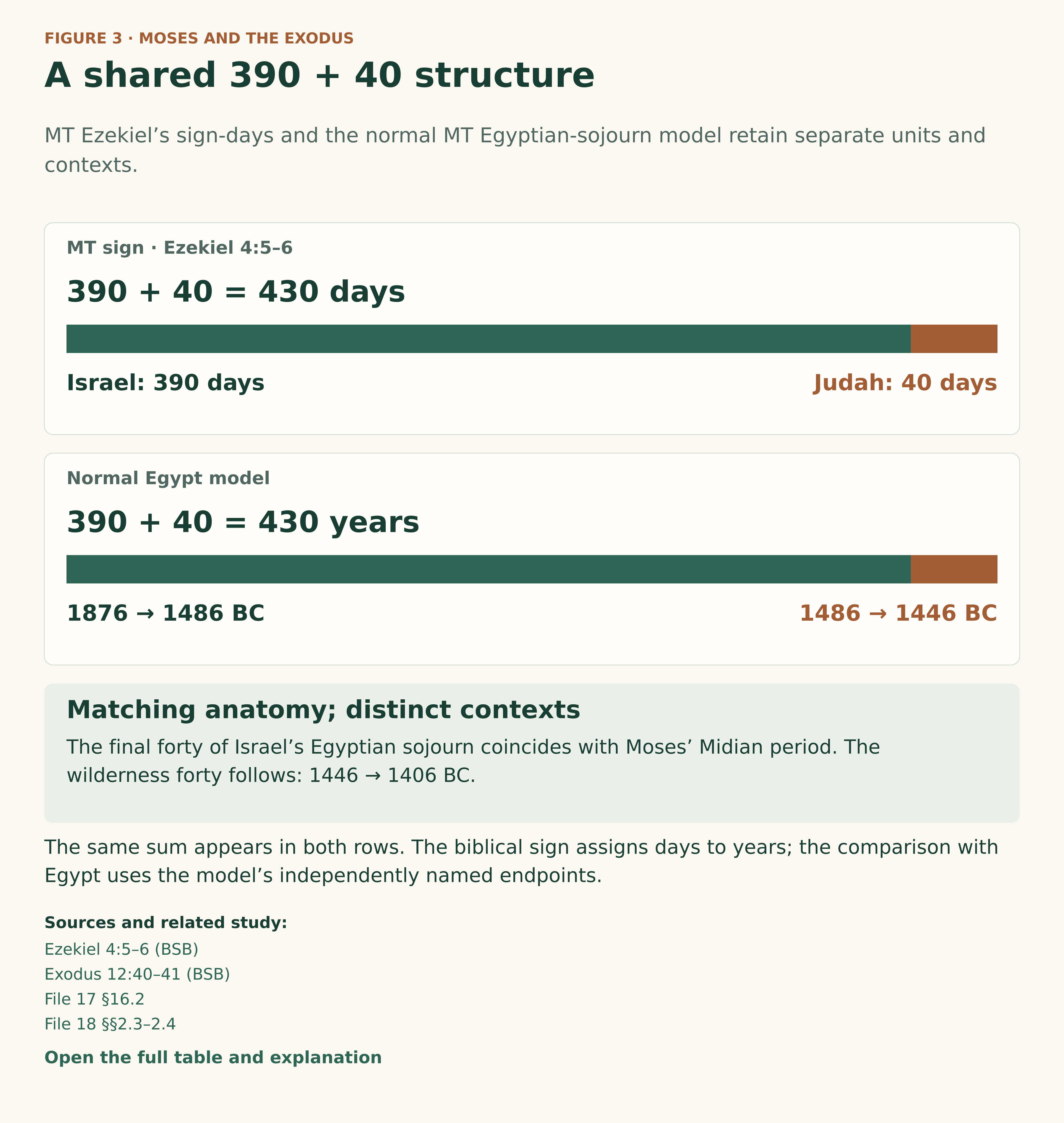
This is why the labels matter. One row describes an enacted prophetic sign in days; the other describes years in the Exodus chronology. The comparison retains both contexts. It also retains the MT setting: the Samaritan Pentateuch (SP) and Septuagint (LXX) sojourn readings and the LXX Ezekiel figures require their own calculations and are not silently inserted into this diagram.
4. Forty and eighty in the purification laws
Leviticus 12 supplies another explicit numerical structure. After the birth of a son, the initial seven days and the following thirty-three days total 40. After the birth of a daughter, two weeks and sixty-six days total 80 (Leviticus 12:2–5, BSB). In calculation form:
7 + 33 = 40 days; 14 + 66 = 80 days.
File 14 places this pattern alongside Moses’ final eighty years: forty in Midian and forty in the wilderness. The arithmetic is shared; the application is typological. Leviticus gives ritual periods after childbirth, while the chronology reads Israel’s deliverance and preparation for the land through the imagery of birth. That imagery has a biblical foundation in God’s designation of Israel as His firstborn son (Exodus 4:22, BSB).
Figure 4 · Moses and the Exodus
Forty and eighty: law and chronology
The day totals come from Leviticus; their application to Moses and Israel is a typological comparison.
BIBLICAL DAY TOTALS · Leviticus 12
Son’s birth
7 + 33 = 40 days
Daughter’s birth
14 + 66 = 80 days
Typological comparison · File 14 §2.3
CHRONOLOGICAL MODEL · years
40 + 40 = 80 years
Midian1446 → 1406 BC
Wilderness
The bars compare numerical totals on an 80-unit scale: days in the law rows, years in the chronology row.
Sources: Leviticus 12:2–5 (BSB) · Exodus 4:22 (BSB) · File 14 §§2.1–2.3.
Model and calculation details
The initial and subsequent legal periods are distinct. 7+33=40 days; 14+66=80 days. Moses’ final eighty years: 1486–1446–1406 BC. This is a birth/purification analogy, not a claim that Leviticus dates these events or directly commands this year conversion. The bars compare numerical totals on an 80-unit scale: days in the law rows, years in the chronology row.
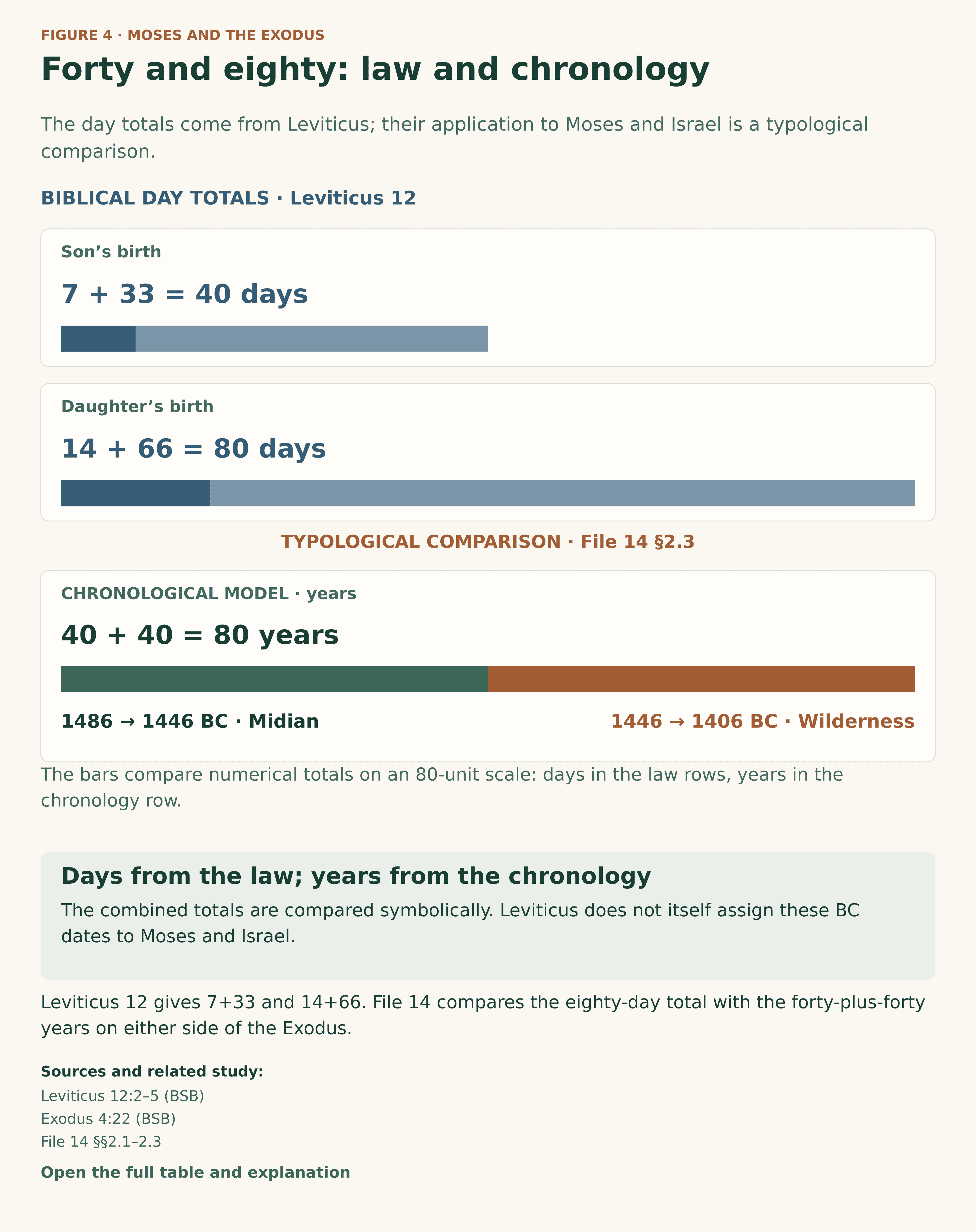
The law does not itself turn these days into the dates 1486, 1446 and 1406 BC. Those dates come from the chronology; the purification pattern supplies an interpretive comparison. The 40 + 40 division preserves the Exodus as the central event between Moses’ preparation and Israel’s wilderness formation.
5. A narrative date is not yet a day count
Some events have explicit month-and-day dates. The Exodus begins on the fifteenth day of the first month; the tabernacle is erected on the first day of the first month of the second year; the cloud lifts on the twentieth day of the second month of that year (Numbers 33:3, Exodus 40:17, Numbers 10:11, BSB).
Turning those dates into elapsed days requires a calendar. With a stipulated year of 12 × 30 = 360 days, and the start of the first year as the origin, the tabernacle date is 360 completed days later. It is also the start of day 361 when days are numbered from 1. A numbered day and a completed-day count differ by one.
The same convention places the departure from Sinai at 409 completed days, or day 410. This is a calculation under a stated calendar assumption. It is not a claim that the narrative independently establishes twelve thirty-day months for the historical year. Figure 5 and the conversion table show every step.
The spies’ mission is different: Numbers gives its forty-day duration but no month-and-day date for its beginning or end. Likewise, the Sinai passages record forty-day periods without supplying a complete dated schedule of every ascent, descent and intercession. Exact placements for these events need additional reconstruction. They do not carry the argument of this introduction.
6. From the Flood to the promised land
Noah and Moses bring the numerical comparisons into a common narrative setting. Noah’s ark preserves life through the Flood; Moses’ basket preserves the future deliverer from the threat surrounding the Nile (Genesis 6:14; Exodus 2:3, BSB). Forty days appear in the Flood and at Sinai. The New Testament also interprets both Noah’s deliverance and Israel’s passage through the sea through baptismal imagery (1 Peter 3:20–21; 1 Corinthians 10:1–2, BSB).
These connections make the Flood and Exodus fruitful bookends for comparison: rescue through water, judgment, covenant and a new beginning. Moses’ death marks the transition to Joshua and entry into the land; it is not the completion of the entire conquest or the later rest from war.
The most secure numerical foundation remains visible throughout: 40 days and 40 years in Numbers, 40 + 40 + 40 in Moses’ life, and the explicitly labelled comparisons 390 + 40 and 40 + 40. Calendar reconstructions and further symbolic projections can then be considered on their own stated terms. The pattern gains clarity when each number keeps its source, unit and place in the narrative.
Continue with the tables, calculations and source notes. Continue with the detailed study, The Mosaic Bookend to the Flood, for the expanded calendar tables and canonical comparison.
Passage links identify the translation. Dates, calculations and diagrams are analytical presentations, not additional Scripture quotations.
Scripture quotations: Berean Standard Bible (BSB), public domain.