Ezekiel makes the weight of Israel’s history visible. Beside a model of besieged Jerusalem, the prophet is instructed to lie on his left side for Israel and then on his right side for Judah. The days of his sign represent years of the people’s iniquity:
For I have assigned to you 390 days, according to the number of years of their iniquity. So you shall bear the iniquity of the house of Israel.
When you have completed these days, lie down again, but on your right side, and bear the iniquity of the house of Judah. I have assigned to you 40 days, a day for each year.
Here the relationship between days and years is stated in the text itself. 390 days for Israel and 40 days for Judah give a combined 430-day sign. Time becomes something the prophet bears before the exiles: the accumulated burden of a history that has brought Jerusalem under judgment.
This study follows the Masoretic Text (MT) numbers represented in the BSB. We begin with that explicit sign, then follow a numerical relationship within Ezekiel’s dated visions. The diagrams distinguish the biblical dates from the calendar models used to compare them.
Supporting tables: The 390 and 40 · Ezekiel’s two dates · The 2700 and 2730 calculations · The comparison with Daniel.
The days Ezekiel bears
The scene begins with a brick bearing the outline of Jerusalem. Ezekiel sets up siegeworks around it and places an iron plate between himself and the city. His posture belongs to this acted prophecy: the threatened siege has a moral history behind it (Ezekiel 4:1–7).
The two sides retain their identities. Israel receives 390; Judah receives 40. Their sum is useful, but it should not make the separate burdens disappear.
Ezekiel’s 430 Days · Figure 1
One day for each year
Ezekiel’s two actions represent the years assigned to Israel and Judah.
Israel
390days of the signJudah
40days of the signEzekiel 4:4–6 supplies the day-for-a-year instruction. The two cards are schematic, not proportional to the durations.
Image version, description, and full-size downloads
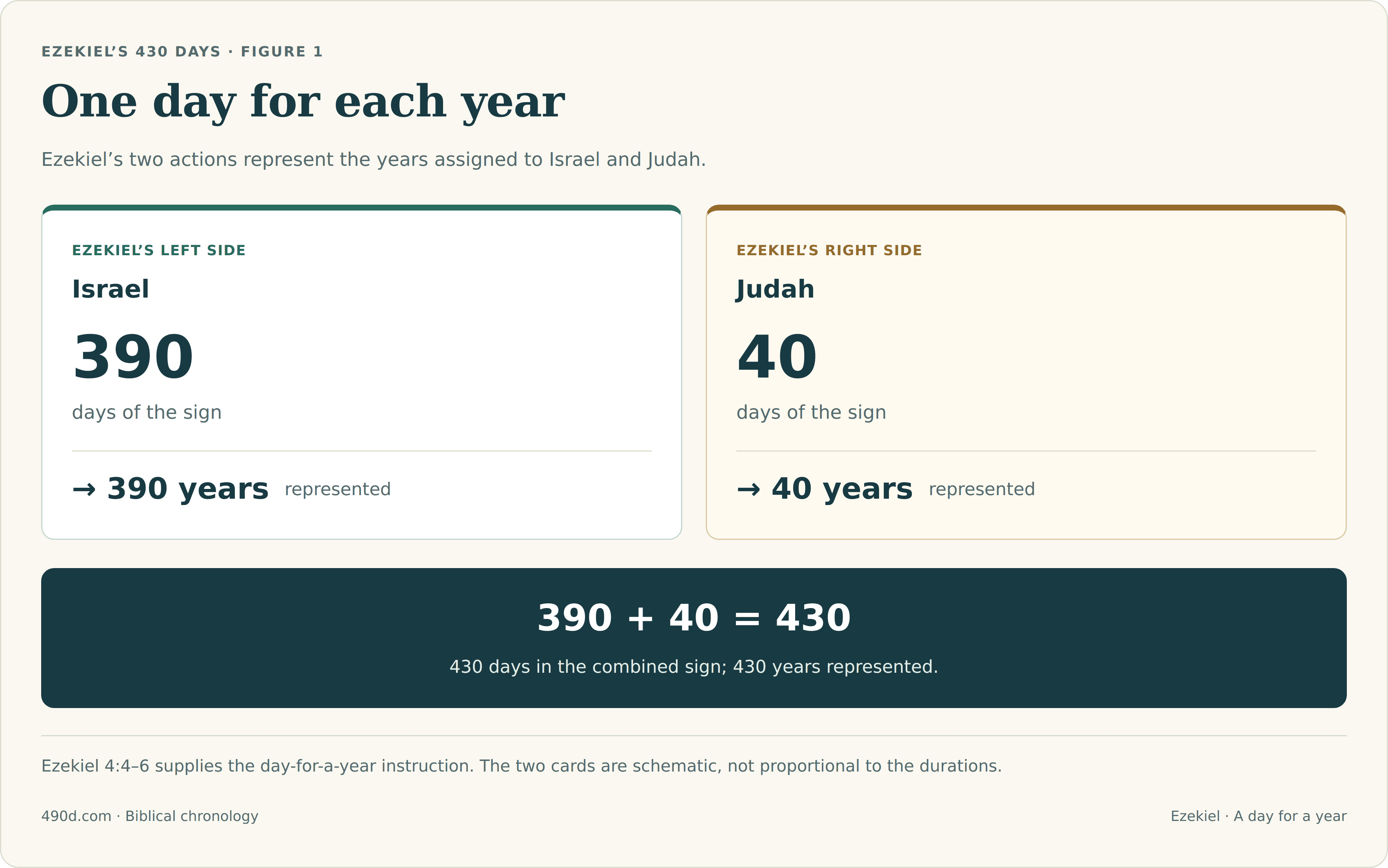
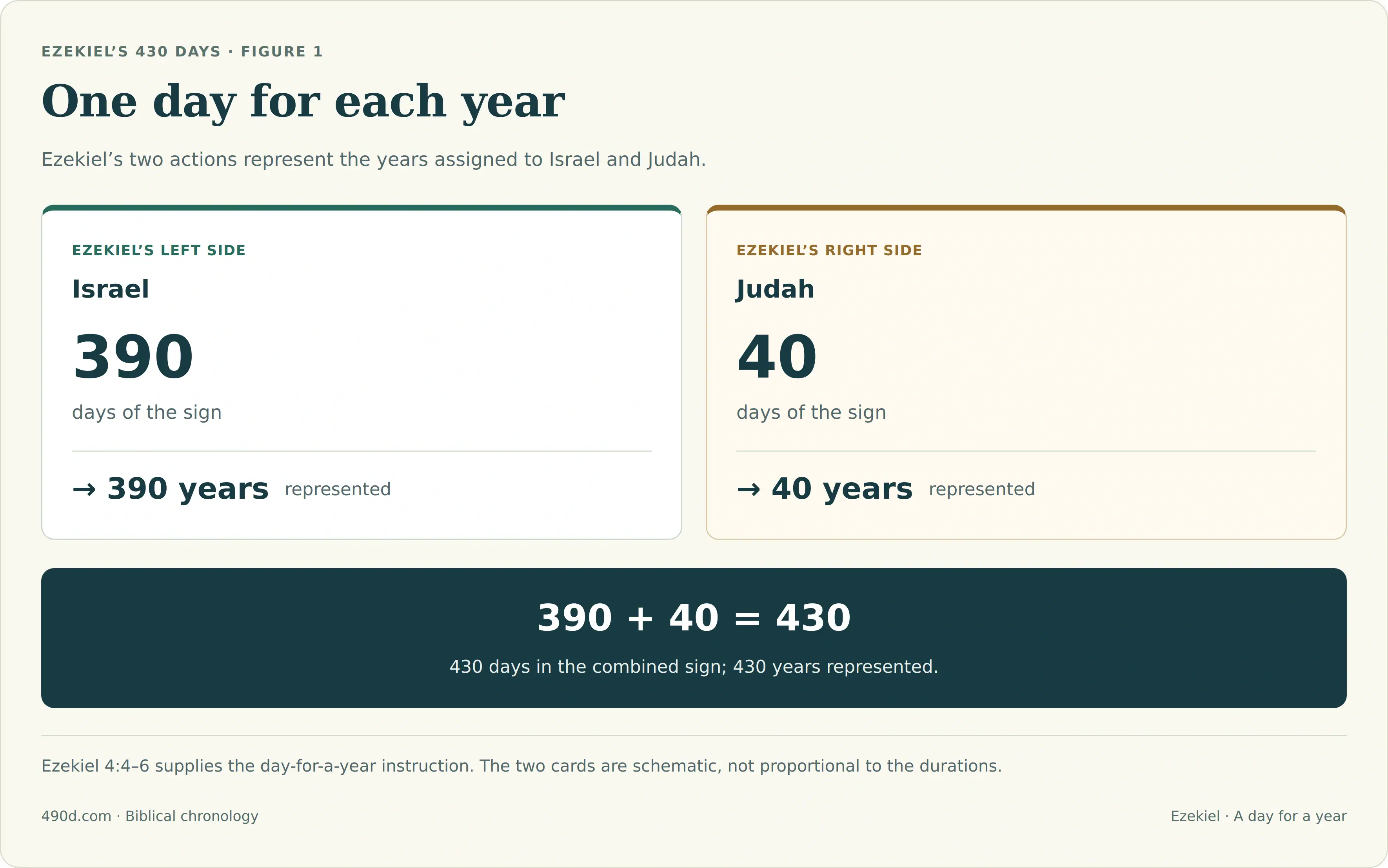
Ezekiel’s left-side action is associated with Israel: 390 days represent 390 years. His right-side action is associated with Judah: 40 days represent 40 years. Adding the two yields 430 days in the sign and 430 represented years. Ezekiel 4:4–6 states the day-for-a-year instruction. Card sizes are schematic, not proportional to duration.
The total also recalls another familiar biblical period: the 430 years of Israel’s residence in Egypt in Exodus 12:40–41. There, the period ends in deliverance. Here, a sign concerning Israel and Judah faces Jerusalem’s siege. The repeated number invites us to read the histories together—bondage, deliverance, covenant, and judgment—while allowing each passage to retain its own setting. The sojourn article explains the Egypt-only MT framework.
Ezekiel’s sign gives us a clear starting principle: a small, enacted period can represent a much longer history. It does not, by itself, identify the first and last historical years of every part of that burden. The following comparison therefore starts with something directly checkable: two dates printed in Ezekiel’s own narrative.
From the opening vision to the news from Jerusalem
Ezekiel’s opening vision is dated to the 5th day of the 4th month, in the 5th year of King Jehoiachin’s exile (Ezekiel 1:1–3). Much later, a fugitive brings the news:
In the twelfth year of our exile, on the fifth day of the tenth month, a fugitive from Jerusalem came to me and reported, “The city has been taken!”
The matching day of the month makes the comparison especially clear. From year 5, month 4, day 5 to year 12, month 10, day 5 is seven years and six months in the dated sequence. The endpoint is the arrival of the report, which must be distinguished from the earlier fall of the city.
To display the interval numerically, use a schematic year of 360 days, arranged as twelve 30-day months:
7 × 360 + 6 × 30 = 2520 + 180 = 2700 days.
Ezekiel’s 430 Days · Figure 2
From Ezekiel’s call to the report
The dates use the years of Jehoiachin’s exile. The middle marker simply makes the count visible.
Ezekiel’s call vision
Year 5Month 4 · Day 5Seven-year mark
Year 12Month 4 · Day 5Not a separately dated biblical event
The fugitive’s report
Year 12Month 10 · Day 5The endpoint is the arrival of news, not the date Jerusalem fell. The 2700-day total uses 30-day months and 360-day years. No leap month has been added in this calculation. Node spacing is schematic.
Image version, description, and full-size downloads
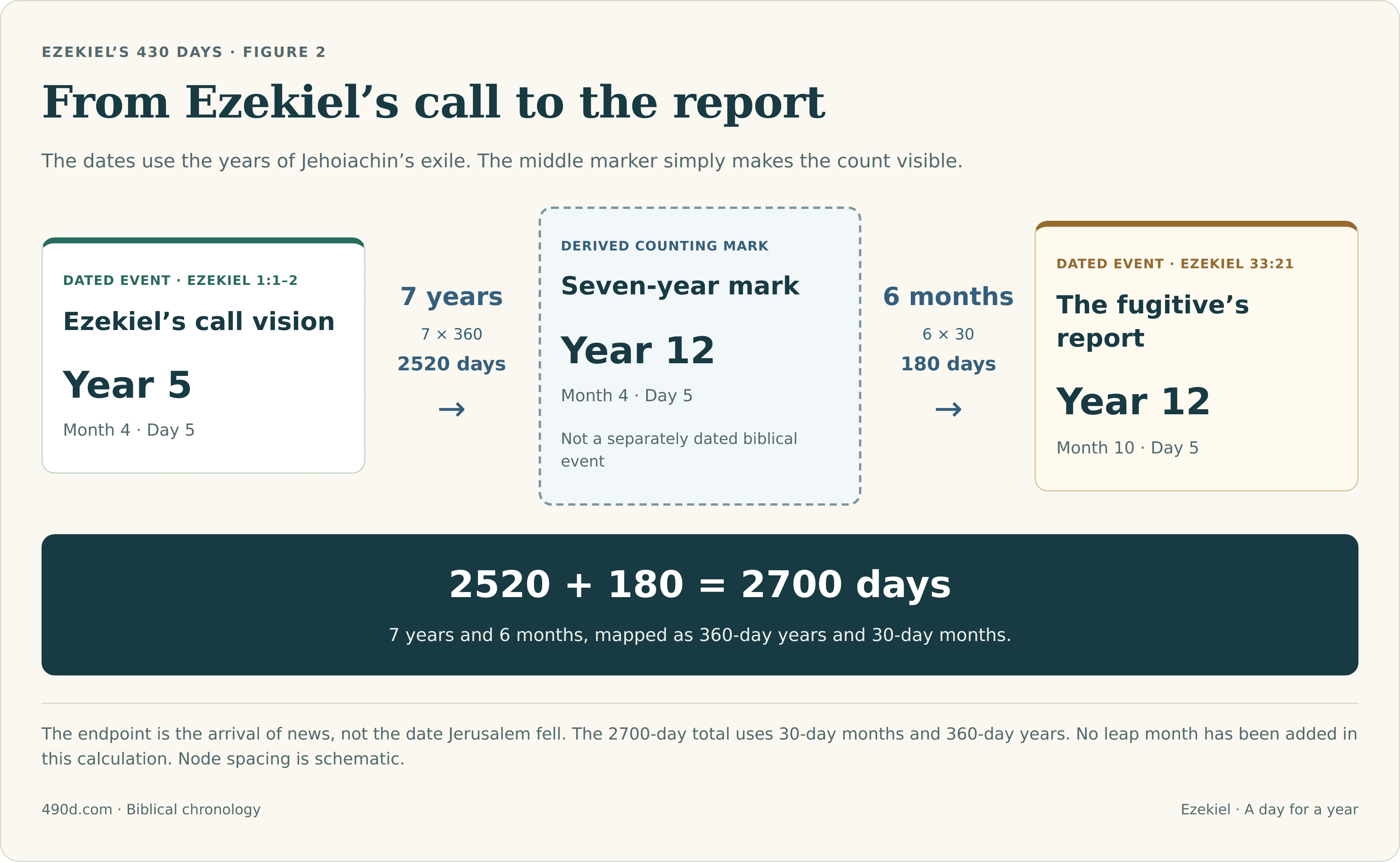
Start: Ezekiel’s call vision, fifth year of Jehoiachin’s exile, fourth month, fifth day, as dated in Ezekiel 1:1–2. A derived counting mark at the twelfth year, fourth month, fifth day completes seven years. It is not a separately dated biblical event. Seven years times 360 days equals 2520. Six further months, each mapped as 30 days, add 180 days. Endpoint: arrival of the fugitive’s report in exile year 12, month 10, day 5, in Ezekiel 33:21. The complete mapped interval is 2520 + 180 = 2700 days. The endpoint dates the report’s arrival, not the fall of Jerusalem. No leap month is added here. Node spacing is schematic.
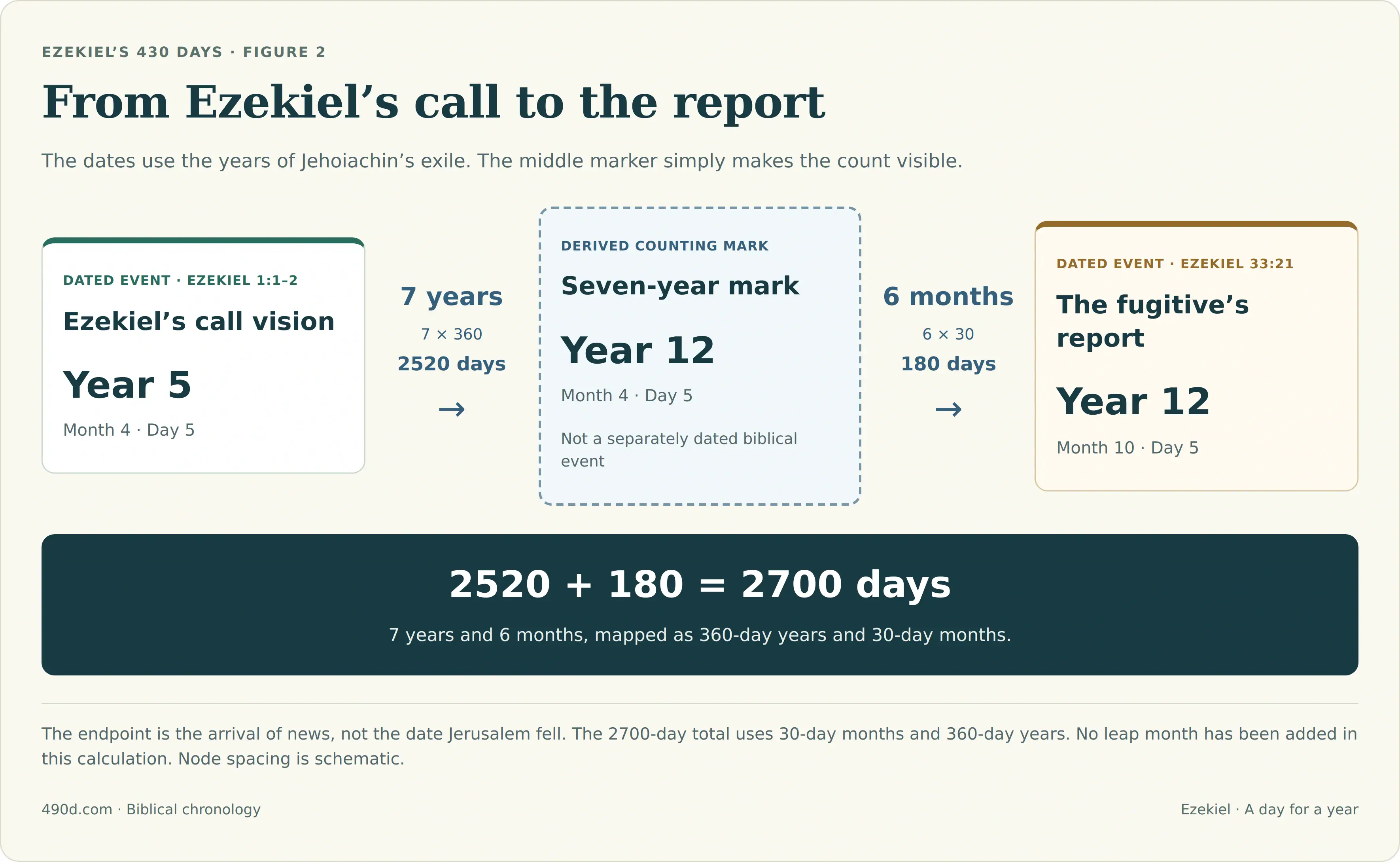
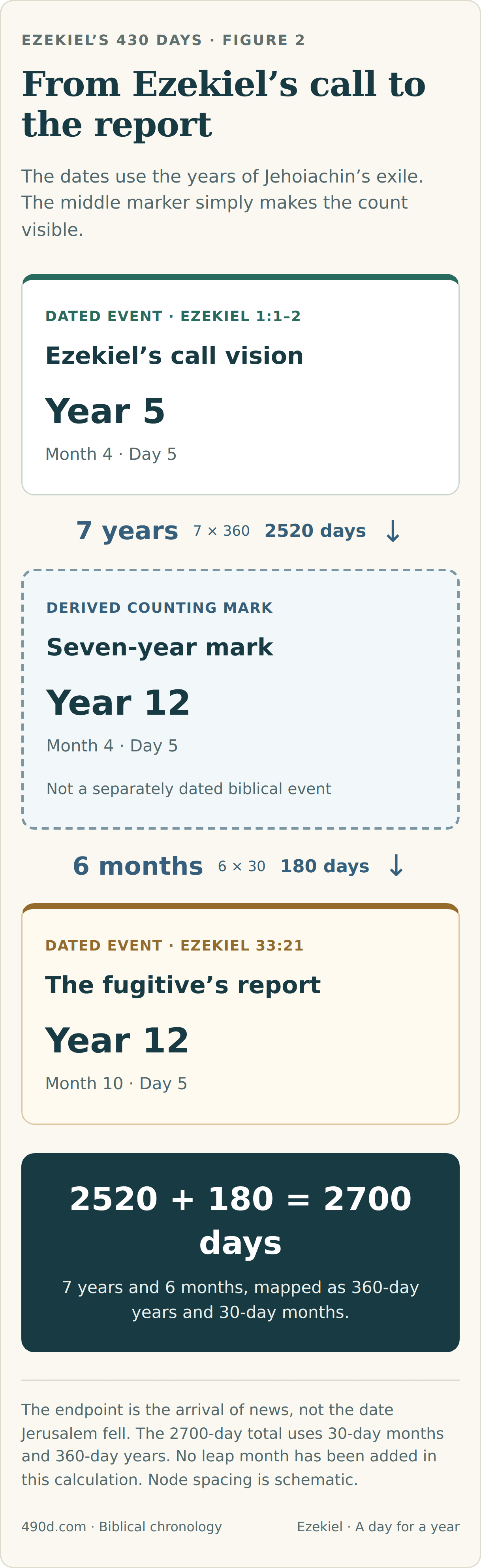
This is a declared calendar calculation. The dates come from Scripture; the uniform 30-day month supplies the measuring rule. Readers can therefore see precisely how the total is reached without mistaking a schematic year for a reconstruction of every historical month.
Two ways to display 2730
The canonical study develops two related readings of this seven-and-a-half-year interval.
In its 360-day scheme, the model counts one intercalation point within the selected interval. A single 30-day leap month is added:
2700 + 30 = 2730 days.
The second reading measures the same numerical length of 7.5 years using a 364-day year:
7.5 × 364 = 2730 days.
Ezekiel’s 430 Days · Figure 3
Two readings of 2730
The same numerical total can be reached through two distinct calendar models.
360-day scheme + one declared leap month
The 2700-day mapping receives an explicitly added 30-day month.
364-day comparison
Seven and a half schematic years are each counted as 364 days.
The extra month in Model A is a declared assumption of that reading. Model B is a separate 364-day comparison, not the same calculation with different wording.
Image version, description, and full-size downloads
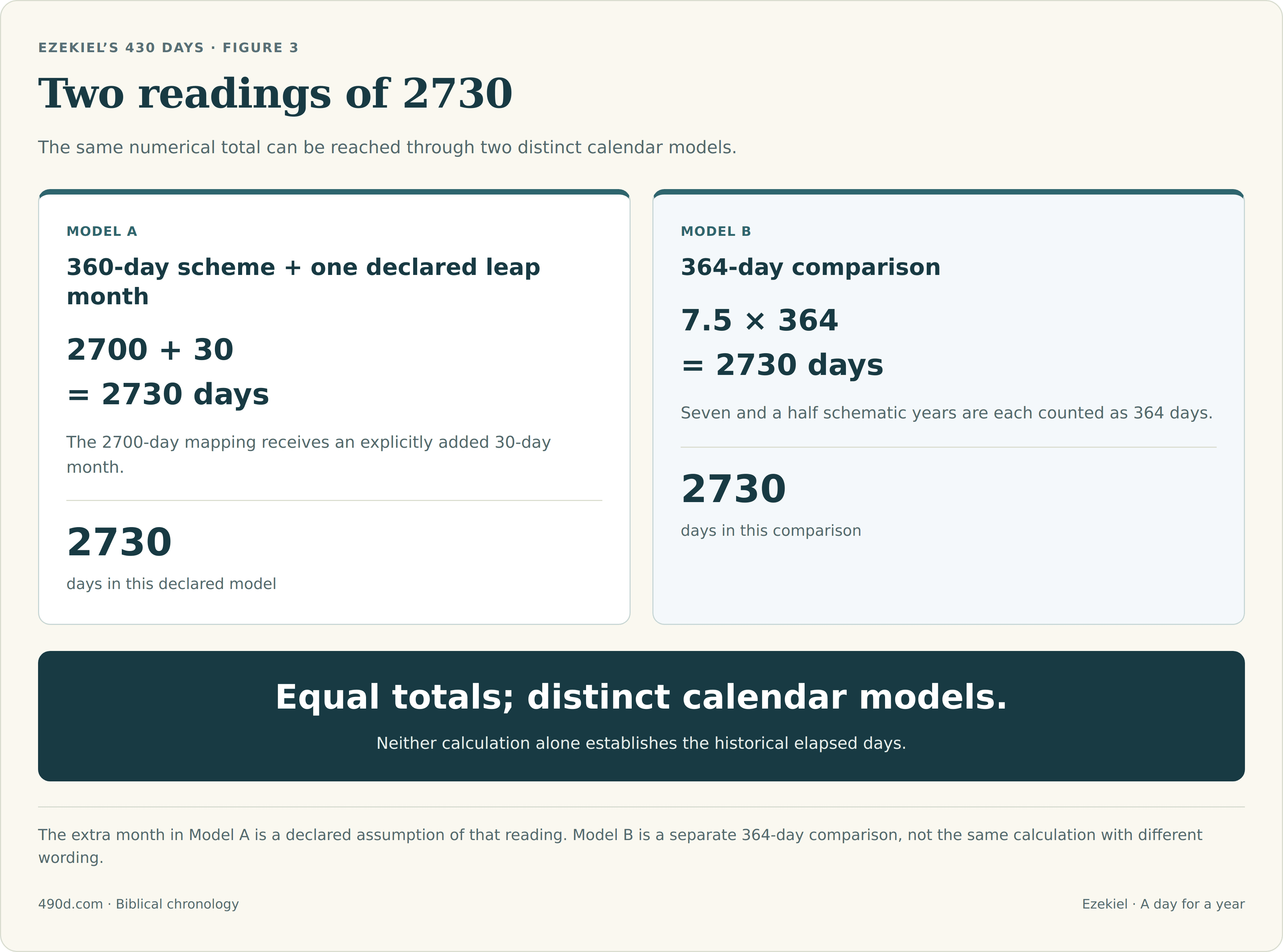
Model A is a 360-day scheme with one declared 30-day leap month: the prior 2700-day mapping plus 30 equals 2730 days. The added month is an explicit assumption of this reading. Model B is a distinct 364-day comparison: seven and a half schematic years times 364 equals 2730 days. The totals are equal, but the calendar models remain distinct. Neither calculation by itself establishes the actual historical elapsed days.
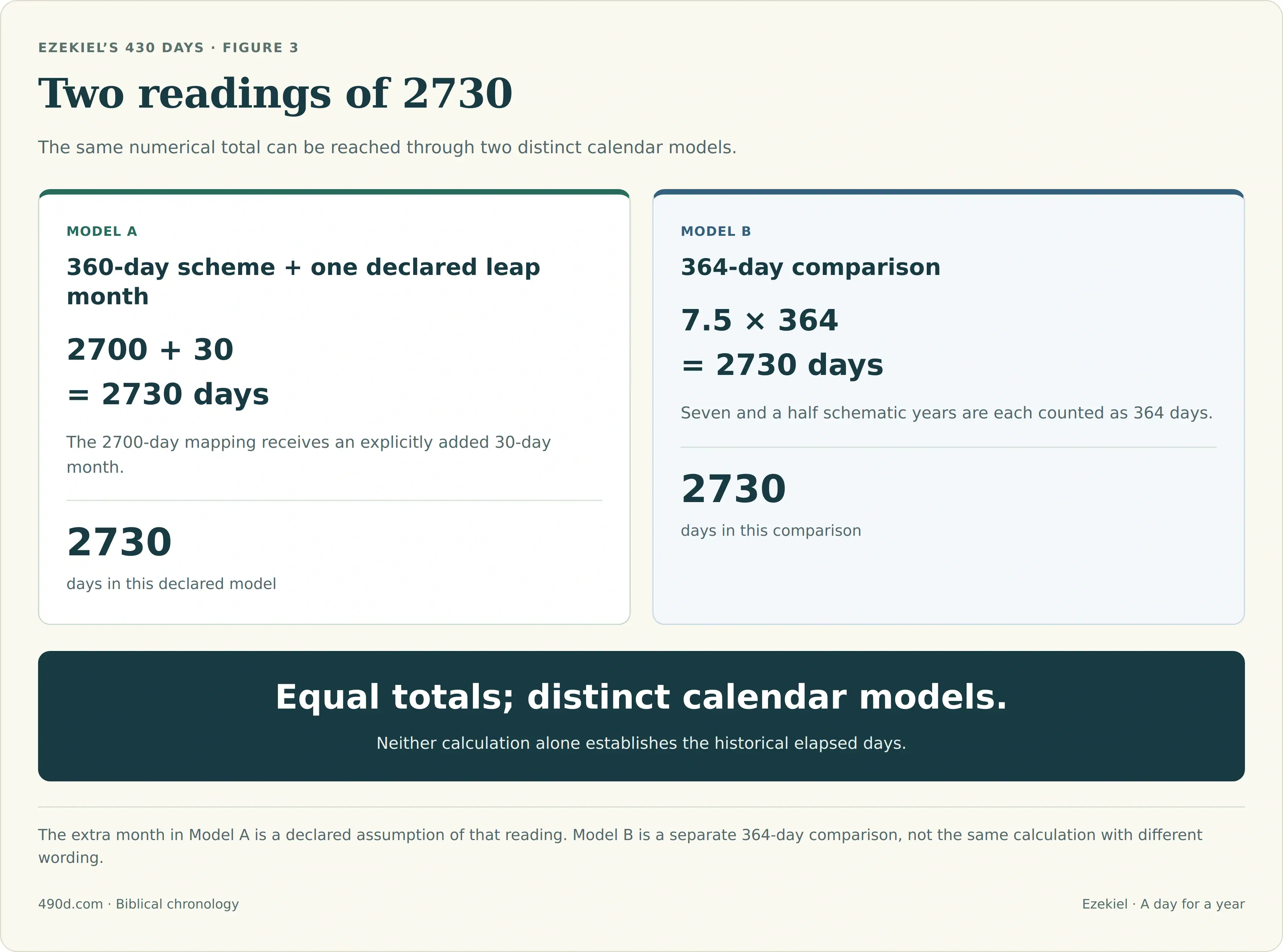
The two routes reach the same total for a simple reason. A 364-day year contains four more days than a 360-day year; across 7.5 years, those extra days amount to 7.5 × 4 = 30. One route adds a single month to the 360-day calculation. The other uses the longer year throughout.
The equality is exact, but the two calendar models remain distinct. Their agreement does not establish which calendar Ezekiel historically used. What it provides is a clear relationship between a prophetic 360-day scheme and the 364-day framework explained in the calendar introduction. The appendix gives the assumptions behind both readings.
Ezekiel’s 430 and Daniel’s 2300
The 2730 total has a further division:
2730 = 430 + 2300.
The first component is Ezekiel’s combined sign for Israel and Judah. The second recalls the answer given in Daniel’s sanctuary vision:
He said to me, “It will take 2,300 evenings and mornings; then the sanctuary will be properly restored.”
Ezekiel’s 430 Days · Figure 4
Ezekiel and Daniel: a numerical comparison
The numbers remain attached to their passages and the visions in which they occur.
Ezekiel’s sign for Israel and Judah
430390 + 40Days of the sign, assigned to represented years.
Daniel’s sanctuary vision
2300evenings and morningsThe sanctuary passage supplies this number.
An arithmetic comparison, not a dated sequence between Ezekiel’s sign and Daniel’s vision. Ezekiel does not explicitly state a 2730-day total here.
Image version, description, and full-size downloads
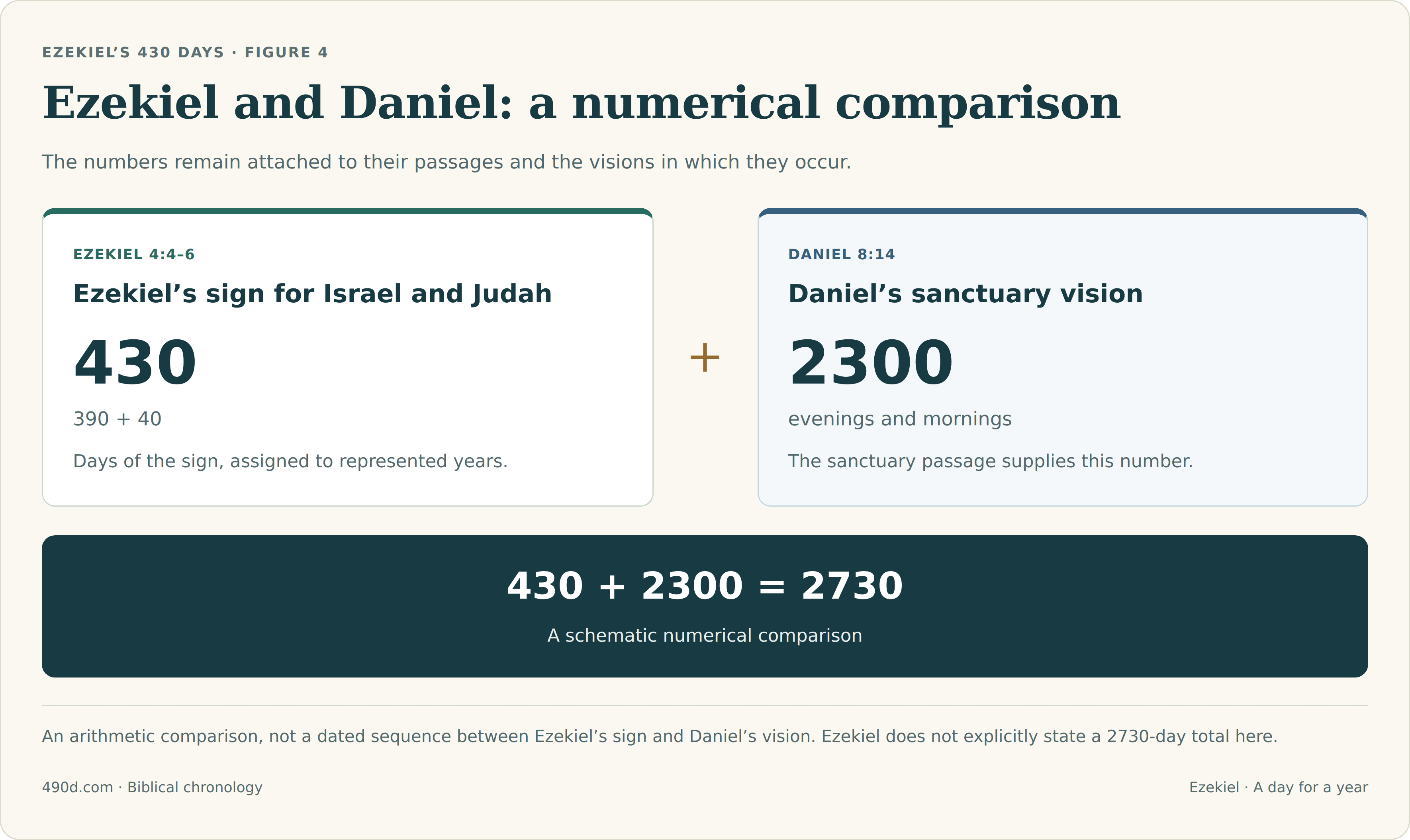
Ezekiel 4:4–6 assigns 390 days to Israel and 40 to Judah, with days representing years; their sum is 430. Daniel 8:14 supplies 2300 evenings and mornings in the sanctuary vision. Adding the two numerical values gives 430 + 2300 = 2730. This is a schematic arithmetic comparison across two passages. It is not a dated sequence from Ezekiel’s sign to Daniel’s vision, and Ezekiel does not explicitly state a 2730-day total in the sign passage.
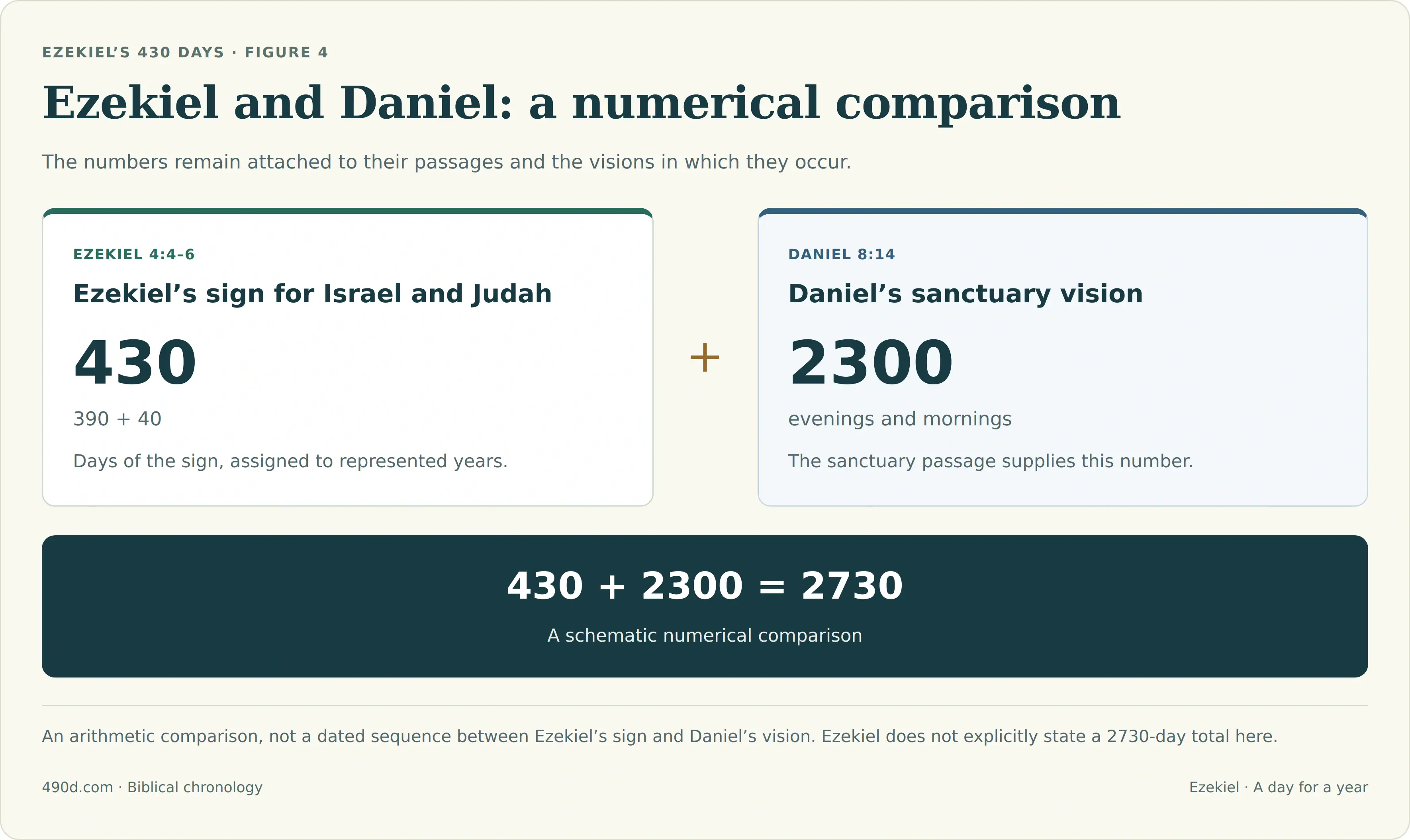
The relationship brings two themes into view: Ezekiel bears the iniquity associated with Jerusalem’s judgment, while Daniel hears of the sanctuary’s restoration after its trampling. Within the declared numerical comparison, the 430 and the 2300 together fill the 2730.
This is an arithmetic and thematic comparison, not a claim that Daniel’s vision begins on the day Ezekiel finishes his sign. Daniel’s wording remains “evenings and mornings”; it is not silently changed into years. Nor does Ezekiel explicitly name a 2730-day total. The comparison emerges when we place the stated biblical numbers beside the separately explained calendar calculation.
Seeing the connection
The argument begins with an unusually direct explanation of a prophetic sign: a day for each year. Its two parts, 390 + 40, preserve the distinction between Israel and Judah while joining them in the burden Ezekiel bears.
From there, the dated narrative supplies a seven-year, six-month interval. The declared calendars make its 2700/2730 relationship visible, and the 430 + 2300 division connects Ezekiel’s sign with Daniel’s sanctuary number. Each step has its own foundation: a biblical statement, a dated interval, a calendar rule, or a comparison between passages.
Keeping those foundations visible allows the numbers to serve the people and events they describe. The reader can move from Ezekiel to Israel and Judah, from the exiles to the report from Jerusalem, and from Jerusalem’s judgment to Daniel’s vision of the sanctuary—seeing both the connection and the calculation at a glance.
Technical appendix and supporting tables · Canonical discussion: File 17 §13A · Detailed companion.
Scripture quotations: Berean Standard Bible (BSB), public domain.