The second Cainan is a small addition to a genealogy with a large effect on its chronology. His 130 years before the birth of Shelah lengthen the regular calculation; his 460-year lifespan lengthens the cumulative calculation. Those unequal additions also reveal relationships between the two systems that are easy to miss when their dates are treated as interchangeable.
This detailed companion develops the explanation in The Second Cainan: Why 130 and 460 Years Matter. It follows the current canonical tables, first showing exactly what changes, then examining the 2300-year comparison, the 2520-year famine correspondence, and the way the alternative dates narrow toward Moses.
Supporting tables: Regular births · Cumulative stations · 2300-year comparison · Famine window · Four regular settings · People and date choices · MT and LXX · Creation comparisons · Sources.
1. The name and the numbers come from different witnesses
The Masoretic Text (MT) reading of Genesis moves directly from Arphaxad to Shelah:
When Arphaxad was 35 years old, he became the father of Shelah.
Luke’s genealogy contains an intervening name. Read in its own backward order, the relevant portion is:
… the son of Shelah, the son of Cainan, the son of Arphaxad, …
Luke supplies the genealogical position, but no ages. The selected Greek Genesis reading supplies those:
And Cainan lived a hundred and thirty years and begot Sala;
Sala is the name rendered Shelah in the BSB. Brenton’s passage adds another 330 years after the son’s birth, making 130 + 330 = 460. “Second Cainan” distinguishes this post-Flood figure from the earlier Kenan, son of Enosh.
The following reconstruction inserts this Cainan into an otherwise MT calculation. It does not replace the MT figures with all the figures of the LXX, or Septuagint. Arphaxad retains 35 years before the next generation and 438 years in all; Shelah retains 30 and 433. The SP, or Samaritan Pentateuch, like the MT framework used here, does not include this intervening Cainan.
Our starting point remains the normal MT framework: Nisan, 430 years in Egypt, and no additional 60 years for Terah. Cainan is included only in the comparisons explicitly marked as restored. His insertion is a controlled way to compare the genealogies; the resulting patterns do not by themselves settle the history or priority of the textual readings.
2. What moves—and what stays fixed
In regular chronology, overlapping lives are connected through the ages at which the next ancestors were born. With later dates held fixed, adding a generation moves the earlier ancestors backward.
| Birth node | Normal MT, BC | MT with Cainan restored, BC |
|---|---|---|
| Arphaxad | 2456 | 2586 |
| Second Cainan | — | 2551 |
| Shelah | 2421 | 2421 |
| Eber | 2391 | 2391 |
Without Cainan, the calculation is 2456 − 35 = 2421. With him, it becomes 2586 − 35 = 2551, followed by 2551 − 130 = 2421. Shelah is the point where the two chains meet again. Eber and every later anchor remain where they were.
Cainan’s regular life in this restored setting is therefore 2551–2091 BC. He fathers Shelah in 2421 BC and lives another 330 years: 2421 − 330 = 2091. His death is not Shelah’s birth. That distinction is essential when we turn to the cumulative method.
The cumulative method joins whole lives
Cumulative chronology adds the complete lifespans along the direct ancestral line, working backward from Moses’ death and the Conquest in 1406 BC. Its BC labels are coordinates in that arrangement, not the ordinary historical births of the people named. One life ends where the next cumulative station begins, even though the actual people lived overlapping lives.
The canonical Moses-line Nisan column gives:
| Cumulative station | Normal MT, BC | MT with Cainan restored, BC |
|---|---|---|
| Arphaxad | 4831 | 5291 |
| Second Cainan | — | 4853 |
| Shelah | 4393 | 4393 |
| Eber | 3960 | 3960 |
The normal calculation is 4831 − 438 = 4393. Restoring Cainan gives 5291 − 438 = 4853, then 4853 − 460 = 4393. Shelah again stays fixed, as does his 433-year step to Eber: 4393 − 433 = 3960.
The complete MT ancestral line contains 26 lifespans totaling 12600 years. Adding Cainan makes 27 lifespans totaling 13060. Anchored at 1406 BC, these totals place the cumulative Adam station at 14006 BC without Cainan and 14466 BC with him.
Both methods therefore follow the same rule: the added generation moves the ancestors before it, while the descendants after it remain fixed. The amount differs because one method adds 130, the other 460.
Sources: File 18 §§1.3, 1.6 and 6A–6B; File 09 §3A.1. For the full literal figures, see the regular tables and unrounded cumulative tables.
3. The same lifespan, 2300 years apart
The cumulative tables also carry seven-year windows, combining the Moses/Aaron framework with the two-year Shem adjustment. A single Moses-line coordinate and the edges of its wider window are different positions. Choosing one must not silently change the other.
For restored Cainan, the cumulative birth window is 4858–4851 BC; subtracting his 460 years gives the death/Shelah window 4398–4391 BC. The Moses-line members used above are 4853 and 4393. The following comparison deliberately selects the younger edges, 4851 and 4391.
| Selected construction | Cainan’s birth position, BC | Death position, BC | Lifespan |
|---|---|---|---|
| Cumulative: younger edges of the seven-year windows | 4851 | 4391 | 460 |
| Regular: restored Cainan, normal 430-year Egypt setting | 2551 | 2091 | 460 |
| Separation between corresponding positions | 2300 | 2300 | — |
The two lives have the same length, and the birth and death positions each differ by 2300 years:
4851 − 2551 = 4391 − 2091 = 2300 = 5 × 460.
The Second Cainan · Detailed study · Figure 1
The same 460-year span, 2300 years apart
Cainan’s complete life, compared at the selected younger edges of the cumulative windows.
Cumulative coordinatesSelected younger edges
Regular chronologyMT with restored Cainan
The cumulative row uses 4851 and 4391, the selected younger window edges—not the Moses-line coordinates 4853 and 4393. Cumulative coordinates are formal lifespan placements; the regular row dates Cainan’s complete life within the restored-Cainan model. These are not Rounded dates.
Image version, description, and full-size downloads
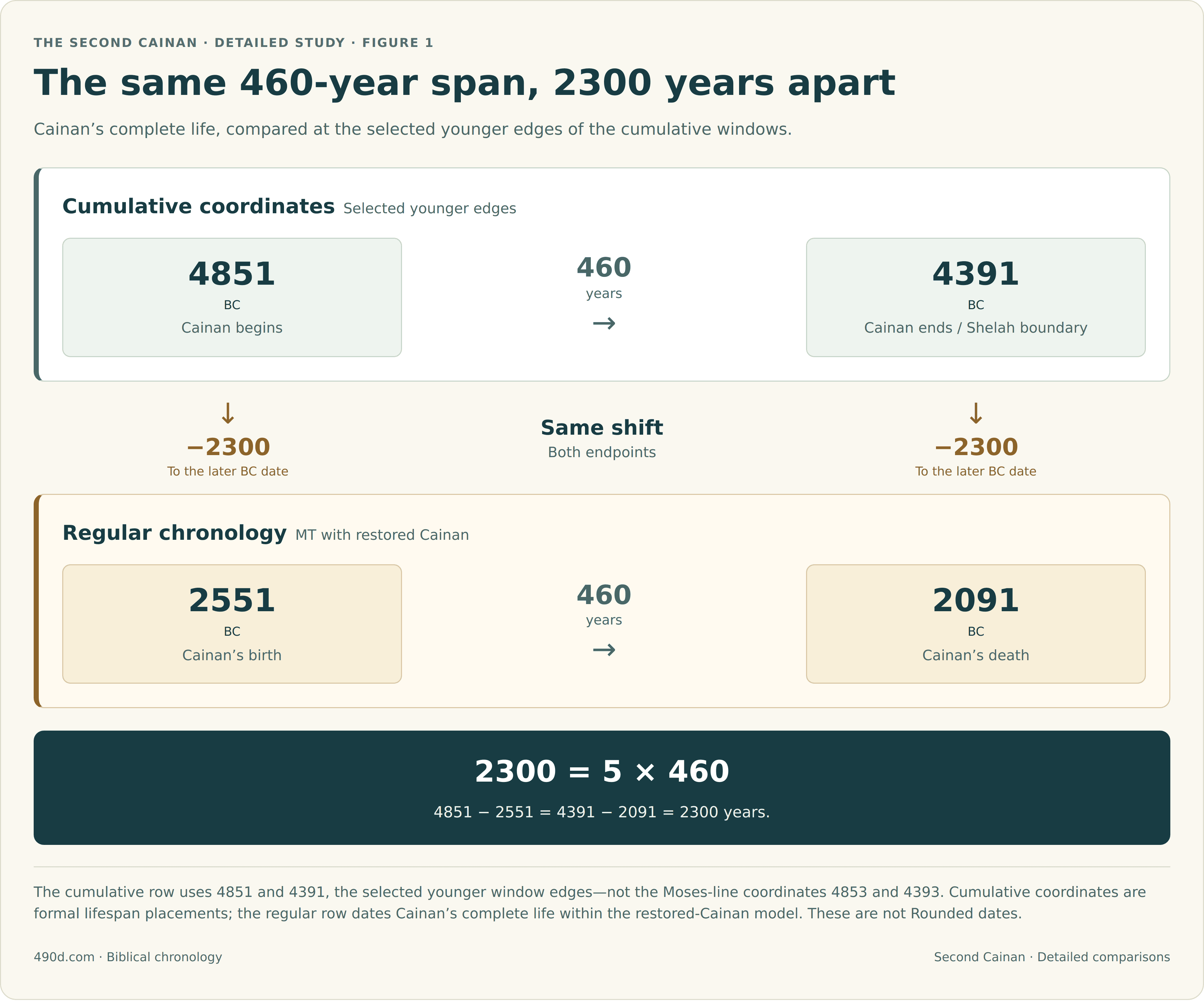
The upper row shows formal cumulative lifespan coordinates at selected younger window edges: Cainan begins at 4851 BC and ends at 4391 BC, the Shelah boundary, a span of 460 years. The lower row shows Cainan’s regular birth and death in the MT model with Cainan restored: 2551 BC to 2091 BC, also 460 years. Subtracting 2300 from each cumulative BC year gives the corresponding regular date. Thus 4851 minus 2551 equals 4391 minus 2091 equals 2300, and 2300 equals 5 times 460. The cumulative coordinates are selected window edges, not the Moses-line 4853 and 4393 dates, and are not Rounded dates.
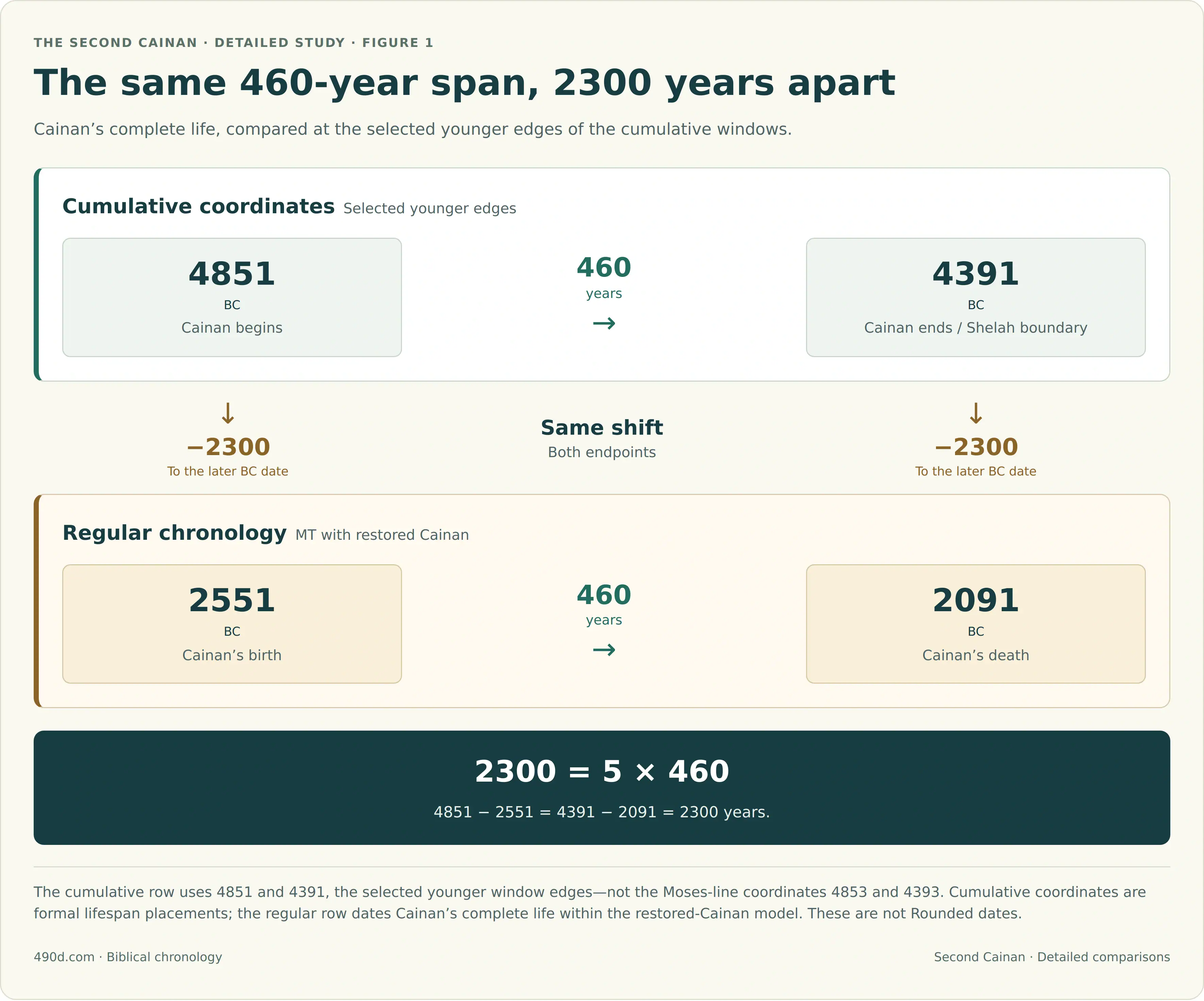
This is the clearest extended relationship. An entire 460-year span can be moved forward by five such spans, preserving both ends. It does not require changing Cainan’s age, shortening his life, or confusing his death with Shelah’s ordinary birth.
The endpoint selection matters. Using the Moses-line positions 4853 and 4393 against the same regular life would give 2302, not 2300. Those are valid coordinates for their own purpose; the exact five-lifespan relationship belongs to the explicitly selected edges in this table.
In the normal MT framework, 2091 BC also marks Abraham’s departure from Haran toward Canaan at age 75. Cainan’s restored regular death therefore coincides with that established anchor. This is a comparison within the reconstruction, not a biblical statement that the two events occurred together. Nor should Terah’s death be added to the same row without qualification: his normal death is 2031 BC; placing it at 2091 opens the separate +60 setting.
Sources: File 22 §6.1, File 16 §§3.3B–3.3C, and File 18 §6B. For Abraham’s age and departure, see Genesis 12:4, BSB.
4. A whole seven-year window maps onto the famine
A second relationship concerns Cainan’s cumulative death/Shelah window, 4398–4391 BC. Moving that entire window forward by 2520 years brings it to 1878–1871 BC, the seven years of famine in the normal MT framework.
The correspondence preserves the outer boundaries and the selected position of Jacob’s entry into Egypt:
| Cumulative death/Shelah position, BC | Span subtracted | Regular target, BC | Target in the normal MT framework |
|---|---|---|---|
| 4398 | 2520 | 1878 | Beginning of the famine |
| 4396 | 2520 | 1876 | Jacob enters Egypt |
| 4391 | 2520 | 1871 | End of the famine |
4398 − 1878 = 4396 − 1876 = 4391 − 1871 = 2520.
The Second Cainan · Detailed study · Figure 2
A seven-year window translated by 2520
The selected member stays two years from the older edge in both windows.
Cumulative Cainan-end / Shelah window
Formal lifespan coordinates · All BC
The seven years of famine
Regular MT · Normal 430 years in Egypt · All BC
The highlighted member is two years from the older edge, not the midpoint. This is a formal comparison between chronologies; it does not place Cainan’s death during the historical famine. Node spacing is schematic.
Image version, description, and full-size downloads
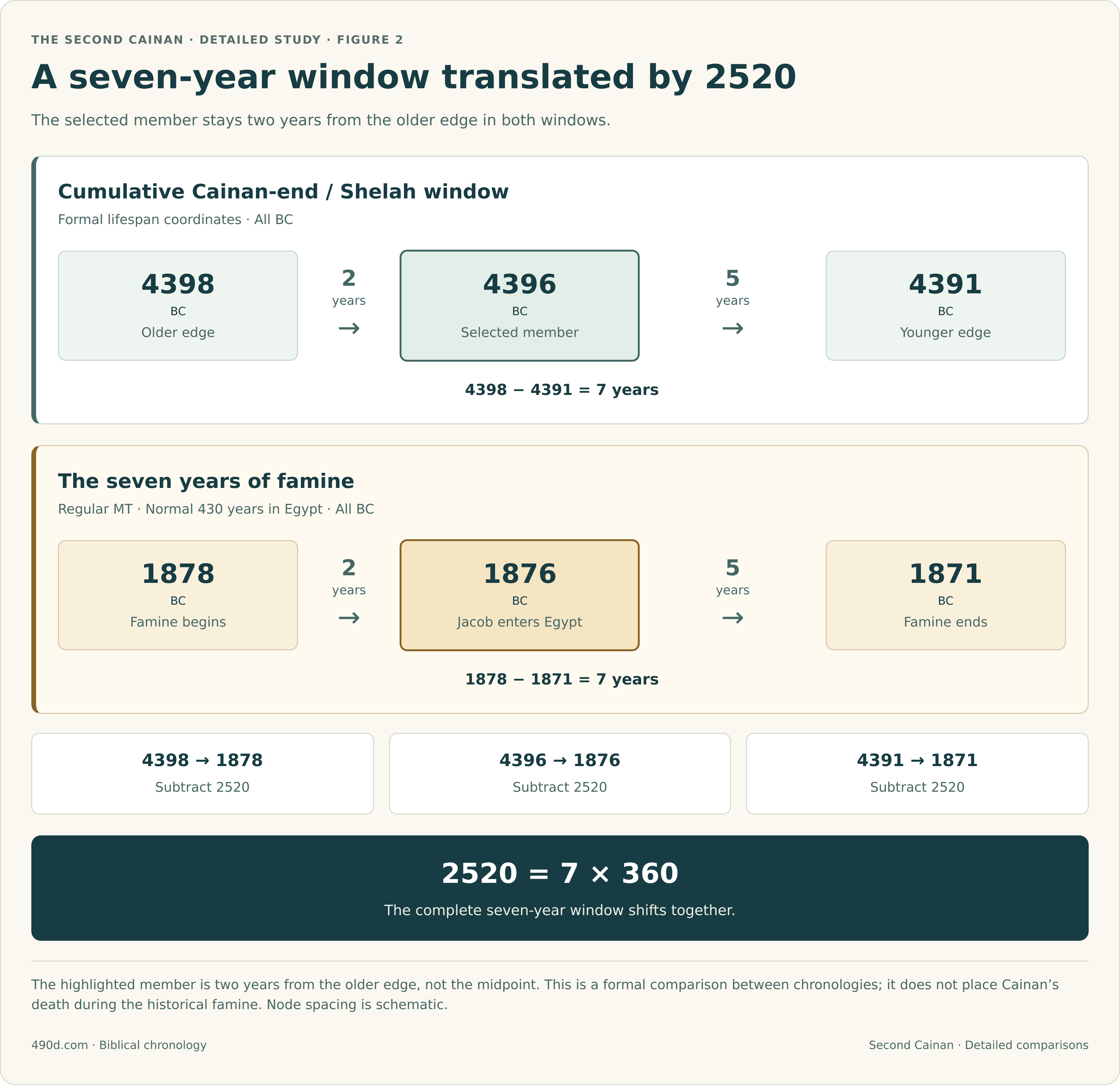
Upper cumulative Cainan-end and Shelah window, all BC: 4398 older edge, two years to selected member 4396, then five years to younger edge 4391. Lower regular MT famine window: 1878 famine begins, two years to 1876 Jacob enters Egypt, then five years to 1871 famine ends. Every corresponding upper coordinate minus lower coordinate equals 2520, or 7 times 360. The selected members are two years from the older edge, not midpoints. The comparison formally translates coordinates and does not identify Cainan’s death with the historical famine.
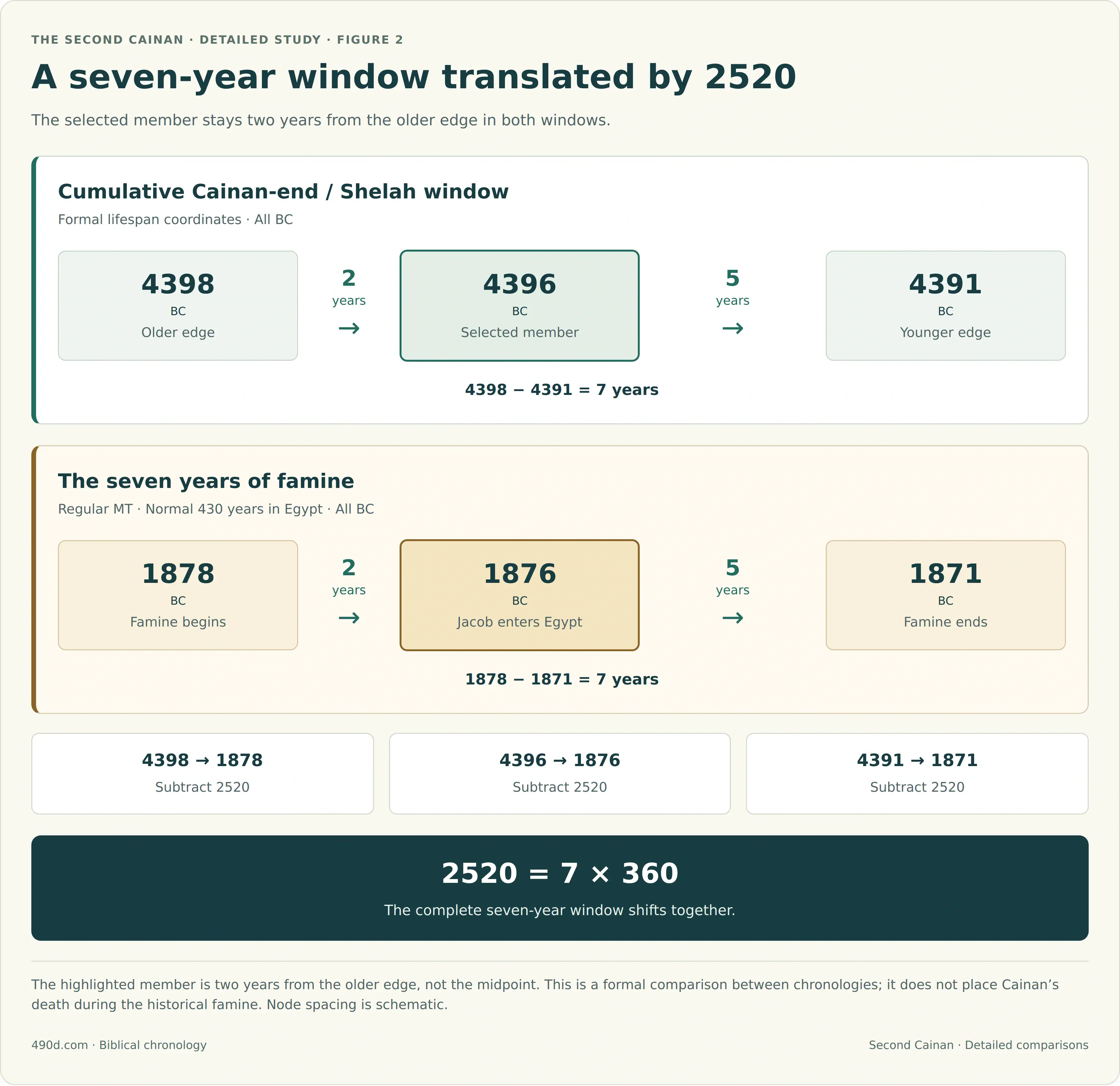
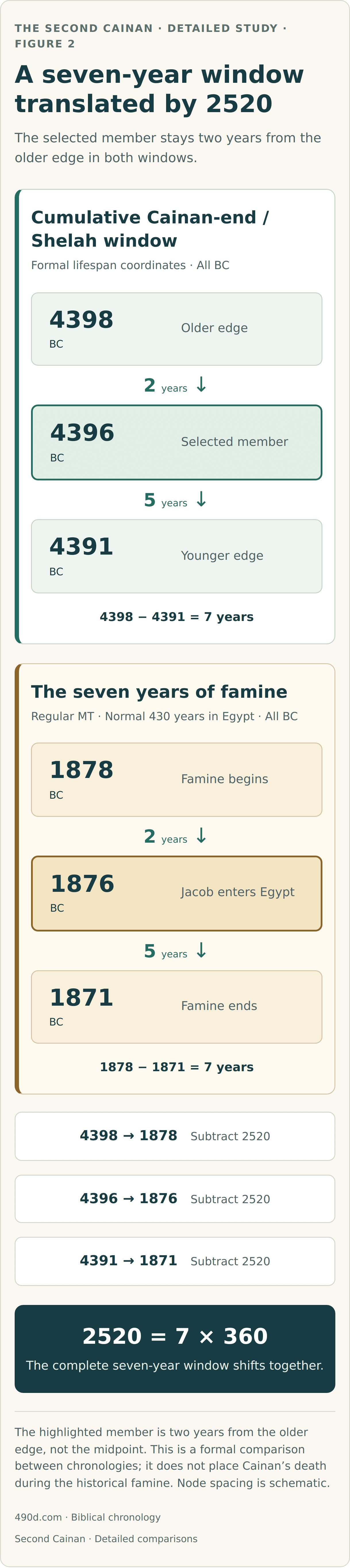
The selected 4396 position lies two years forward from the older edge, just as 1876 lies two years forward from 1878. Neither is the midpoint of its window. The outer spans each remain seven years.
The factorization makes the calendrical form visible: 2520 = 7 × 360 = 1260 + 1260. This is a sevenfold schematic 360-unit measure used to compare the chronological positions. It does not mean that the ordinary MT chronology has suddenly been converted into literal 360-day years, or that Scripture explicitly dates Cainan 2520 years before Jacob’s arrival.
What makes this more informative than a single subtraction is that the whole window and its selected interior position align. The cumulative arrangement and the ordinary famine chronology remain distinct, but their internal shape is preserved by one translation.
The sojourn article explains the 1876 BC Egypt-entry anchor. The underlying window comparison is registered in File 16 §§3.3–3.3A, with its cumulative dates in File 18 §6B.
5. Why Cainan can have four regular date settings
The normal setting above is not the only one explored in the canonical tables. Two independently named choices alter Cainan’s regular position: the shorter 215-year Egypt alternative, and the additional 60 years for Terah. Each choice shifts the applicable earlier dates without changing Cainan’s 130-year fatherhood interval or 460-year lifespan.
| Restored-Cainan setting | Shelah’s birth, BC | Cainan’s birth, BC | Cainan’s death, BC |
|---|---|---|---|
| Normal: 430 years in Egypt; no +60 Terah | 2421 | 2551 | 2091 |
| 430 years in Egypt; +60 Terah | 2481 | 2611 | 2151 |
| Shorter 215-year Egypt alternative; no +60 Terah | 2206 | 2336 | 1876 |
| Shorter 215-year Egypt alternative; +60 Terah | 2266 | 2396 | 1936 |
Every row obeys the same rule: Shelah’s birth + 130 = Cainan’s birth, then Cainan’s birth − 460 = his death. These are four alternatives for one figure, not four Cainan lifetimes occurring within one chronology.
The shorter-sojourn row places his death at 1876 BC. That date can be compared with Jacob’s Egypt entry in the normal 430-year framework, but the two roles come from different settings. In the shorter-sojourn framework itself, Jacob’s entry is 1661 BC. Naming the settings preserves the comparison without presenting it as one unchanged historical timeline.
The +60 choice also begins at a particular point in the genealogy. It moves Terah and the earlier ancestors; Abraham’s birth remains fixed within the chosen sojourn setting. Likewise, adding Cainan moves Arphaxad and earlier ancestors; Shelah and the later rows remain fixed. This explains why alternative dates do not spread uniformly through the entire family tree.
Source: File 18 §1.3.1. That table describes normal 430-year Egypt as “+215” relative to its minimum 215-year setting; the order here leads with the normal MT setting instead.
6. The alternatives narrow toward Moses
Three choices enter the regular calculation at different points: sojourn length, Terah’s fatherhood setting, and Cainan absent or restored. Where all three apply, their twofold choices give 2 × 2 × 2 = 8 date positions. Farther down the ancestral line, only two choices apply, then only one.
This produces the following arrangement. The number of people and the number of possible dates are separate counts:
| Direct ancestral block | People in the block | Choices affecting their regular dates | Date positions across those choices |
|---|---|---|---|
| Adam through Arphaxad | 12 | Sojourn, Terah, and Cainan absent/restored | 8 |
| Second Cainan through Terah | 8 | Sojourn and Terah | 4 |
| Abraham, Isaac, Jacob, Levi | 4 | Sojourn | 2 |
| Kohath and Amram | 2 | Their overlapping lives do not supply direct regular birth-date pivots here | 0 direct pivots |
| Moses | 1 | Fixed later framework | Fixed |
The Second Cainan · Detailed study · Figure 3
How the date alternatives narrow
Name counts describe the ancestral line. Position counts describe alternatives across declared states.
Adam → Arphaxad
Three switches: 215-year sojourn difference, 60-year Terah difference, and Cainan’s 130 years.
Cainan → Terah
Two switches remain: the 215-year sojourn difference and the 60-year Terah difference.
Abraham → Levi
The remaining switch is the 215-year sojourn difference.
Kohath + Amram
Their births float within the sojourn. Zero means no direct regular birth-date pivot; it does not mean zero possible birth dates.
The 8, 4, and 2 positions are alternative dates across the named states, not simultaneous dates. The normal fixed MT state remains one selected chronology. The name total follows the ancestral line through Levi, Kohath, Amram, and Moses.
Image version, description, and full-size downloads
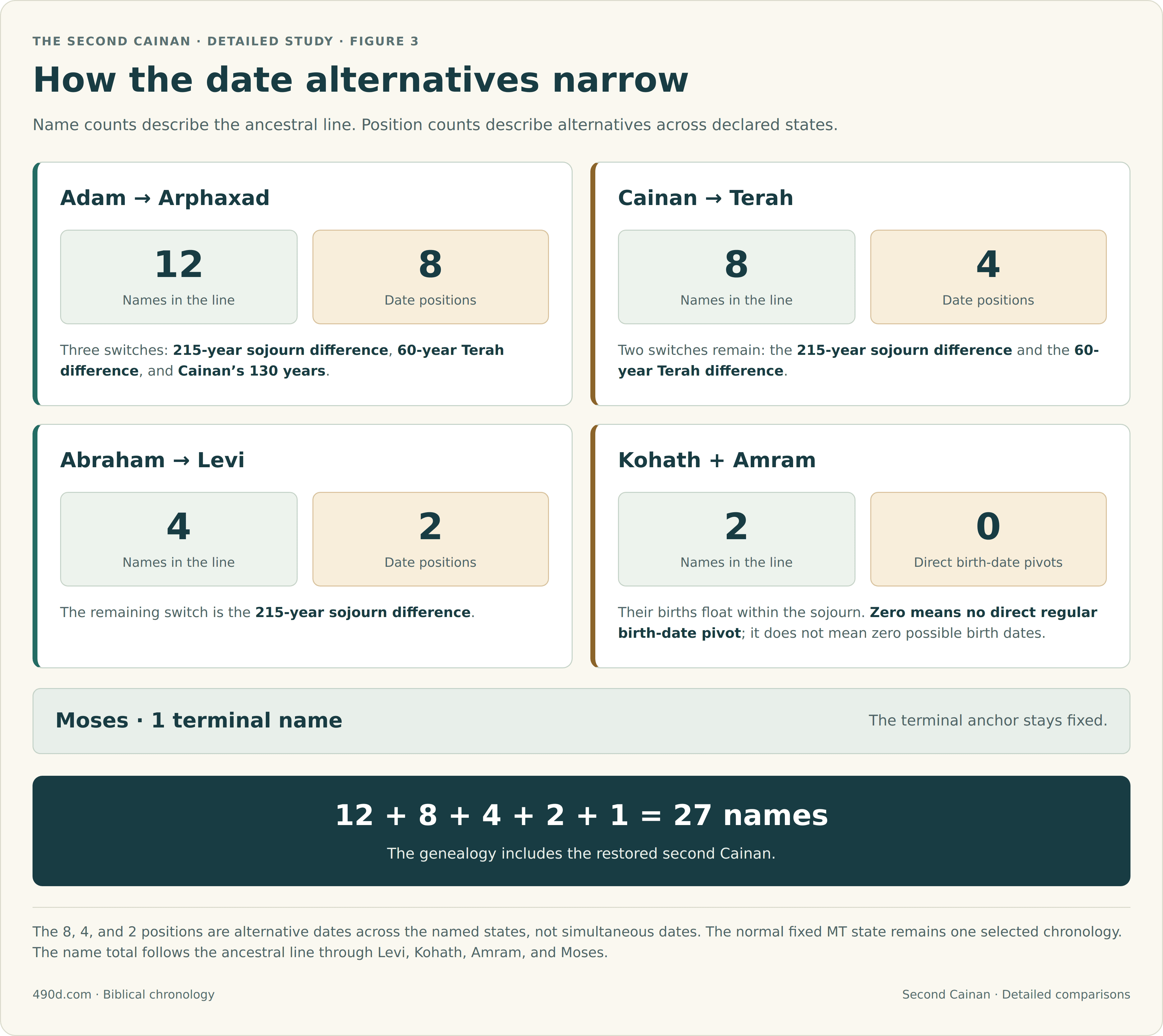
Adam through Arphaxad comprises 12 names and has eight date positions across three named switches: a 215-year sojourn difference, a 60-year Terah difference, and Cainan’s 130-year insertion or absence. Cainan through Terah comprises eight names and has four positions across the sojourn and Terah switches. Abraham through Levi comprises four names and has two positions across the sojourn switch. Kohath and Amram comprise two names and have zero direct regular birth-date pivots; their births float within the sojourn. Zero does not mean zero possible ages or dates. Moses is one fixed terminal name. With second Cainan included, 12 + 8 + 4 + 2 + 1 = 27 names. Alternative position counts are across declared states, not simultaneous dates within one fixed chronology.
The first twelve are Adam, Seth, Enosh, Kenan, Mahalalel, Jared, Enoch, Methuselah, Lamech, Noah, Shem, and Arphaxad. The following eight are Cainan, Shelah, Eber, Peleg, Reu, Serug, Nahor, and Terah. Levi, rather than Joseph, belongs in the direct ancestral line leading to Moses.
The eight upstream dates are alternatives across both Cainan-absent and Cainan-restored calculations. They are not eight simultaneous dates, and Cainan himself has only four positions. “Zero direct pivots” for Kohath and Amram means that the regular method does not assign their births by chaining their full lives. It does not mean that they lack historical lifetimes or that no chronological constraints apply to them.
The count of people is a different calculation: 12 + 8 + 4 + 2 + 1 = 27, including Moses. Without the second Cainan, the eight-name block loses one person and the total returns to 26. This is the same additional life that raises the cumulative sum from 12600 to 13060 years.
The narrowing pattern shows where the alternatives enter and stop. It does not include every other possible adjustment: Noah/Shem gear choices, seasonal phases, and apparent-age overlays are not extra unnamed branches in this table.
Source: File 18 §§1.3.1–1.3.3. For the distinction between overlapping lives and formal cumulative calculations, see Kohath and Amram: The Fourteen-Year Link.
7. Matching Cainan on both sides of the MT–LXX comparison
The MT-plus-Cainan calculation is a comparison constructed from MT values. The native LXX cumulative table already contains Cainan. To compare like with like, we can include him in both traditions—or explicitly remove him from both for a theoretical comparison.
| Cumulative construction | Adam’s Moses-line Year-6 position, BC |
|---|---|
| LXX, native Cainan-inclusive chain | 14896 |
| MT with Cainan restored | 14466 |
| LXX with Cainan theoretically removed | 14436 |
| MT, normal Cainan-absent chain | 14006 |
With Cainan present on both sides, 14896 − 14466 = 430. With him absent on both sides, 14436 − 14006 = 430. Within either tradition, the insertion itself remains 460 years.
The Second Cainan · Detailed study · Figure 4
Four cumulative Adam positions
Actual Moses-line Adam / Year-6 coordinates, ordered from older to later BC.
These are Adam / Year-6 positions, not Creation-week heads or Rounded dates. The selected LXX lifespan data retain Lamech’s 753 years. Removing native LXX Cainan is a theoretical comparison; normal MT remains Cainan-absent. Node spacing is schematic.
Image version, description, and full-size downloads
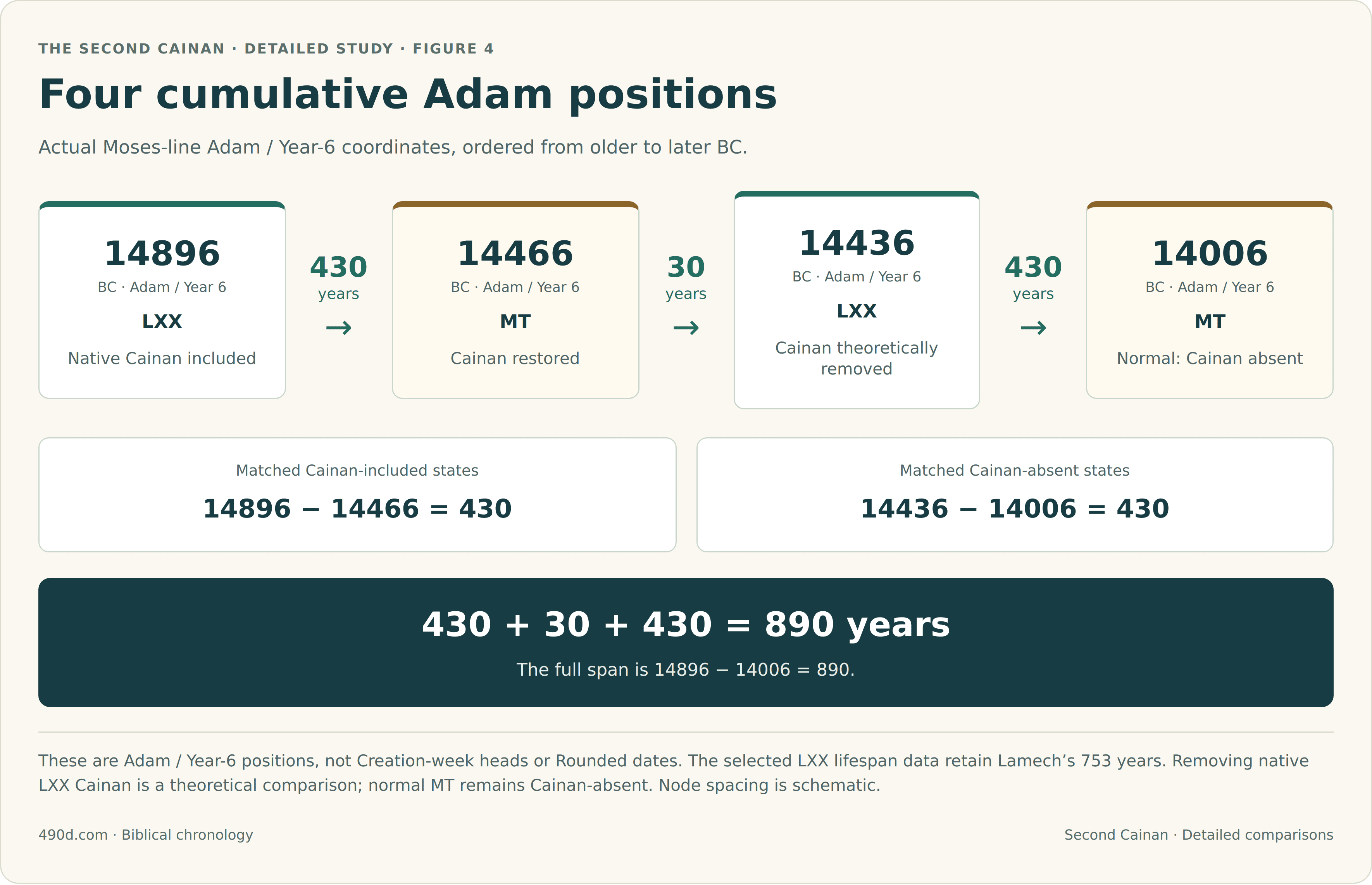
From older to later BC, the four actual Moses-line cumulative Adam or Year-6 positions are: LXX native Cainan included, 14896 BC; MT with Cainan restored, 14466 BC; LXX with Cainan theoretically removed, 14436 BC; normal MT with Cainan absent, 14006 BC. Consecutive differences are 430, 30, and 430 years. The matched Cainan-included LXX and MT states differ by 430; the matched Cainan-absent states also differ by 430. The full difference is 890, not 920. The LXX data retain Lamech’s 753 years. These are not Creation-week heads or Rounded dates. Node spacing is schematic.
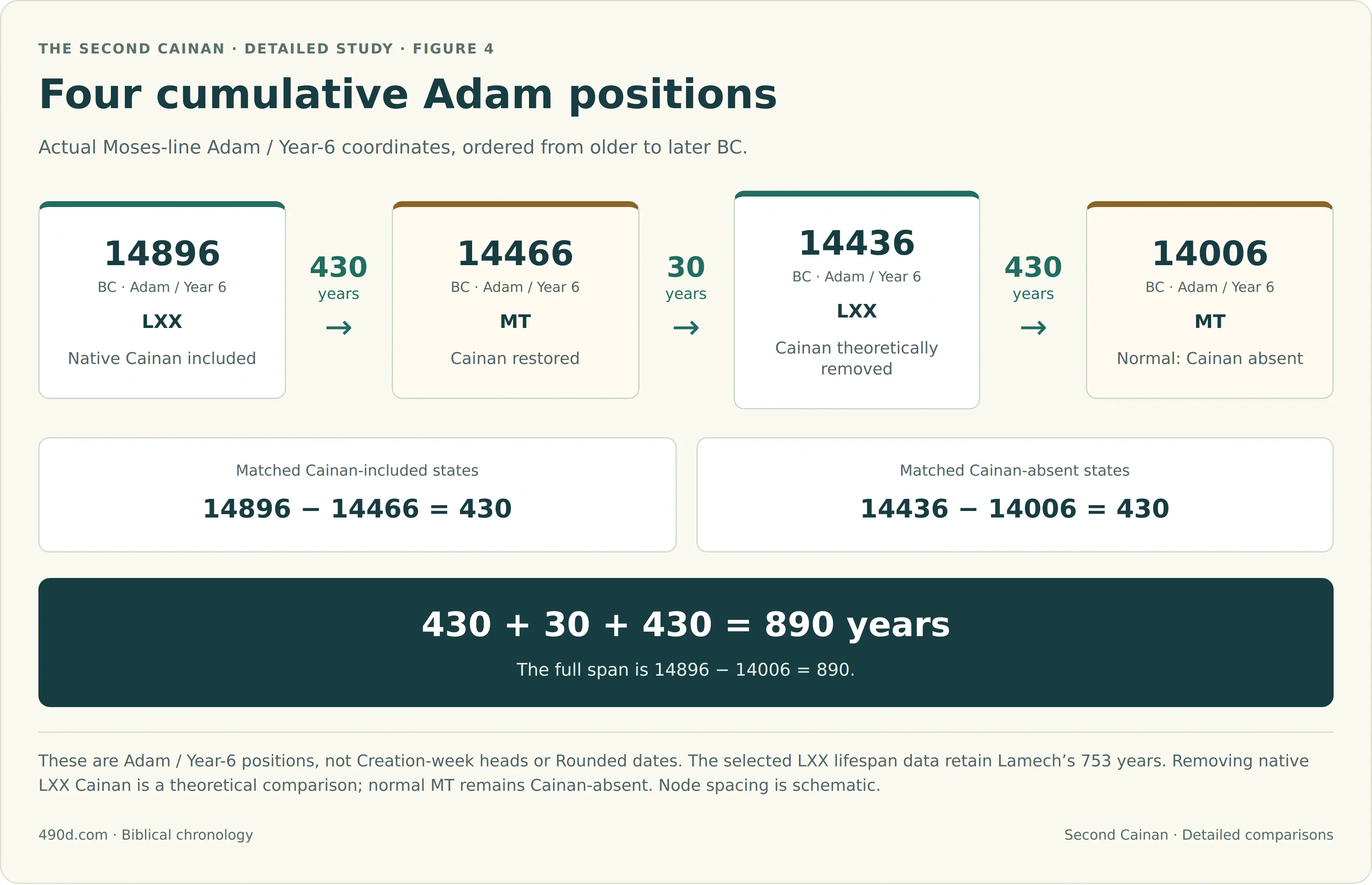
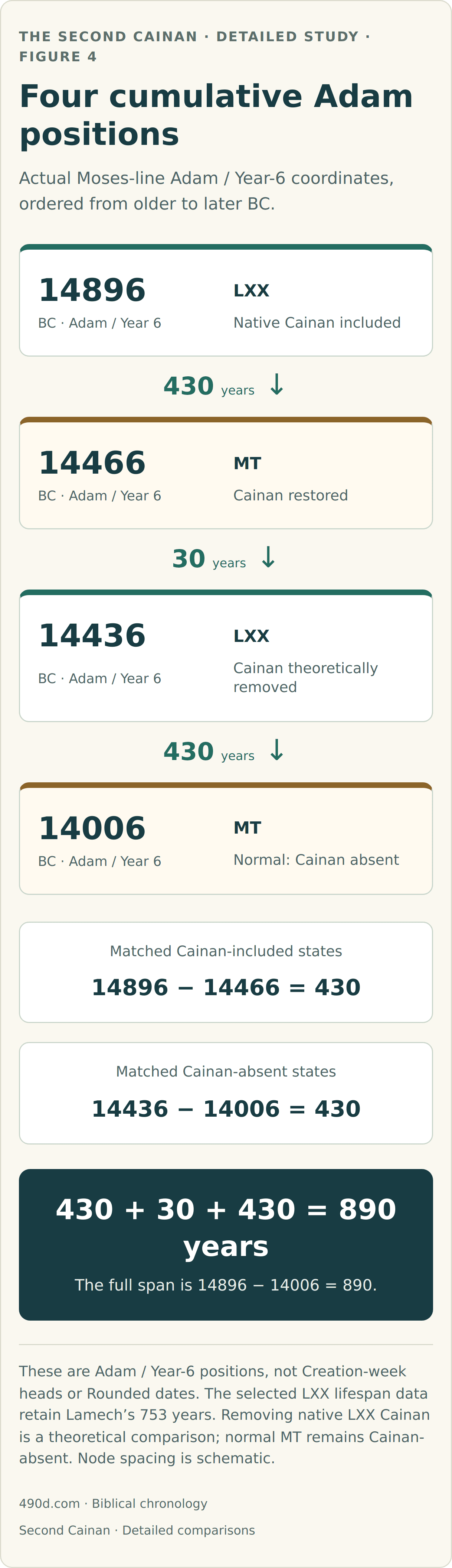
The four positions interleave in a particularly simple way: 430 + 30 + 430 = 890. The middle 30 arises because a 460-year insertion exceeds the 430-year separation by 30. No additional apparent-age adjustment is included in these four values.
These are actual cumulative Moses-line Year-6 positions, not Rounded dates or the older heads of their seven-year envelopes. The selected LXX chain uses Lamech’s 753 years, as specified in the current canonical table. Its cumulative difference from the restored MT chain is 454 years at the next station, Noah; Lamech’s LXX lifespan is 24 years shorter than the MT’s 777, leaving 454 − 24 = 430 from Lamech back to Adam.
This explains how the 430 separation is produced by the adopted figures. It does not establish why a manuscript tradition preserved a particular lifespan. The theoretical Cainan-absent LXX row is likewise an analytical comparison, not a claim that the native table lacked him.
Sources: File 18 §6D and File 46 §6A.5. For the wider literal tables, use the unrounded cumulative chronology.
8. Two further connections, kept in their proper setting
The number 460 also appears before the Flood. The ordinary MT begetting ages from Adam to Jared add to 130 + 105 + 90 + 70 + 65 = 460. That is the same length as the second Cainan’s selected lifespan, though it arises from a sum of fatherhood intervals rather than one person’s life.
There is a literary reason to notice Jared and Cainan together. 1 Enoch 6:6, in R. H. Charles’s translation, places the Watchers’ descent in Jared’s days. Jubilees 8:1–5 associates Arpachshad’s son Kainam with the discovery and copying of earlier Watcher teachings, before naming his son Shelah.
These passages provide literary context for the comparison. They do not date the descent to Jared’s birth, nor does Jubilees supply the selected Greek Genesis 130/460 calculation. The numerical relationship and the literary association are related observations, each with its own evidence.
A smaller relationship concerns Shelah’s 433-year life in the normal MT chronology. His 2421–1988 BC lifespan contains Abraham’s death in 1991 BC:
| Part of Shelah’s normal MT lifespan | Years |
|---|---|
| Shelah’s birth, 2421 BC → Abraham’s death, 1991 BC | 430 |
| Abraham’s death, 1991 BC → Shelah’s death, 1988 BC | 3 |
| Complete lifespan | 433 |
This retains the exact 430 + 3 division. It need not be turned into a 3½-year period or supported by an uncertain name etymology. It is a useful smaller comparison within the same family of figures, rather than another adjustment to Cainan’s chronology.
Source for the chronological figures: File 18, regular MT table; the wider Cainan/Jared discussion is in File 22 §6.1.
9. The two larger bridges must remain distinct
The introductory article shows why adding Cainan to both methods widens the regular-to-cumulative separation by 330 years: the cumulative system gains 460 while the regular system gains only 130.
Using Adam’s Year-6 positions as the baseline gives:
| Comparison | Cumulative position, BC | Regular position, BC | Separation |
|---|---|---|---|
| Normal MT in both methods | 14006 | 4116 | 9890 |
| Cainan restored in both methods | 14466 | 4246 | 10220 |
| Cumulative Cainan restored; separate regular +30 apparent-age overlay | 14466 | 4146 | 10320 |
The matched-Cainan relationship is 9890 + 460 − 130 = 10220. It also holds when matching the beginnings or closes of the two Creation weeks; the introductory appendix supplies those corresponding boundaries.
The third row is a different comparison. 4146 BC is the separate +30 overlay on 4116 BC, not the regular Cainan-restored Year-6 position of 4246 BC. Its span is 14466 − 4146 = 10320 = 24 × 430. The equality is exact, but its assumptions must remain visible.
Keeping these rows separate allows both relationships to be understood without exchanging one date setting for another halfway through the calculation. File 22 §5A.1 controls the 10220 relationship; §7.2 of the same file gives the distinct 10320 comparison. The underlying 9890-year bridge and the Rounded 9900-year construction should likewise retain their own stated inputs.
10. What the second Cainan brings into view
The importance of Cainan lies first in a simple difference: 130 years join successive births; 460 years add a complete life. Once that distinction is held steady, the larger structure becomes easier to follow.
His cumulative and regular lifespans can stand 2300 years apart, with both ends preserved. His cumulative death/Shelah window can be translated by 2520 onto the famine window, retaining its seven-year width and the selected Egypt-entry position. The alternative regular settings narrow through the ancestral line, while matching Cainan’s presence or absence reveals the cumulative MT–LXX 430–30–430 arrangement.
These relationships give the extra generation a definite place in the chronological comparisons. Their force comes from explicit inputs and repeatable calculations. Their theological significance remains a matter of interpretation; arithmetic alone is not a statistical proof of design or a demonstration of how the manuscript traditions developed.
Sources and further study
| Topic | Controlling source |
|---|---|
| Regular insertion; four settings; narrowing date choices | File 18 §§1.3 and 1.6 |
| Literal cumulative rows, Cainan insertion, MT–LXX comparison | File 18 §§6A–6D |
| Cumulative envelope and variant controls | File 09 §3A.1 |
| Seven-year famine correspondence | File 16 §§3.3–3.3C |
| 2300 comparison, Jared context, 10220 and 10320 bridges | File 22 §§5A.1, 6.1 and 7.2 |
| Four cumulative Adam positions | File 46 §6A.5 |
The canonical source index contains the fuller framework and amendments. Related research is indexed at research.490d.com/read/.
Return to the introductory article · Open its supporting appendix.
Scripture quotations: Berean Standard Bible (BSB), public domain. Brenton Septuagint Translation: public domain, as identified. See the Brenton edition information. Calculations are presented separately from translation wording.