Supporting tables, manuscript evidence, and credited sources
This appendix accompanies Rabbinic Chronology, Daniel’s 490 Years, and Enoch’s Ten Weeks. It makes the calculations reproducible and distinguishes ancient statements, later interpretations, historical dates, and the applied models used on 490d.
1. Identify the unit before multiplying
On a narrow screen, scroll the table sideways to see every column.
| Text or construction | Unit or operation | Result | Status |
|---|---|---|---|
| Leviticus 25:8 | 7 × 7 years | 49 counted years | Explicit sabbaths-of-years count |
| Daniel 9, year-week reading | 70 × 7 years | 490 years | Seven-year interpretation of the seventy sevens |
| Seder Olam 28 | 70 + 420 years | 490 years | Traditional destruction-to-destruction calculation |
| Apocalypse of Weeks | 10 weeks × 7 implied parts | 70 parts | No fixed ordinary-year length supplied |
| Ten jubilee cycles of 49 years | 10 × 49 years | 490 years | Cycle convention stated; compare 11Q13 |
| 490d primary Enochic week | 7 × 70 years | 490 years | Applied model in File 68 |
| 490d companion Enochic week | 7 × 72 years | 504 years | Bounded companion; separate from Daniel’s 490 |
Daniel’s seventy weeks understood as year-weeks give 49 + 434 + 7 = 490. Splitting the final week gives 49 + 434 + 3.5 + 3.5 = 490; the first sixty-nine weeks give 483. These are arithmetic consequences of the seven-year unit. Assigning historical events to their boundaries is a further interpretive step. Daniel 9:24–27 supplies the divisions; File 17 §7 preserves their distinct forms in the Repository.
Leviticus 25:8–10 distinguishes counting forty-nine years from consecrating the fiftieth year. Accordingly, a calculation using ten recurring forty-nine-year cycles needs that convention stated. It is not a claim that every ancient author used the word “jubilee” in precisely the same calendrical way.
Two different meanings of 420 + 70
On a narrow screen, scroll the table sideways to see every column.
| Construction | First component | Second component | Relationship |
|---|---|---|---|
| File 68’s Sabbath analysis | 420 work years | 70 Sabbath years | Categories distributed within 490 |
| Seder Olam’s historical allocation | 70 desolation years | 420 Second-Temple years | Successive periods totaling 490 |
In the work/rest analysis, 420 and 70 are categories distributed through the whole framework. In Seder Olam, 70 and 420 are successive allocations between events. A common total does not make the component objects interchangeable. The first belongs to File 68 §4; the second is the rabbinic interpretation in Seder Olam 28.
2. The rabbinic destruction-to-destruction ledger
On a narrow screen, scroll the table sideways to see every column.
| Component | Years | Relative position | Source |
|---|---|---|---|
| Desolation between the Temples | 70 | 0–70 | Seder Olam 28 |
| Persian Temple period | 34 | 70–104 | Seder Olam 30; Avodah Zarah 9a |
| Greek period | 180 | 104–284 | Same |
| Hasmonean period | 103 | 284–387 | Same |
| Herodian period | 103 | 387–490 | Same |
| Second Temple subtotal | 420 | 70–490 | 34 + 180 + 103 + 103 |
| Destruction-to-destruction total | 490 | 0–490 | 70 + 420 |
The Temple subtotal is independently checkable from its four components: 34 + 180 + 103 + 103 = 420. Adding the desolation allocation gives 490. The corresponding relative boundaries are 0 → 70 → 104 → 284 → 387 → 490. These positions belong to the traditional duration scheme; they are not historical BC/AD dates.
Seder Olam 28 explicitly attributes the destruction-to-destruction interpretation to Rabbi Yose. Chapter 30 and Avodah Zarah 9a supply the four Temple-period figures. The accessible Hebrew text contains correction brackets at some numerical readings. A modern critical treatment is Chaim Milikowsky’s Seder Olam: Critical Edition, Commentary, and Introduction (2013). This revision consulted its publication record and Farber’s expressly attributed discussion, rather than claiming examination of the full two-volume commentary.
The original memorandum’s Jewish Encyclopedia citation is relevant. Its article explains the Persian figure as a remainder within a Daniel-based scheme: the later periods total 180 + 103 + 103 = 386, leaving 490 − 70 − 386 = 34. Credit for that explanation belongs to the article’s named authors, M. Seligsohn and the Executive Committee of the Editorial Board. Its explanatory argument should not be expanded into an undocumented claim about Enoch or the compilers’ knowledge of a different chronology.
A modern proposal, and its reconsideration
Rabbi Shimon Schwab proposed that a historical interval had deliberately been concealed, then reconsidered that hypothesis in the epilogue to “Comparative Jewish Chronology?” in Selected Speeches (1991), pp. 255–285. The proposal appears around pp. 268–272; pp. 281–285 acknowledge missing evidence and other difficulties, leave the question open, and explicitly invoke retraction. This is a twentieth-century response to the discrepancy. It is not evidence that an ancient Enochic calculation motivated Seder Olam.
3. The Persian comparison and the “missing years”
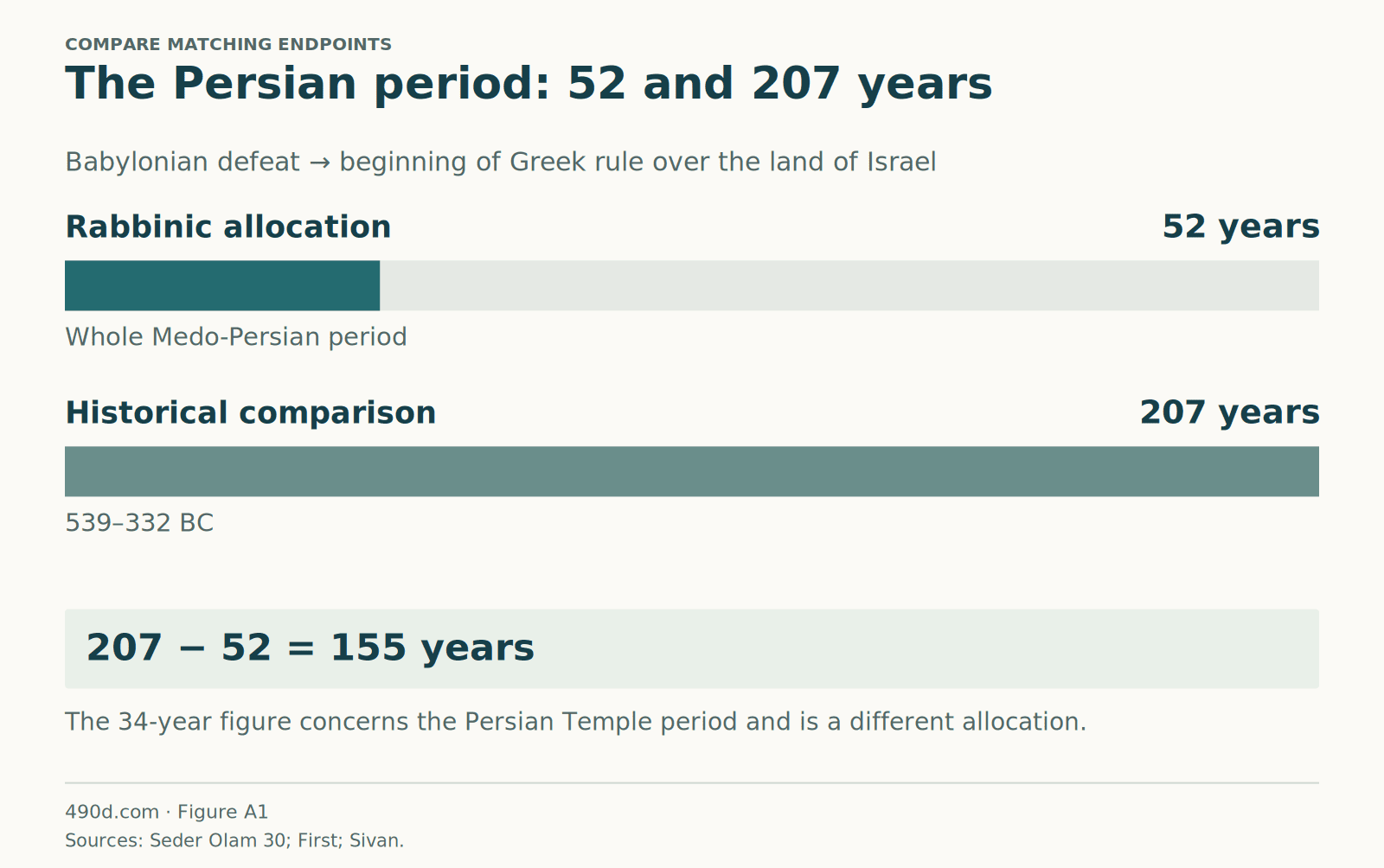
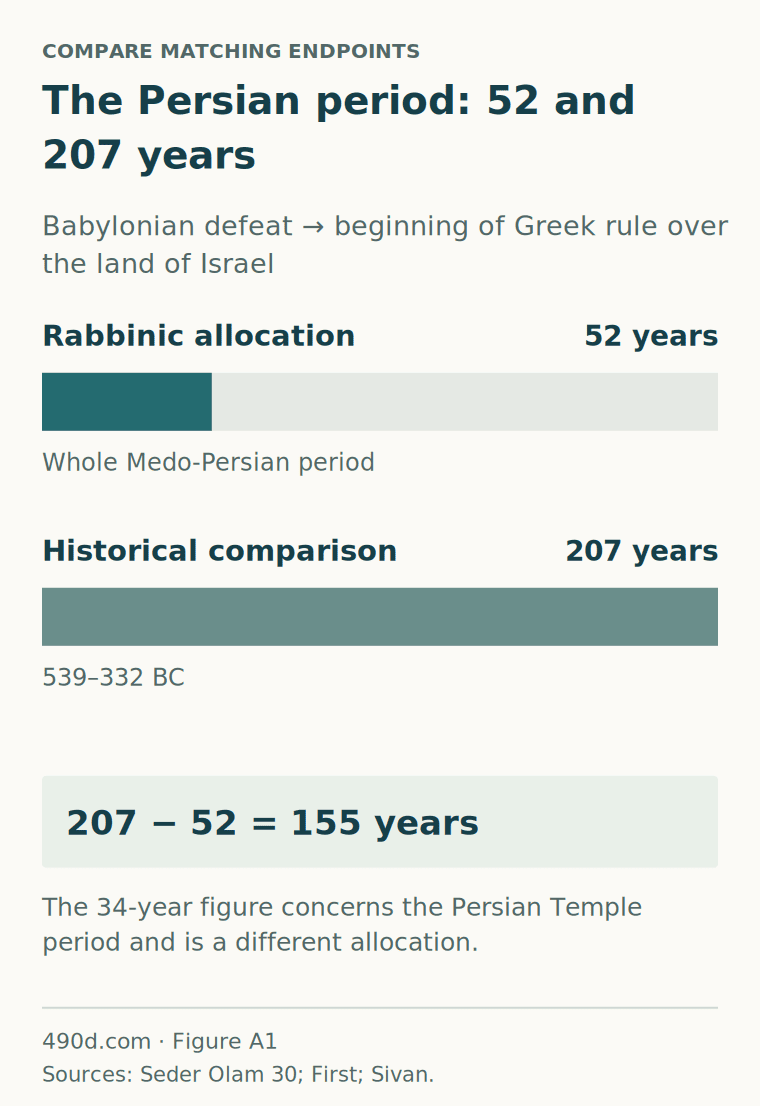
The cleanest comparison concerns the whole period from the Babylonian defeat to the beginning of Greek rule over the land of Israel. The rabbinic allocation is 52 years; the historical labels 539–332 BC span 207 years. This is the comparison set out in Mitchell First’s description of Jewish History in Conflict and supported by Hagith Sivan’s account of Achaemenid Jerusalem.
Compare matching endpoints
The Persian period: 52 and 207 years
Babylonian defeat → beginning of Greek rule over the land of Israel
Whole Medo-Persian period
539–332 BC
The 34-year figure concerns the Persian Temple period and is a different allocation.
Sources: Seder Olam 30; First, book description; Sivan, “Jerusalem and Iran”.
Full text description
From the Babylonian defeat to the beginning of Greek rule over the land of Israel, the rabbinic scheme allocates 52 years. The historical labels 539 BC to 332 BC span 207 years. The difference is 155. The separate figure of 34 years concerns Persian rule in the Temple period.
On a narrow screen, scroll the table sideways to see every column.
| Interval or allocation | Rabbinic years | Historical year labels | Computed years | Difference |
|---|---|---|---|---|
| Whole Persian period over the land of Israel | 52 | 539–332 BC | 207 | 155 |
| Persian Temple-era allocation versus interval from completion | 34 | 515–332 BC | 183 | 149 |
| Second-Temple allocation versus interval from completion | 420 | 515 BC–AD 70 | 584 | 164 |
| First destruction to Roman destruction | 490 | 586 BC–AD 70 | 655 | 165 |
The Temple rows deliberately state their counting basis. The 34-year rabbinic allocation is associated with the Temple’s renewed building/standing period; its construction stages are not identical to a modern interval beginning at completion in 515 BC. Farber notes the traditional reckoning from Darius’s second year, while Seder Olam 29 also reports completion in his sixth. The rows therefore compare stated Temple-era allocations with explicitly chosen historical completion intervals, rather than claim exact agreement over the building phase.
The selected historical comparison uses the Society for Old Testament Study’s 515 BC completion date and its AD 70 Roman destruction date. The destruction-to-destruction row uses 586 BC, the date used on this website and also given by Sivan. The alternative year labels sometimes used in historical literature change the arithmetic: 516 BC → AD 70 gives 585 years; 587 BC → AD 70 gives 656. Such one-year alternatives do not eliminate the much larger disagreement with the rabbinic allocations.
Across BC and AD there is no civil year zero. Thus 515 BC → AD 70 gives 515 + 70 − 1 = 584, and 586 BC → AD 70 gives 586 + 70 − 1 = 655. These are intervals between year labels, not day-level anniversary calculations. The difference 655 − 490 = 165 explains one familiar “165 years” comparison. The different whole-Persian calculation remains 207 − 52 = 155.
4. A duration is not a calendar-era label
The original memorandum placed 3338 AM and 3828 AM beside loosely interchangeable BC/AD equivalents. Their subtraction is straightforward—3828 − 3338 = 490—but translating an AM date requires an era convention and a position within the year.
On a narrow screen, scroll the table sideways to see every column.
| Operation | Starting label | Ending label | Year-label interval |
|---|---|---|---|
| AM subtraction | 3338 AM | 3828 AM | 490 |
| Modern proleptic conversion, Av dates | 423 BC | AD 68 | 423 + 68 − 1 = 490 |
| 490-year illustration ending at historical AD 70 | 421 BC, calculated | AD 70 | 421 + 70 − 1 = 490 |
| Historical destruction comparison selected here | 586 BC | AD 70 | 586 + 70 − 1 = 655 |
These modern calendar conversions illustrate the problem; they do not independently date the historical destructions. Hebcal’s proleptic conversion for Av 3338 falls in 423 BC, and its conversion for Av 3828 falls in AD 68. Their year-label interval is 423 + 68 − 1 = 490. Calling the latter AM date “AD 68–70” obscures the conversion.
If AD 70 is instead fixed as the historical endpoint and a 490-year span is counted back from it, the resulting year label is 421 BC, because 421 + 70 − 1 = 490. That is a separately re-anchored illustration; it is not the same calculation as converting Av 3338 in today’s AM system.
Sacha Stern and TheTorah.com’s staff editors explain that event-to-event chronologies and dating eras developed differently, with several eras used across Jewish history. A traditional total should therefore be distinguished from the later numbering of calendar years. Their article is jointly credited because the published presentation was rewritten by the staff with Stern’s oversight.
The same care applies within 490d. File 20 §7A displays a subordinate Seder Olam comparison re-anchored to the website’s Exodus in 1446 BC. Its own BC labels, such as Abraham at 1946 BC, belong to that declared comparison. They are not conversions from the conventional rabbinic AM era.
5. The ten-week narrative, with textual references
The table follows the numerical sequence of 1 Enoch 93:1–10; 91:11–17. The concise descriptions paraphrase the passage. Names in the interpretation column identify the usual historical reading; several are not written explicitly in the corresponding verse.
On a narrow screen, scroll the table sideways to see every column.
| Week | Narrative feature | Usual identification or explanation | 1 Enoch passage |
|---|---|---|---|
| 1 | Enoch, seventh; righteousness | Enoch is named | 93:3 |
| 2 | Evil, destruction, a survivor | Noah and the Flood | 93:4 |
| 3 | A chosen man and righteous descendants | Abraham and his line | 93:5 |
| 4 | Revelation, law, an enclosure | Sinai and the tabernacle | 93:6 |
| 5 | A house of glory and dominion | Solomon’s Temple | 93:7 |
| 6 | Apostasy, ascent, burning, dispersion | Elijah; First Temple destruction and exile | 93:8 |
| 7 | Apostasy; chosen righteous; instruction and judgment | The pivotal righteous community | 93:9–10; 91:11 |
| 8 | Righteous judgment; a lasting house | House of the Great King | 91:12–13 |
| 9 | Righteous judgment disclosed | Worldwide horizon | 91:14 |
| 10 | Angelic judgment; a new heaven | Seventh part of the tenth week | 91:15–16 |
| Beyond | Unnumbered righteous weeks | Beyond the ten numbered periods | 91:17 |
Enoch is explicitly seventh in the first week, and the tenth week explicitly reaches a seventh part. These features support the seven-part reading of each week. They do not supply a complete list of seventy named ancestors, seventy identical biological generations, or a uniform ordinary-year length. Church discusses the generational arrangement; Stuckenbruck’s 2021 chapter distinguishes the implied parts from any inference of equal duration.
A separate passage, 1 Enoch 10:12, explicitly speaks of seventy generations of confinement for the Watchers. Its narrated scope runs from their punishment toward judgment. Its seventy generations should not be equated automatically with the ten-week survey of history; the passage likewise gives no fixed number of ordinary years per generation.
6. What 4Q212 establishes
The Aramaic manuscript 4Q212 is also designated 4QEnochg. The Israel Antiquities Authority’s archive identifies the surviving material and provides photographs. Church dates the manuscript around 50 BC and explains that the counterparts of 93:10 and 91:11 occur consecutively. This corroborates the numerical sequence used by critical editions.
The correct junction is therefore 93:10 → 91:11. Verse 91:11 completes the Week 7 unit; Week 8 begins at 91:12. The whole displaced block cannot accurately be labeled “Weeks 8–10” without acknowledging its opening completion of Week 7.
The manuscript is damaged. Weeks 3–6 are missing in its surviving text, and other portions are fragmentary. Consequently, pre-Christian attestation of the apocalypse is stronger evidence than a claim that this particular fragment physically preserves every line about the Temple’s burning. A wholly post-AD 70 origin is incompatible with the witness; a theory about subsequent editing of a particular lost line would need separate textual evidence.
Many scholars place the apocalypse’s composition in the early second century BC, often before the Maccabean revolt; the exact date and compositional history remain debated. The date of a surviving manuscript, the original composition, and a later rearrangement in transmission are three different questions. The first-century-BC manuscript supplies evidence for the first of these, not an exact answer to all three.
The Repository explores a further hypothesis in File 68 §§1–2: an early ten-week edition may preserve an older seven-week composition whose ending-tradition survives in 91:8–10. File 68 also preserves substantial evidence for the ten-week work’s integration. The proposed older core remains unproved; no recovered seven-week-only manuscript is being claimed here.
7. Modern applications and the limits of a numerical parallel
On a narrow screen, scroll the table sideways to see every column.
| Model | One part | One seven-part week | Conditional ten-week total |
|---|---|---|---|
| 490d primary applied measure | 70 years | 490 years | 4900 years |
| 490d bounded companion | 72 years | 504 years | 5040 years |
| Pratt’s separate 2015 proposal | 104 proposed Enoch-calendar years | 728 proposed Enoch-calendar years | 7280 proposed Enoch-calendar years |
The conditional ten-week totals in this table explain what added unit choices would do. They do not replace File 68’s own seven-week construction or its separately interpreted final three weeks. In particular, the file does not require appending three new linear 490-year periods after its established seven-week sequence.
John P. Pratt’s 2015 article uses a different chronology from the 490d models. His AD 70 interpretation of Week 6 belongs inside a proposed 728-year block. B. J. Oropeza’s 2024 article instead identifies that week with Elijah and the First Temple’s destruction. Both should be credited for the readings they actually offer. Neither furnishes an ancient rabbinic statement that Seder Olam was arranged to fulfill Enoch.
Stuckenbruck discusses relationships among Enochic and Danielic ways of dividing time while recognizing the difficulty of establishing direct influence. Ulrich distinguishes texts that interpret Daniel from texts sharing its interests in sacred periods and restoration. These studies support comparison without supplying a demonstrated chain of borrowing from Enoch to Daniel to Seder Olam.
Shortening a duration between two destructions also does not merge the destructions. To relocate the end of Enoch’s sixth week, an interpreter must establish an epoch, the duration of its units, and the intended event. The original memorandum supplied none of those steps for a rabbinic Enoch calculation. Its categorical answer has therefore been replaced by an open historical question.
8. The tenth jubilee in 11QMelchizedek
11Q13 II.6–9 connects liberation with jubilee and atonement language. The tenth-jubilee and Day-of-Atonement wording is central to II.7b–8. It provides a relevant ancient comparison for readers interested in Daniel’s seventy weeks and the transformation of calendrical institutions into expectations of restoration.
The damaged beginning of the jubilee statement has been reconstructed differently. The older reading places the relevant liberation setting in the first week after nine jubilees; Ariel Feldman’s 2018 proposal, adopted by Logan Williams in 2023, reads a beginning after ten jubilees. Williams prints the Hebrew, his translation, and the editorial sources he follows. This revision relies on that inspected discussion, with Feldman’s original note credited through it. It makes no independent judgment about the manuscript’s ink traces.
The comparison used in the main article is therefore limited to the tenth-jubilee, liberty, and atonement framework. The arithmetic 10 × 49 = 490 states a forty-nine-year cycle convention; it does not establish an exact civil date or settle the disputed boundary.
9. What changed from the 2025 memorandum
The earlier page was an AI research memorandum dated 23 August 2025, prepared by ChatGPT (GPT-5 Thinking) in response to a targeted question from Dean Coombs. Astra Pro (ChatGPT AI assistant) carried out the source checking, chronological review, and editorial revision for this 7 October 2026 edition. The revision retains the original provenance and research question, reassesses the conclusions against the linked sources and additional scholarship, and checks the calculations and compatibility with the Unified Repository.
On a narrow screen, scroll the table sideways to see every column.
| Original claim or treatment | Disposition | Reason |
|---|---|---|
| Daniel and the rabbinic 490 | Retained | Seder Olam expressly relates the two Temple destructions to Daniel’s seventy weeks. |
| “34 years of Persian dominance” | Qualified | 34 describes the Persian Temple allocation; the broader total is 52. |
| One universal “165 missing years” | Replaced with specified comparisons | 52 versus 207 differs by 155; destruction-to-destruction figures can differ by 165. |
| 3338/3828 AM and loose BC/AD equivalents | Corrected | AM subtraction, modern proleptic conversion, and re-anchoring to AD 70 are distinguished. |
| Knowing concealment; anti-Christian purpose | Removed as established conclusions | The citations do not demonstrate those intentions. |
| Rabbinic compression moves Enoch Week 6 to AD 70 | Removed | No Enochic epoch, unit calculation, or ancient rabbinic citation establishes this. |
| Pratt as evidence for post-AD 70 composition/editing | Corrected | His article proposes a modern 728-year-week interpretation and does not make that argument. |
| Whole apocalypse first composed after AD 70 | Rejected | A pre-Christian Aramaic witness rules out that claim. |
| Every clause of Week 6 proven early by 4Q212 | Not asserted | The surviving manuscript has a gap across Weeks 3–6. |
| Ten weeks / generations; sixth / seventh | Corrected | Ten seven-part periods are distinguished from their parts; Temple-burning is Week 6. |
| Elijah placed in an eighth-to-sixth-century setting | Removed | The broad dating was inaccurate; the revised narrative gives the identification without it. |
| Blanket confirmation of the initial hypothesis | Rewritten | The Daniel relationship is explicit; an Enochic influence on the rabbinic calculation remains unestablished. |
The revision also removes conversational assurances and repeated claims of certainty, supplies explicit units, and adds the Qumran jubilee comparison and the distinction between intervals and calendar eras. The original source is preserved in the publication package as an editorial record. No canonical Repository Markdown has been rewritten.
10. Sources and credits
These references identify the evidence used and the people responsible for the interpretations. Ancient texts are paraphrased except for the short, credited BSB quotation in the main article. The charts are new explanatory graphics prepared from the cited facts; no scholar’s figure or manuscript photograph is reproduced.
Primary texts and historical evidence
- Biblical texts. Daniel 9:2, 24–27; Leviticus 25:8–10; 2 Chronicles 36:20–23. Berean Standard Bible. Daniel 9 · Leviticus 25 · 2 Chronicles 36 · Public-domain notice.
The quoted opening of Daniel 9:24 is BSB; other passages are summarized. - Seder Olam Rabbah. Chapters 28–30; Hebrew text via Sefaria. Chapter 28 · Chapter 29 · Chapter 30 · Chapters 21–30.
Traditional chronology and corrected numerical readings; compare the Talmudic parallel. - Babylonian Talmud. Avodah Zarah 9a. English Soncino translation hosted at Halakhah.com. Text.
The four durations are paraphrased as numerical data; no extended translation is reproduced. - R. H. Charles, translator. “The Book of Enoch,” in The Apocrypha and Pseudepigrapha of the Old Testament, vol. 2 (Oxford: Clarendon, 1913), digital text at CCEL. Section V · Section I.
Historical public-domain translation; modern manuscript work controls the transmission discussion. - Israel Antiquities Authority. Leon Levy Dead Sea Scrolls Digital Library: 4Q212 / 4QEnoch g, image record B-371256. Archive record.
Manuscript identification. Shai Halevi is credited for the archive photograph; it is linked, not reproduced. - Hagith Sivan. “Jerusalem and Iran.” Encyclopaedia Iranica 14.6 (2008): 632–634; updated 2012. Article.
539–332 BC Achaemenid period over Judea; 586 BC destruction comparison. - Society for Old Testament Study. “Temple.” SOTS Wiki. Article.
515 BC completion and AD 70 destruction used for the stated historical interval. - Hebcal. Hebrew Date Converter: proleptic conversions of Av 3338 and Av 3828. Av 3338 · Av 3828.
Calendar conversion only; not independent dating of ancient events.
Scholarly analysis used in the revision
- M. Seligsohn and the Executive Committee of the Editorial Board. “Seder ’Olam Rabbah.” The Jewish Encyclopedia (1901–1906). Article.
An original citation retained with its actual byline and bounded explanatory role. - Mitchell First. Jewish History in Conflict: A Study of the Major Discrepancy between Rabbinic and Conventional Chronology (Jason Aronson, 1997). Author’s description · Publisher record.
The author’s description directly states 52 versus 207; the complete monograph was not inspected. - Zev Farber. “Persia’s Achaemenid Dynasty—If You Read the Bible Without History.” TheTorah.com (2024). Article.
Persian king identifications and regnal counting; explicitly draws on Milikowsky. - Chaim Milikowsky, editor. Seder Olam: Critical Edition, Commentary, and Introduction. 2 vols. (Jerusalem: Yad Ben-Zvi, 2013), Hebrew. Publisher.
Critical-edition credit; publication details verified. Commentary used indirectly through Farber, not represented as fully inspected. - Sacha Stern and Staff Editors. “The Calendar: When Did We Begin Counting from Creation?” TheTorah.com, 21 September 2025. Article.
Calendar-era history. The article credits a Stern submission rewritten with staff and his oversight. - Philip Church. “The Temple in the Apocalypse of Weeks and in Hebrews.” Tyndale Bulletin 64.1 (2013): 109–128. Article PDF · DOI.
Enochic narrative, textual order, surviving manuscript gaps, and dating discussion. - Loren T. Stuckenbruck. “The Apocalypse of Weeks: Periodization and Tradition-Historical Context.” In Four Kingdom Motifs before and beyond the Book of Daniel, edited by Andrew B. Perrin and Loren T. Stuckenbruck, 81–95 (Leiden: Brill, 2021). Chapter DOI · Open volume.
The whole chapter was consulted. Its parts, duration, and relationship arguments are distinguished from the website’s models. - Loren T. Stuckenbruck. 1 Enoch 91–108 (Berlin: Walter de Gruyter, 2007). Publisher preview.
Selected preview portions concerning structure and division of time were consulted, not the whole volume. - Dean R. Ulrich. “How Early Judaism Read Daniel 9:24–27.” Old Testament Essays 27.3 (2014). Article.
Variety of ancient interpretations and the distinction between interpreting Daniel and sharing its themes. - Logan Williams. “Melchizedek, the Son of Man, and Eschatological Jubilee: The Sin-Forgiving Messiahs in 11QMelchizedek and Mark.” Journal for the Study of the New Testament 46.2 (2023): 111–149. Article DOI.
Inspected Hebrew/translation and jubilee-boundary discussion; the article’s broader Mark thesis is outside this study. - Ariel Feldman. “New Light on the Ten Jubilees of 11QMelchizedek (11Q13).” Dead Sea Discoveries 25.2 (2018): 178–184. DOI.
Revised reading credited through the abstract and Williams’s inspected discussion; no independent palaeographic verdict claimed.
Modern interpretations cited in the original memorandum
- Shimon Schwab. “Comparative Jewish Chronology?” In Selected Speeches (1991), pp. 255–285. Original essay and epilogue.
Twentieth-century hypothesis and the author’s own reconsideration/retraction, both retained in the appendix; no ancient Enoch motive inferred. - B. J. Oropeza. “The Apocalypse of Weeks in 1 Enoch: A Neglected Prophecy.” Patheos, 11 January 2024. Article.
Retained for the explanation it actually gives: Elijah and the First Temple’s destruction in Week 6. - John P. Pratt. “Enoch’s Ten Week Prophecy.” 24 May 2015. Article.
Credited as an independent modern 728-year-week proposal, without attributing it to the rabbis or to scholarly consensus.
Website model and research provenance
- Astra Pro (ChatGPT AI assistant). Source checking, chronological review, and editorial revision, 7 October 2026. Revised article.
Reviewed the ancient texts and cited scholarship, checked the calculations and Repository compatibility, and prepared the revised explanations, tables, and diagrams. - 490d Unified Chronology. File 17 §7; File 20 §7A; File 68 §§0–4, 12 and Appendix A. File 17 · File 20 · File 68 · Current source index.
These canonical sources remain unchanged and retain their own claim classifications. - ChatGPT (GPT-5 Thinking), prepared for Dean Coombs. “Rabbinic Chronology and the 490-Year Prophecy and the Book of Enoch’s Ten Heptad Generations.” Research memorandum, 23 August 2025. Existing page URL.
Original provenance retained. This October 2026 edition replaces its prose after source checking; an original snapshot accompanies the publication package.