This appendix supports Noah’s Flood: Forty Days, 150 Days, and a New Beginning. It provides the textual durations, dated-event calculations, bird sequence and edition comparison behind the illustrations. The Masoretic Text (MT) account as rendered in the BSB supplies the principal narrative. Brenton’s Septuagint (LXX) translation is identified separately wherever its different dates are used.
On smaller screens, swipe tables horizontally to see every column. Keyboard users can focus a table and use the arrow keys.
A. The stated durations
| Event | Days | Source (BSB) | Scope |
|---|---|---|---|
| Warning before Flood onset | 7 | Genesis 7:4, 10 | Stated interval preceding the onset |
| Rain | 40 | Genesis 7:12 | Stated duration; included within the 150-day period in the continuous reading used here |
| Prevailing / receding waters | 150 | Genesis 7:24; 8:3 | One period referred to twice; not two successive 150-day blocks |
| Later wait before window opens | 40 | Genesis 8:6 | Stated duration; exact month/day starting point not stated in verse |
| Wait before the dove brings an olive leaf | 7 | Genesis 8:10–11 | Explicit wait between first and second dove sendings |
| Wait before the dove no longer returns | 7 | Genesis 8:12 | Explicit wait between second and third dove sendings |
The two 150-day references, Genesis 7:24 and 8:3, describe the same interval in the continuous reading used by the article. The five months between the outbreak and the Ark’s resting correspond to 150 days when thirty-day months are stipulated. That reading includes the initial forty days of rain within the 150; it does not add the forty before a new 150-day interval.
The subtraction 150 − 40 = 110 is an analytical consequence of that reading. The text does not separately label a 110-day stage. Likewise, a literary arrangement of the repeated numbers 40–150–150–40 is not a list of four consecutive elapsed intervals. Literary repetition and calendar succession must be examined separately.
Genesis 8:6 names the later forty-day wait without explicitly naming its starting date. Reading it from the immediately preceding dated appearance of the mountain tops is a possible reconstruction; placing it from the Ark’s resting is a different proposal. Neither should be concealed inside a table headed “biblical dates.” The introductory figure therefore leaves this wait without an exact month-and-day position.
Download the duration register.
B. Dated events and the declared calendar
This table uses 12 × 30 = 360 days, no intercalation, with the beginning of the Flood as its principal origin: Noah-year 600, month 2, day 17. It is a transparent schematic calculation, not an assertion that Genesis establishes every month length throughout the year.
For Noah-year Y, month M and day D:
Elapsed days from Flood onset = 360 × (Y − 600) + 30 × (M − 2) + (D − 17).
| Event | Noah-year / month / day | Elapsed from Flood onset | Source (BSB) |
|---|---|---|---|
| Flood begins | 600 / 2 / 17 | 0 | Genesis 7:11 |
| Ark rests on the mountains of Ararat | 600 / 7 / 17 | 150 | Genesis 8:4 |
| Mountain tops become visible | 600 / 10 / 1 | 224 | Genesis 8:5 |
| Noah removes covering; surface dry | 601 / 1 / 1 | 314 | Genesis 8:13 |
| Earth completely dry | 601 / 2 / 27 | 370 | Genesis 8:14 |
The 150-day datum is stated in Genesis 7:24 and 8:3. Its agreement with the five-month date interval is exact under this calendar. The later offsets of 224, 314 and 370 are calculated; Genesis prints the corresponding dates rather than those continuous day counts.
| Interval | Calculation in the declared scheme | Elapsed days |
|---|---|---|
| Flood begins → Ark rests | 150 − 0 | 150 |
| Ark rests → mountain tops visible | 224 − 150 | 74 |
| Mountain tops visible → surface dry | 314 − 224 | 90 |
| Surface dry → earth completely dry | 370 − 314 | 56 |
| Ark rests → earth completely dry | 370 − 150 | 220 |
| Flood begins → earth completely dry | 150 + 74 + 90 + 56 | 370 |
Genesis 8:13 and 8:14 distinguish the surface-dry observation from the earth’s complete dryness. Verses 15–19 then give the command to leave and the departure without a further explicit month-and-day date. The table’s final dated event is therefore earth completely dry. It is not a claim that a separate dated verse identifies the moment of disembarkation.
Under the same stipulated calendar, 370 elapsed days span 371 endpoint-inclusive dates. Another calendar would require a fresh calculation, not a silent adjustment. File 12 distinguishes its Prophetic 360-day and Enochian 364-day registers; it does not authorize substituting one into a table calculated from the other.
Download the dated-event table. The download also includes counts from the alternative year origin discussed in §D.
C. The raven and the three dove sendings
| Sending | Reported result | Interval before sending | Source (BSB) |
|---|---|---|---|
| Raven sent out | Goes back and forth until the waters dry | After the later forty-day wait and opening of the window | Genesis 8:6–7 |
| First dove sending | No resting place; returns to Noah | No explicit numbered interval after the raven is given | Genesis 8:8–9 |
| Second dove sending | Returns in the evening with a freshly plucked olive leaf | 7 days | Genesis 8:10–11 |
| Third dove sending | Does not return | 7 days | Genesis 8:12 |
Two seven-day waits are explicitly stated between the dove sendings. They total 14 days. The wording of Genesis 8:10 refers to another seven-day wait, which can suggest an earlier waiting pattern, but the account does not independently specify a seven-day raven-to-first-dove interval. The introductory diagram leaves that gap unnumbered.
Nor do the three dove reports constitute three forty-day periods. The later forty in Genesis 8:6 precedes the window opening; the subsequent explicitly numbered waits are seven days each. Exact dates for the bird episodes depend on how the later forty and any unstated intervals are placed.
The raven’s continued activity, the dove’s first return, the olive leaf, and the dove’s final absence remain distinct observations. Noah’s exit is not dated by the bird’s nonreturn; the divine command and the exit are narrated later.
Download the bird-sequence table.
D. Elapsed days, numbered days and the older 410/417 framework
Changing an origin changes the labels attached to an event. It does not change the interval between two fixed events. In a numbering system that starts with day 1:
Numbered day = elapsed days from the origin + 1.
| Origin | Onset: completed days | Dry earth: completed days | Onset: numbered day | Dry earth: numbered day |
|---|---|---|---|---|
| Flood onset: year 600, month 2, day 17 | 0 | 370 | 1 | 371 |
| Start of Noah-year 600: month 1, day 1 | 46 | 416 | 47 | 417 |
| Seven-day warning before Flood onset | 7 | 377 | 8 | 378 |
Figure 4 · Noah’s Flood
Day 417 depends on the origin
Changing the counting origin changes the labels. The interval between the same two dates stays fixed.
Origin: Flood begins
Origin: Noah-year 600 begins
Same year origin; numbered days
Sources: Genesis 7:4, 10–11 (BSB) · Genesis 8:14 (BSB) · File 12: calendar assumptions · File 17: distinguish numerical units.
Model and calculation details
From the Flood onset, the earth-dry endpoint is 370 elapsed days later, or numbered day 371 when the onset is day 1. From 600 / 1 / 1, onset and dry earth are at 46 and 416 elapsed days, or numbered days 47 and 417. From the seven-day warning, dry earth is 377 elapsed days later, or numbered day 378; this changes the origin again. Subtracting seven from the year-origin label 417 produces 410 arithmetically but does not identify a dated Flood endpoint in Genesis.
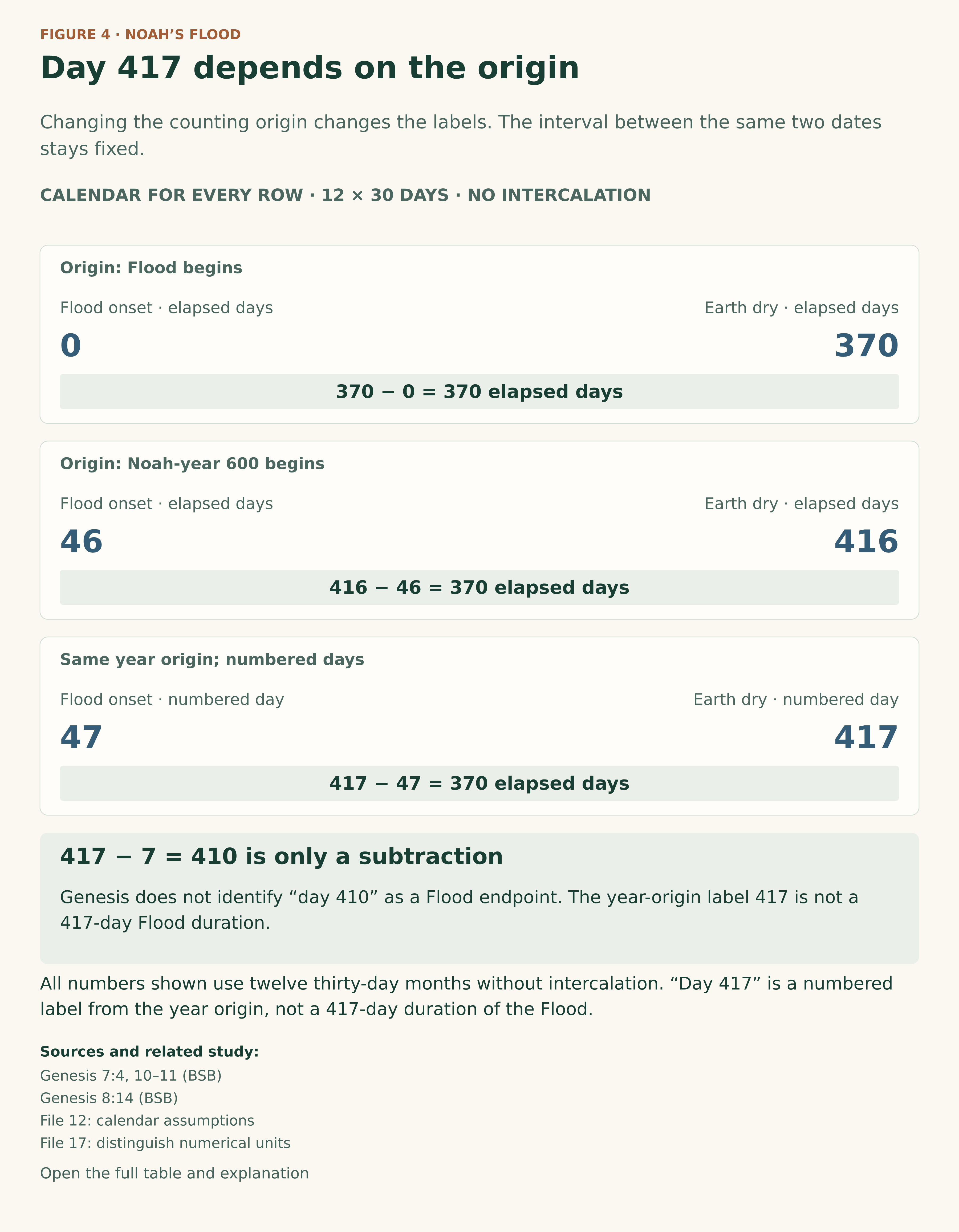
The first row starts at the Flood itself. The second starts at month 1, day 1 of Noah-year 600, which precedes the outbreak by 46 completed days under the stated calendar. The third starts seven days before the outbreak, using the warning interval in Genesis 7:4, 10, BSB.
The same end-to-end duration appears in all three rows:
370 − 0 = 416 − 46 = 377 − 7 = 370 elapsed days.
The year-origin row also gives 417 − 47 = 370 when numbered days are subtracted. Including the warning produces 377 elapsed days from that earlier warning origin, not 377 days from the Flood’s beginning. The 377 and 417 therefore belong to different kinds of count with different starting points.
What is retained from the older table?
The older presentation uses several useful dates but mixes zero-based offsets and one-based day labels. A consistent table from Noah-year 600, month 1, day 1 gives:
| Event | Completed days from year origin | Numbered day |
|---|---|---|
| Flood begins | 46 | 47 |
| Ark rests | 196 | 197 |
| Mountain tops visible | 270 | 271 |
| Surface dry | 360 | 361 |
| Earth completely dry | 416 | 417 |
Thus 417 can be retained as a numbered-day label. It is neither 417 completed days from the year origin nor the Flood’s onset-to-dry-earth duration.
The arithmetic 417 − 7 = 410 is valid, but a subtraction alone does not supply an independently dated Flood event. The legacy’s proposed 410-year spans and doubled chronological overlays require additional origins and transformations. They are not part of the introductory argument. Their totals also need to distinguish 410 + 410 = 820 from 410 + 7 + 410 = 827. Two 410-year spans sharing seven years would instead cover 410 + 410 − 7 = 813 years. Adjacent intervals, an intervening interval and overlapping intervals are different constructions.
No projection into patriarchal BC dates is inferred from these day labels. The completed detailed study examines those proposals and their stated chronological settings. This package preserves the original capture without endorsing its unreconciled claims.
Download the origin-comparison table.
E. MT-based BSB and Brenton’s Septuagint dates
The principal table follows the MT-based BSB. Brenton’s Septuagint translation has a different day number for the Flood’s outbreak and the Ark’s resting: 27 rather than 17. Its readings must be calculated as a separate set.
| Event | MT / BSB date | Brenton LXX date | MT elapsed | Brenton elapsed | Edition-specific sources |
|---|---|---|---|---|---|
| Flood begins | 600 / 2 / 17 | 600 / 2 / 27 | 0 | 0 | BSB Genesis 7:11; Brenton Genesis 7:11 |
| Ark rests on the mountains of Ararat | 600 / 7 / 17 | 600 / 7 / 27 | 150 | 150 | BSB Genesis 8:4; Brenton Genesis 8:3 |
| Mountain tops become visible | 600 / 10 / 1 | 600 / 10 / 1 | 224 | 214 | BSB Genesis 8:5; Brenton Genesis 8:5 |
| Noah removes covering; surface dry | 601 / 1 / 1 | 601 / 1 / 1 | 314 | 304 | BSB Genesis 8:13; Brenton Genesis 8:13 |
| Earth completely dry | 601 / 2 / 27 | 601 / 2 / 27 | 370 | 360 | BSB Genesis 8:14; Brenton Genesis 8:14 |
Figure 5 · Noah’s Flood
MT / BSB and Brenton: matched dates
Two explicitly named textual witnesses are compared under the same flat-calendar assumption.
Sources: Genesis 7:11 (BSB) · Genesis 8:4 (BSB) · Genesis 8:5 (BSB) · Genesis 8:13 (BSB) · Genesis 8:14 (BSB) · Genesis 7:11 (Brenton) · Genesis 8:3 (Brenton) · Genesis 8:5 (Brenton) · Genesis 8:13 (Brenton) · Genesis 8:14 (Brenton).
Model and calculation details
This comparison uses the MT-based Berean Standard Bible and the eBible Brenton Septuagint reader, not a composite of all LXX witnesses. Both columns use twelve thirty-day months, no intercalation, with elapsed days counted from their own onset dates. Brenton’s Ark-rest sentence is linked at Genesis 8:3 and the mountain tops at 8:5 in this reader; the corresponding BSB locations are 8:4 and 8:5. Noah’s 600/601 labels are age-year labels. No Samaritan Pentateuch reading is asserted by this comparison.
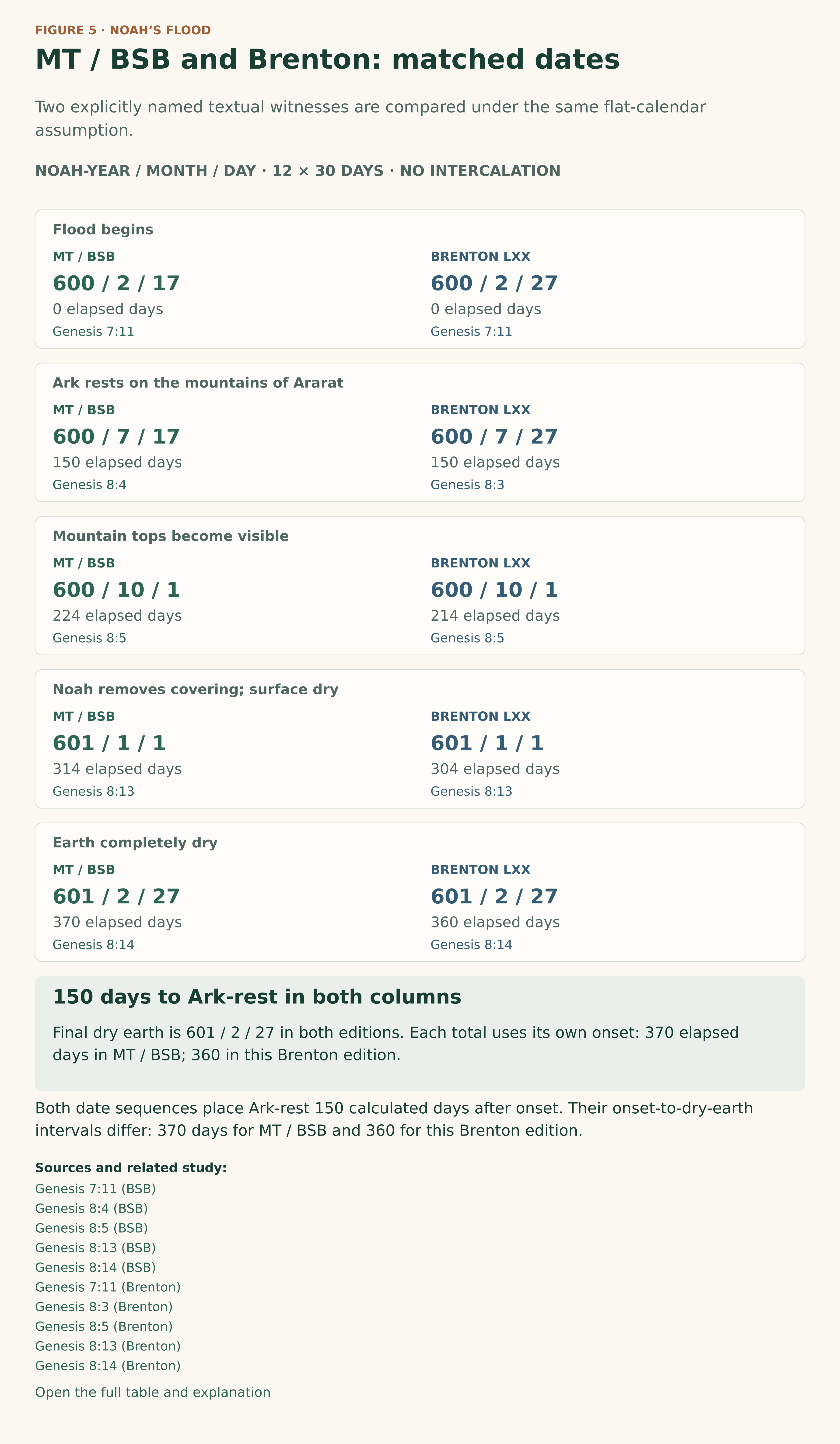
In the linked eBible Brenton edition, the Ark-rest clause is displayed within Genesis 8:3, whereas the BSB places it in 8:4. The mountain-top date appears in 8:5 in both editions. The direct links follow the actual edition’s layout so that each opens the stated datum.
Both readings give a five-month outbreak-to-resting interval. In the flat thirty-day-month scheme, both equal 150 elapsed days. Their full outbreak-to-dry-earth intervals differ because the final dry-earth date remains month 2, day 27:
MT/BSB: 360 + (27 − 17) = 370 days.
Brenton LXX: 360 + (27 − 27) = 360 days.
This is an edition-specific comparison of dates, not a demonstration that every LXX witness is identical. The Samaritan Pentateuch (SP) is a separate textual tradition; no SP reading is silently substituted into either row. The Gregorian or Julian length of a year is also not at issue: both calculations here use the same declared schematic calendar.
Download the matched-reading table.
F. Canonical setting and interpretive boundaries
The article’s main sequence needs Noah’s stated year, month and day labels; it does not depend on assigning an absolute BC date to each event. Where the wider site chronology is invoked, File 02’s normative state remains the regular MT Flood at 2458 BC, Gear 2 / Shem axis, with the full 430 years in Egypt and no optional +60 Terah addition. The following year is 2457 BC in that chronological setting. These are model coordinates, not dates printed in Genesis 7–8.
Files 02 and 18 distinguish that normal state from minimum, alternative-gear, SP, LXX and cumulative states. A shared word such as “Flood,” or a shared numerical label, does not make all those coordinates interchangeable. None of the cumulative Flood-week or restored-Cainan constructions is needed for this introductory calendar.
The same restraint governs day–year interpretation. Numbers 14:34 and Ezekiel 4:6, BSB explicitly assign days to years in their own settings. Extending that operation to the Flood is a further proposal. It must define the source count, the chronological origin and the direction of projection before comparing its result with an independently established event.
Files 17 and 23 likewise keep component arithmetic and typological interpretation distinct. The Noah–Moses tebah connection identifies the Ark and basket narratives; it is not a claim that the Hebrew word occurs only twice as an individual token. The old table’s chronological correspondences and coverage ratios are not presented as a completed statistical demonstration.
G. Source map and downloads
| Source | Control supplied |
|---|---|
| Genesis 7, BSB | Warning, outbreak date, forty-day rain and 150-day waters period |
| Genesis 8, BSB | Recession, Ark resting, later dates, forty-day wait, bird sendings, command to leave and renewed earthly rhythms |
| Genesis 9:8–17, BSB | Covenant with Noah and the living creatures; rainbow sign |
| Genesis 7 and 8, Brenton LXX | Edition-specific twenty-seventh-day readings and linked verse placement |
| File 02, §§0.4–1 | Normal regular MT Flood state and separation of alternative chronological settings |
| File 12, calendar register and §6 | Distinct calendar registers and declared alignment; no silent interchange of year lengths |
| File 17, §§0.1–0.6 | Textual data, inferred components, operations and interpretations kept distinct |
| File 23, §1 | Ark/basket narrative comparison and its interpretive status |
| File 18, regular chronological tables | Chronological coordinates checked alongside the Flood-state controls |
Download the duration register, dated events, bird sequence, origin comparison, or MT/Brenton comparison. The publication package includes the complete cited source captures, full BSB text, diagram sources and a person/event figure index. The supplied canonical files remain unchanged.
Return to Noah’s Flood: Forty Days, 150 Days, and a New Beginning.
Passage links identify the translation. Brenton’s Septuagint readings are separately identified. Dates, calculations and diagrams are analytical presentations, not additional Scripture quotations.
Scripture quotations: Berean Standard Bible (BSB), public domain.