In Luke’s genealogy of Jesus, one short sequence introduces an important chronological question:
… the son of Shelah, the son of Cainan, the son of Arphaxad, …
Read forward from ancestor to descendant, the order is Arphaxad → Cainan → Shelah. The Masoretic Text (MT) of Genesis places Shelah directly after Arphaxad. The Greek Genesis reading represented by Brenton’s Septuagint includes Cainan between them.
That additional generation has two different numerical effects. In a chronology built from ages at fatherhood, Cainan contributes 130 years. In a chronology built from complete lifespans, he contributes 460 years. Both figures describe the same life, measured in different ways.
This is the second Cainan, after the Flood. He is distinct from the earlier Kenan, son of Enosh, whom Luke also calls Cainan. The witness table keeps those names and textual traditions clear.
Supporting tables: The biblical readings · Regular dates · Cumulative coordinates · The Creation comparison.
One life, two measurements
The Greek Genesis passage gives the first part of Cainan’s life as follows:
And Cainan lived a hundred and thirty years and begot Sala;
The passage continues with 330 years after Sala’s birth. Sala is the form of the name rendered Shelah in the BSB. Written as a calculation, the two parts give:
130 + 330 = 460 years.
The first 130 years bring us from Cainan’s birth to his son’s birth. His full 460 years bring us from his own birth to his own death. Luke identifies the place of the name in the genealogy; these age figures come from Greek Genesis.
The Second Cainan · Figure 1
One life, two ways of counting
The second Cainan, between Arphaxad and Shelah
Regular chronology
Counts 130 yearsThe interval from Cainan’s birth to Shelah’s birth.
Cumulative chronology
Counts 460 yearsCainan’s complete lifespan joins the ancestral sum.
The 130 and 330 are the selected LXX figures for Cainan. Applying them to MT is an explicitly restored-Cainan alternative, not the normal MT chronology.
Image version, description, and full-size downloads
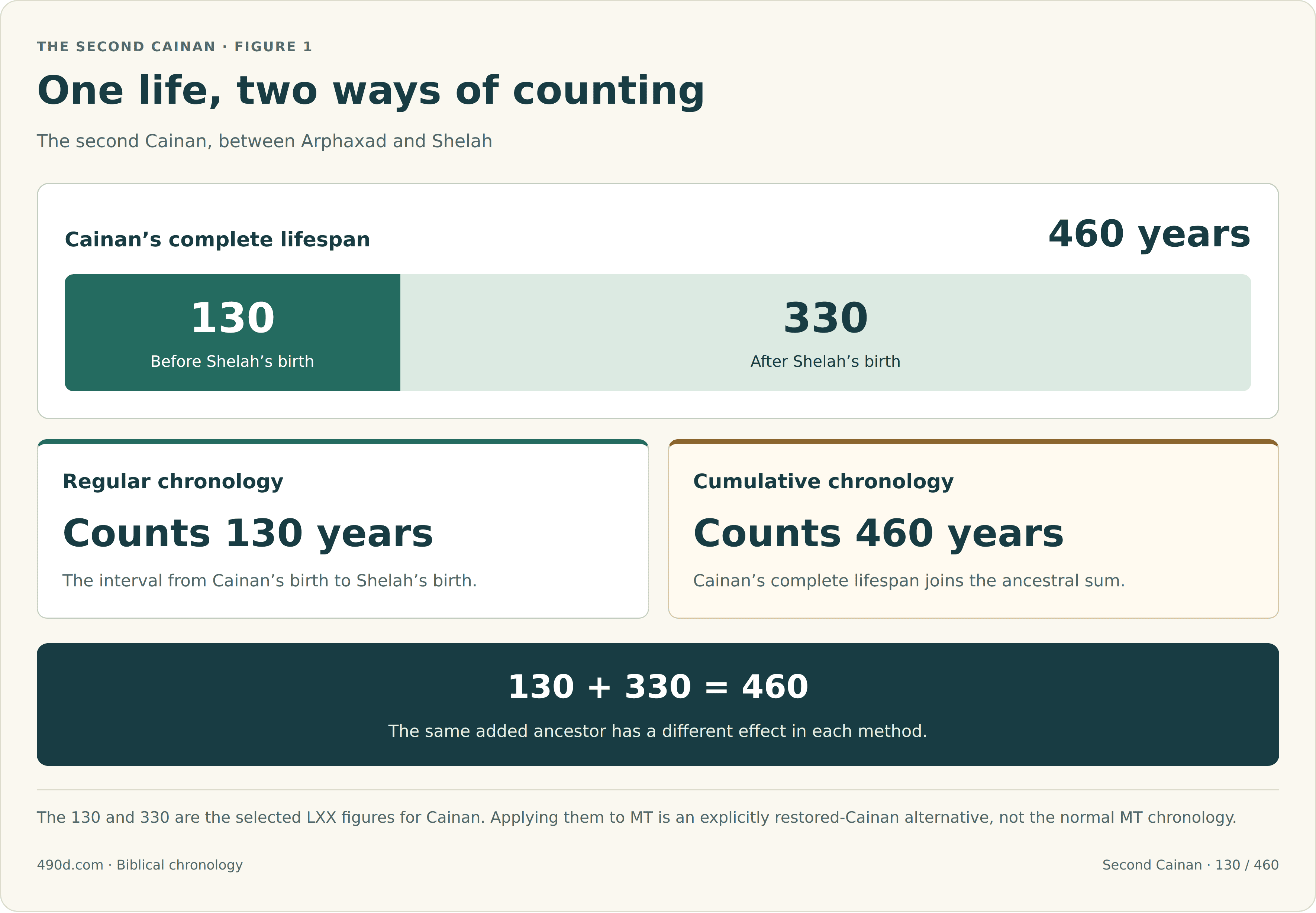
The second Cainan is the ancestor between Arphaxad and Shelah. In the selected LXX reading, Cainan is 130 at Shelah’s birth and lives 330 years afterward, totaling 460. Regular chronology uses 130, the begetting interval. Cumulative chronology uses all 460 years. The bar is proportional to 130:330 at every viewport.
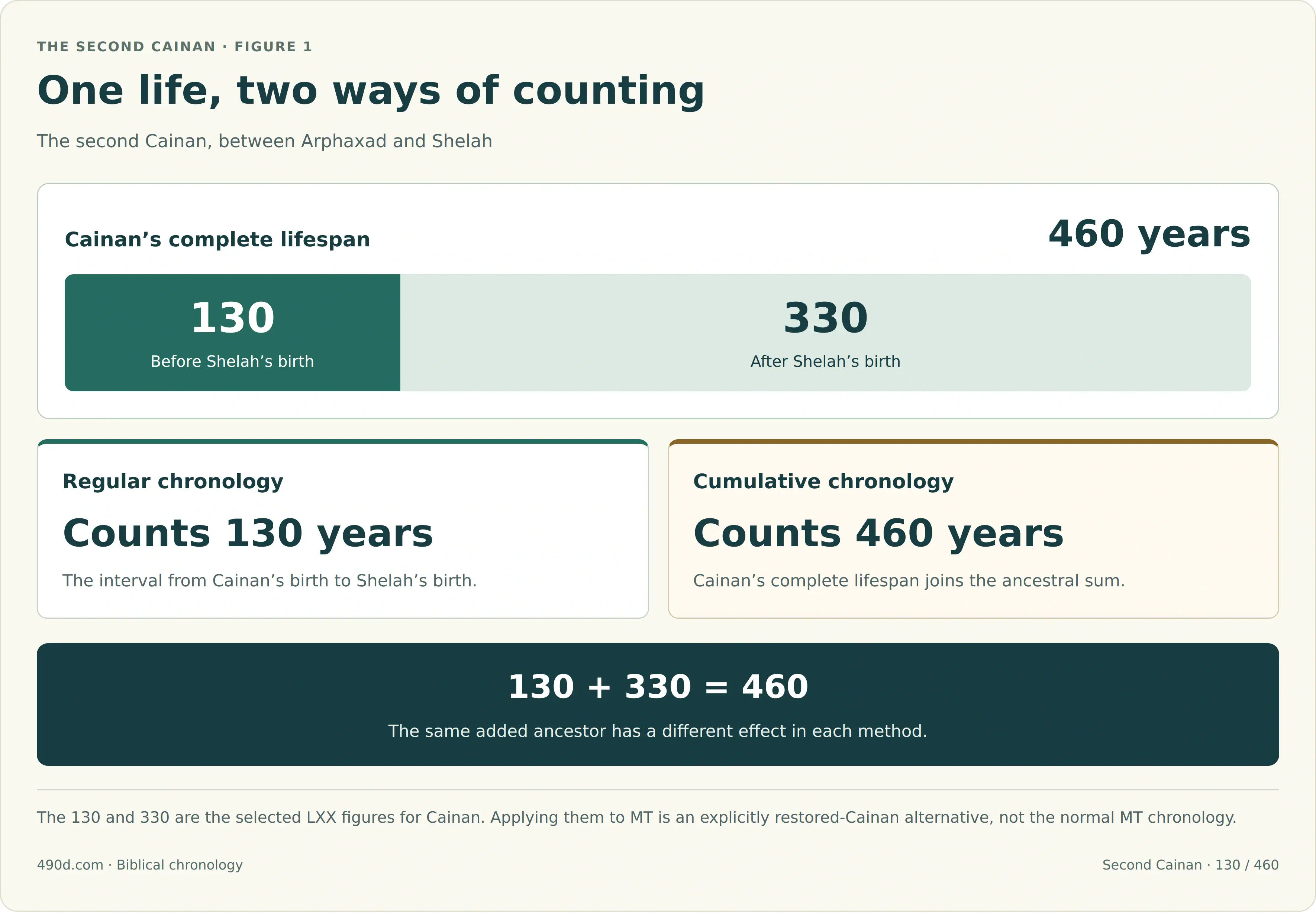
A regular chronology follows successive births, so the 130 belongs in its chain. The remaining 330 years overlap the lives of descendants already being counted. Adding them again to that chain would count overlapping years twice.
A cumulative chronology asks a different question: what total results when the complete lifespans along the ancestral line are placed end to end? For that calculation, Cainan contributes all 460 years. The arrangement is a formal lifespan sum; the historical lives still overlap. The cumulative introduction explains the method from its beginning.
Keeping the comparison clear
Our starting point is the normal MT chronology: 430 years in Egypt, the Nisan framework, and no additional 60 years for Terah. Its normal genealogical chain has no second Cainan.
We can then ask what happens when Cainan’s 130-year fatherhood interval or 460-year lifespan is inserted into that MT framework. This is a defined comparison. The other MT figures are retained; adopting Cainan does not turn the whole table into the LXX chronology.
For example, MT Arphaxad contributes 35 years to the regular calculation and 438 years to the cumulative calculation. Those figures remain unchanged in the comparison. Only the additional Cainan interval is inserted before Shelah.
In the native LXX tables, Cainan is already included. His years must therefore be counted once. The appendix explains the distinction between the textual witness and the comparative calculation.
Where the additional years go
The tables are anchored from the later chronology and worked backward. This makes Shelah the meeting point between the versions with and without Cainan.
In the regular MT chronology, Shelah is born in 2421 BC. Arphaxad’s 35-year fatherhood interval places his birth in 2456 BC. With Cainan inserted, the same fixed Shelah date first takes us back 130 years to Cainan’s birth in 2551 BC, then another 35 years to Arphaxad in 2586 BC.
The cumulative calculation follows the same logic using complete lives. Shelah’s position is 4393 BC. Arphaxad’s 438 years place his cumulative position at 4831 BC. Insert Cainan’s 460 years, and Cainan occupies 4853 BC, while Arphaxad moves back to 5291 BC.
The Second Cainan · Figure 2
The extra years go before Shelah
Keep the later anchor fixed; the earlier coordinates move back.
Regular chronology
Birth-to-birth intervals · All dates BC
Earlier dates move back 130 years. Shelah remains at 2421 BC.
Cumulative chronology
Complete lifespans · Moses-line Nisan coordinates, all BC
Earlier coordinates move back 460 years. Shelah remains at 4393 BC.
Positions are schematic. Cumulative coordinates arrange complete lifespans end to end; they are not ordinary historical birth dates. Shelah is held fixed within each method, not at one date shared by both methods.
Image version, description, and full-size downloads
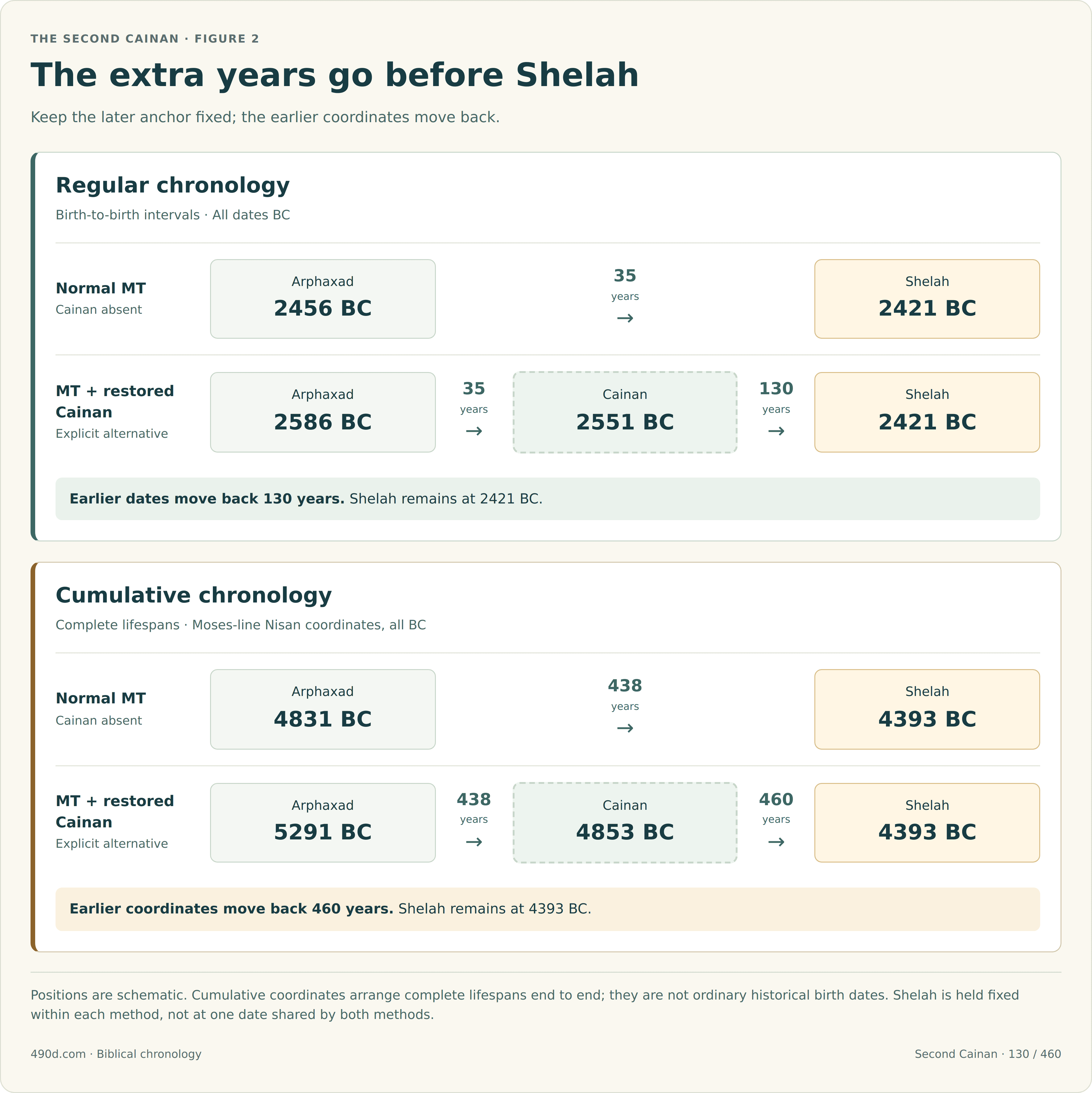
All dates are BC. Regular normal MT: Arphaxad 2456, then 35 years to Shelah 2421. Regular restored Cainan: Arphaxad 2586, then 35 years to Cainan 2551, then 130 years to Shelah 2421. Cumulative normal MT: Arphaxad 4831, then 438 years to Shelah 4393. Cumulative restored Cainan: Arphaxad 5291, then 438 years to Cainan 4853, then 460 years to Shelah 4393. The cumulative dates are Moses-line Nisan coordinates constructed by adding complete lifespans, not ordinary birth dates. Earlier coordinates shift back by 130 or 460; Shelah remains fixed separately within each method. All connecting spans are labeled in years; node spacing is schematic.
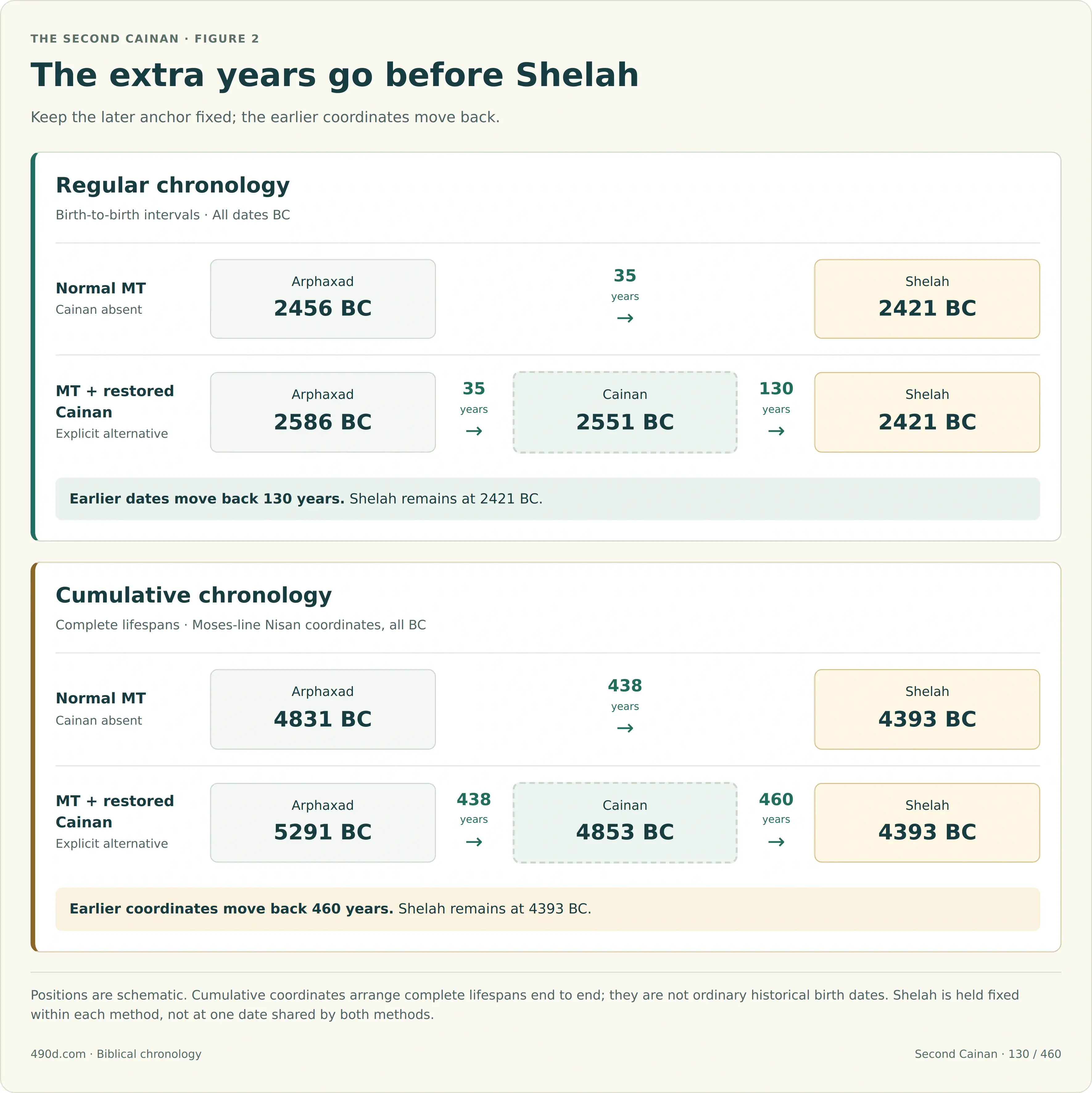
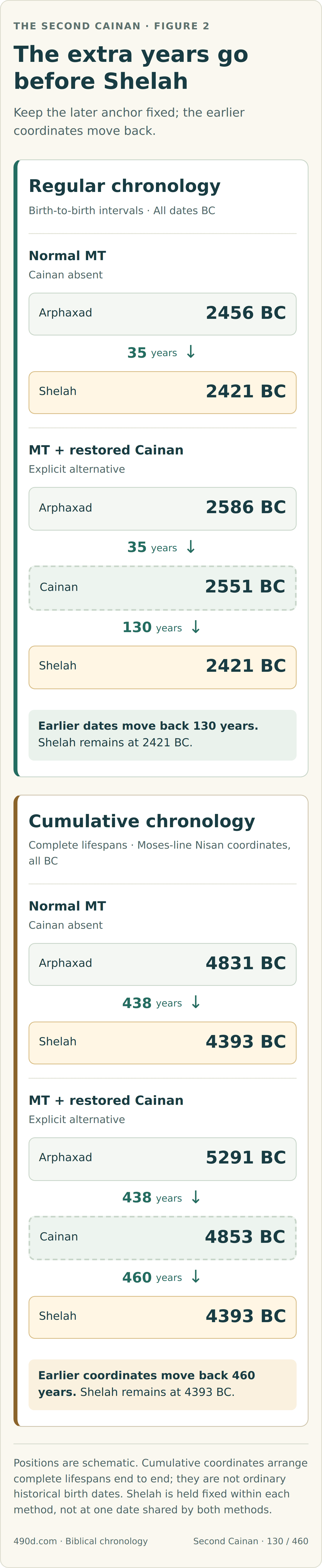
Each comparison leaves Shelah and the later generations unchanged. The additional interval moves Arphaxad and the earlier ancestors backward—by 130 years in the regular table and 460 years in the cumulative table.
The two sets of BC coordinates belong to different constructions. Shelah’s regular birth date is 2421 BC; 4393 BC identifies his place in the lifespan sum. Keeping those meanings visible makes the comparison easy to follow without confusing cumulative positions with ordinary birth dates.
Why the difference is 330 years
The unequal additions also explain how the distance between the two chronologies changes:
460 − 130 = 330 years.
These are exactly the years Cainan lives after Shelah’s birth. The cumulative sum includes them; the birth-to-birth chain has already moved to the next generation.
The relationship can be seen at the beginning of the two chronologies. Compare Adam’s corresponding Year-6 positions within their Creation weeks. Without restored Cainan, the cumulative position is 14006 BC and the regular position is 4116 BC:
14006 − 4116 = 9890 years.
With Cainan included in both constructions, those positions become 14466 BC and 4246 BC:
14466 − 4246 = 10220 years.
The Second Cainan · Figure 3
A 330-year change in the bridge
Compare the same actual Year-6 Creation position in both methods.
Normal MT · Cainan absent
Cainan restored in both
These are matched actual Year-6 coordinates, not Rounded Creation dates. The cumulative coordinate is a lifespan-sum construction. Both comparisons retain the same later anchor and use no +60 Terah shift.
Image version, description, and full-size downloads
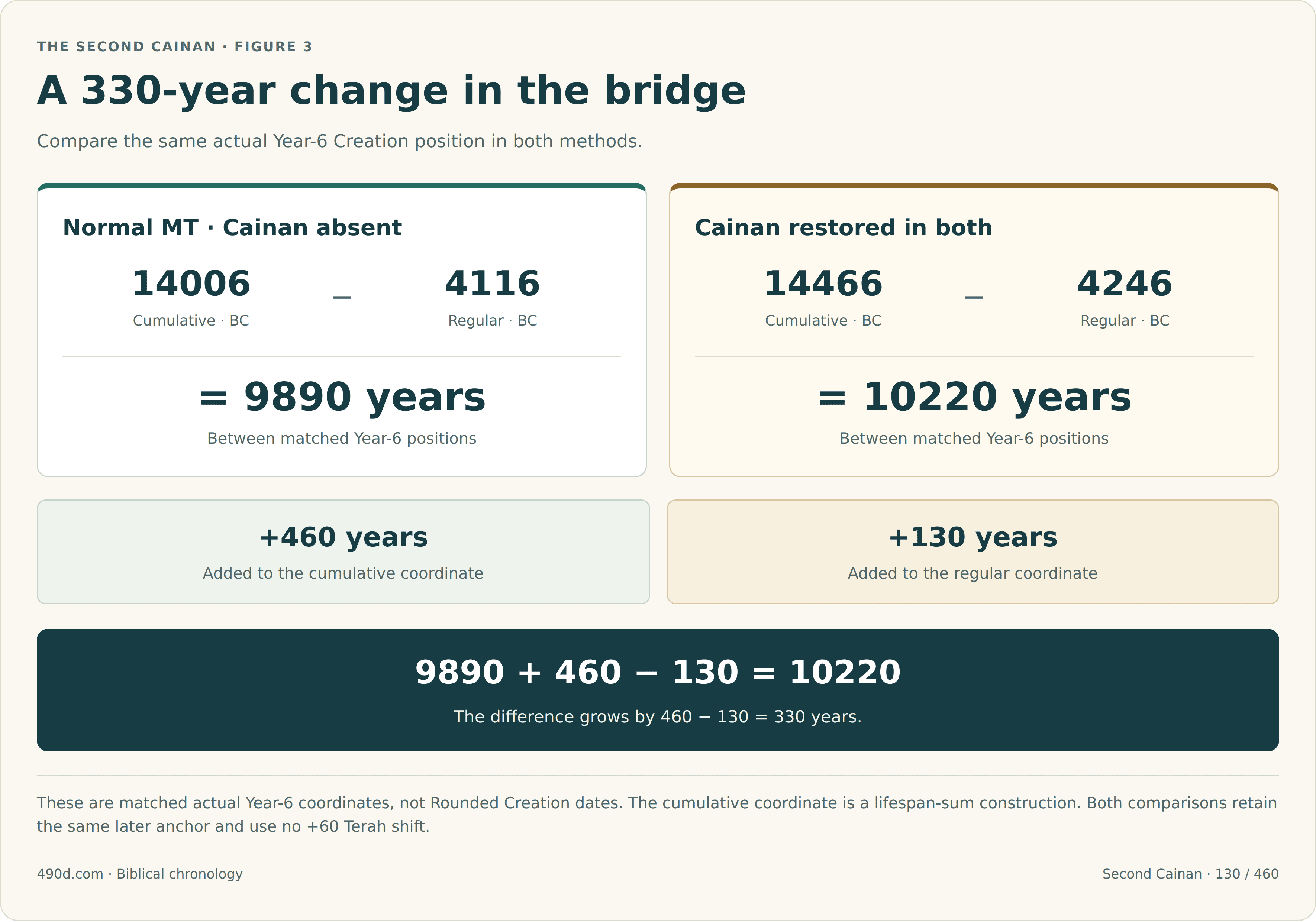
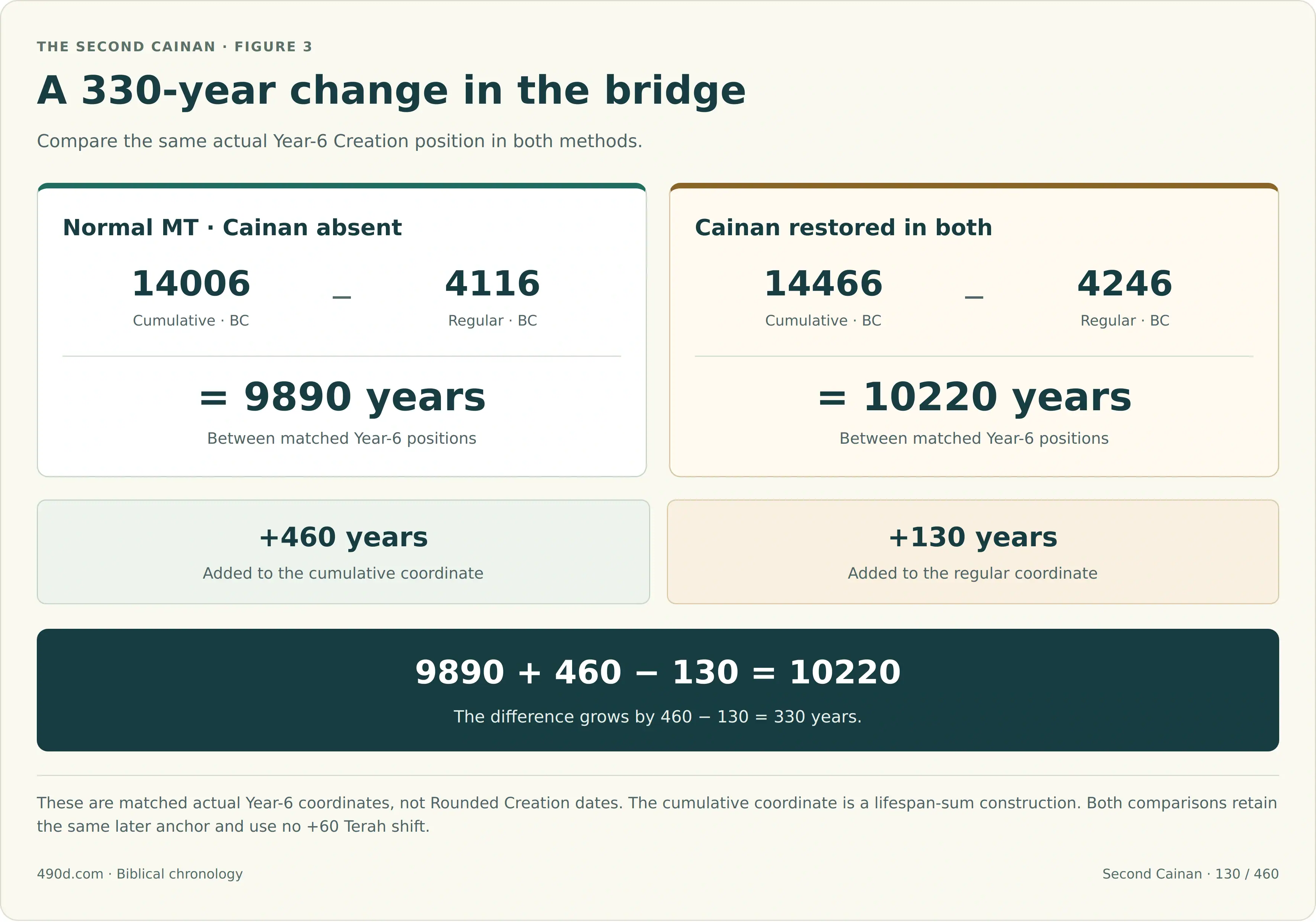
Without second Cainan: cumulative Year-6 Creation coordinate 14006 BC minus regular Year-6 Creation coordinate 4116 BC equals 9890 years. With Cainan restored in both methods: cumulative Year-6 Creation coordinate 14466 BC minus regular Year-6 Creation coordinate 4246 BC equals 10220 years. The cumulative coordinate moves back 460 years; the regular coordinate moves back 130 years. Thus 9890 + 460 − 130 = 10220, an increase of 330 years. These are actual, not Rounded, Year-6 positions. Cumulative coordinates are formal lifespan-sum coordinates, not ordinary historical dates.
The new separation follows directly:
9890 + 460 − 130 = 10220.
The same difference holds when we compare the corresponding beginnings or closing boundaries of the Creation weeks. The complete boundary table shows all three comparisons. These are unrounded figures; the Rounded 9900-year construction has its own specified inputs.
Reading the two numbers together
Cainan’s importance begins with a simple distinction already built into the genealogies: the age at which a son is born and the length of his father’s life measure different things.
The 130-year interval preserves the succession of births. The 460-year interval preserves the complete life. Their 330-year difference explains why including Cainan changes the relationship between the regular and cumulative chronologies, even though both continue to meet their own unchanged later anchors.
This provides a clear foundation for the more detailed patterns associated with Cainan and the Key of 23: 460 = 20 × 23. Before following those larger relationships, we can see exactly which years enter each calculation and why.
Technical appendix and supporting tables · Canonical tables: File 18 §§1.6 and 6B · Detailed companion.
Scripture quotations: Berean Standard Bible (BSB), public domain. Brenton Septuagint Translation: public domain, as identified. See the Brenton edition information.